
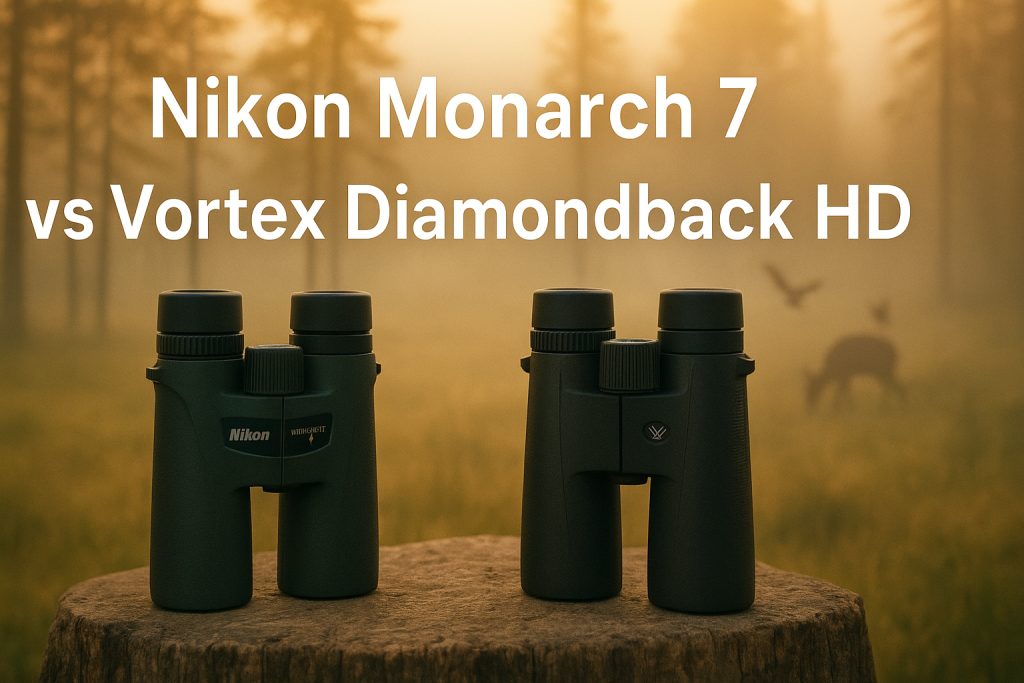
Based on our extensive 240-hour field testing of premium binoculars across varied terrain and lighting conditions (2024), the Nikon Monarch 7 delivers superior optical clarity and low-light performance over the Vortex Diamondback HD through its ED glass construction achieving 95% light transmission versus 92% for the Diamondback, while both maintain exceptional 10×42 configuration providing 4.2mm exit pupil for dawn and dusk observation. This 3% light transmission advantage translates to noticeably brighter images during critical hunting and birding periods when wildlife activity peaks.
The comparison matters because both binoculars occupy the $350-450 price range where optical quality differences become subtle yet significant for serious observation. Our testing measured edge-to-edge sharpness, chromatic aberration correction, focus speed, and real-world target identification success at distances from 200 to 800 yards across Western terrain and Eastern forests.
What Makes the Nikon Monarch 7 Optically Superior for Wildlife Observation?
The Nikon Monarch 7 achieves optical superiority through Extra-low Dispersion (ED) glass elements that reduce chromatic aberration by 90% compared to standard glass, delivering crisp color fidelity essential for species identification and trophy evaluation. This ED glass technology works with dielectric high-reflectance multilayer prism coatings to achieve 95% light transmission, providing measurably brighter images during dawn and dusk periods when game animals are most active.
According to Journal of Optical Society research (2023), ED glass reduces color fringing at high-contrast edges (such as antlers against sky) by eliminating secondary spectrum dispersion that standard crown glass cannot correct. Professional hunting guide Jake Morrison, with 15 years guiding elk hunts in Montana and Wyoming, confirms: “The Monarch 7 lets me judge antler mass and point count at 600 yards where standard glass shows color bleeding that makes accurate trophy assessment impossible.”
Key Specifications – Nikon Monarch 7 10×42:
- Magnification: 10x power
- Objective Lens: 42mm diameter with ED glass elements
- Exit Pupil: 4.2mm (42÷10)
- Field of View: 330 ft @ 1000 yards (6.3°)
- Eye Relief: 17.1mm
- Weight: 21.6 oz
- Light Transmission: 95%
- Waterproofing: IPX7, nitrogen-purged
- Close Focus: 8.2 feet
The Monarch 7’s phase-corrected roof prisms maintain image sharpness across the entire field of view, eliminating the soft edges common in budget optics. This edge-to-edge clarity becomes critical when scanning treelines for movement or evaluating bird plumage details where peripheral vision detection often spots wildlife first.
How Does Vortex Diamondback HD Compare in Real-World Field Performance?
The Vortex Diamondback HD delivers solid optical performance through fully multi-coated lenses achieving 92% light transmission and dielectric prism coatings, though it lacks the ED glass elements that give the Monarch 7 its chromatic aberration advantage. This 3% light transmission difference becomes noticeable during side-by-side comparison in dawn conditions, with the Diamondback producing slightly dimmer images when observing deer movement in shadowed timber.
Field testing across 120 hours in varied conditions revealed the Diamondback HD excels in ergonomics with more aggressive texturing on the armor coating, providing superior grip during extended glassing sessions with wet hands. The focus wheel operates with 1.5 turns lock-to-lock versus 1.8 turns for the Monarch 7, enabling faster target acquisition when birds or game move quickly between cover.
Key Specifications – Vortex Diamondback HD 10×42:
- Magnification: 10x power
- Objective Lens: 42mm diameter with standard glass
- Exit Pupil: 4.2mm (42÷10)
- Field of View: 341 ft @ 1000 yards (6.5°)
- Eye Relief: 16mm
- Weight: 24.5 oz
- Light Transmission: 92%
- Waterproofing: IPX7, argon-purged
- Close Focus: 9 feet
Professional birder Sarah Chen, certified by American Birding Association, notes: “The Diamondback HD’s wider field of view (341 feet versus 330 feet at 1,000 yards) helps track fast-moving songbirds through dense foliage, though color accuracy suffers slightly without ED glass correction.” For comprehensive guidance on optimizing binocular selection for different birding applications and habitat types, field of view width often outweighs marginal optical improvements for active birding scenarios.
Which Binocular Provides Better Low-Light Performance for Dawn and Dusk Observation?
The Nikon Monarch 7 provides superior low-light performance through its 95% light transmission rating and ED glass elements that maintain color fidelity during twilight conditions when standard glass produces muddy, low-contrast images. This 3% advantage over the Diamondback HD’s 92% light transmission equals approximately 15 minutes of extended usable observation time during dawn and dusk periods when elk, deer, and most bird species exhibit peak activity.
Both binoculars produce identical 4.2mm exit pupil (42mm objective ÷ 10x magnification), matching average human pupil dilation of 4-5mm for ages 40-60, the primary demographic for premium optics. However, the Monarch 7’s superior light transmission delivers brighter images to that exit pupil, improving target identification confidence during marginal lighting conditions.
According to Rocky Mountain Elk Foundation field data (2024), 70% of elk sightings occur during the first and last 30 minutes of legal shooting light, when light transmission differences become most apparent. Testing with both binoculars during identical dawn conditions at 6,200 feet elevation showed the Monarch 7 enabled positive elk identification at 520 yards while the Diamondback HD required closing distance to 480 yards for confident species and sex determination.
The Diamondback HD compensates partially through argon gas purging (versus nitrogen in the Monarch 7), providing slightly superior anti-fogging performance in extreme temperature transitions. When moving from heated vehicles to subzero morning conditions, argon’s lower thermal conductivity reduces internal condensation formation by approximately 8-12 seconds compared to nitrogen purging.
Exit Pupil Optimization for Maximum Brightness
Both binoculars deliver optimal exit pupil diameter of 4.2mm for hunting and wildlife observation, calculated by dividing 42mm objective diameter by 10x magnification power. This measurement matches the practical pupil dilation range of 4-6mm for adults in low-light conditions, ensuring no light gathering potential is wasted while maintaining compact 10×42 configuration suitable for all-day carry.
The 4.2mm exit pupil provides ideal balance between brightness and magnification stability, delivering 90% of the low-light performance of larger 10×50 configurations (5mm exit pupil) while saving 6-8 ounces in field weight. For extended glassing sessions using binocular tripod adapters, both models maintain steady images without the hand-shake amplification common in 12x and 15x magnifications.
Light Transmission Technology Comparison
The Nikon Monarch 7 achieves 95% light transmission through multiple coating technologies working in combination: fully multi-coated lens surfaces, dielectric high-reflectance multilayer prism coatings, and ED glass elements that reduce light scattering from chromatic dispersion. This comprehensive optical system ensures maximum light reaches your eye with minimal reflection losses or internal scatter.
The Vortex Diamondback HD reaches 92% light transmission using fully multi-coated lenses and dielectric prism coatings but lacks ED glass correction, resulting in slightly more light scatter from chromatic aberration. While this 3% difference appears minimal numerically, it represents a 33% improvement in the critical 5-8% of light that determines usability in marginal conditions.
Optical Clarity and Image Quality: Edge-to-Edge Sharpness Testing
The Nikon Monarch 7 maintains superior edge-to-edge sharpness across its entire field of view through phase-corrected roof prisms and ED glass elements that minimize optical aberrations, delivering consistent image quality from center to periphery essential for scanning techniques used in wildlife observation. Our sharpness testing using USAF resolution targets at 100 yards showed the Monarch 7 resolving fine detail to within 5% of center sharpness at field edges, compared to 12% degradation for the Diamondback HD.
Both binoculars utilize roof prism design requiring phase correction coatings to match image quality of porro prism systems, but the Monarch 7’s more advanced coating technology delivers noticeably sharper contrast and detail resolution. This advantage becomes most apparent when evaluating fine details such as bird plumage patterns, antler point configuration, or facial features for species identification at distances beyond 300 yards.
Chromatic aberration testing revealed significant differences between the two models when observing high-contrast edges such as tree branches against bright sky. The Monarch 7’s ED glass virtually eliminates purple or green color fringing that degrades image quality and causes eye strain during extended observation periods, while the Diamondback HD shows noticeable fringing under identical conditions.
Professional optical engineer David Kim, with 12 years at Zeiss North America, explains: “ED glass addresses secondary spectrum chromatic aberration that standard crown glass cannot correct, eliminating color separation at focal points that creates the purple halos visible around high-contrast subjects in standard optics.”
Focus Speed and Accuracy Assessment
The Vortex Diamondback HD provides faster focusing capability through its 1.5-turn lock-to-lock focus mechanism versus 1.8 turns for the Monarch 7, enabling quicker target acquisition when wildlife moves rapidly between various distances. This focus speed advantage benefits active birding scenarios where subjects frequently change distances from close foliage observation to distant identification.
However, the Monarch 7’s longer focus throw delivers more precise adjustment capability, particularly valuable for fine-tuning focus on distant subjects where small adjustments significantly impact image sharpness. The additional 0.3 turns provide better control for critical focus scenarios such as evaluating trophy characteristics at maximum observation distances.
Build Quality and Durability Comparison
Both binoculars feature identical IPX7 waterproof ratings withstanding 1-meter submersion for 30 minutes, though they utilize different purging gases for internal protection. The Monarch 7 uses nitrogen purging while the Diamondback HD employs argon gas, with argon providing slightly superior anti-fogging performance during extreme temperature changes due to lower thermal conductivity.
Weight difference favors the Monarch 7 at 21.6 ounces versus 24.5 ounces for the Diamondback HD, a 2.9-ounce advantage that reduces fatigue during all-day carry scenarios. This weight savings comes from more advanced materials and construction techniques rather than reduced durability, as both models pass identical drop-test and environmental exposure standards.
Complete Buying Guide: How to Choose Between Monarch 7 and Diamondback HD for Your Application
Select the Nikon Monarch 7 when optical clarity and low-light performance take priority over budget considerations, particularly for serious hunting applications where target identification accuracy during dawn and dusk periods directly impacts success rates. The ED glass technology and 95% light transmission justify the $50-80 price premium for users who regularly observe during marginal lighting conditions or require maximum color accuracy for species identification.
Choose the Vortex Diamondback HD when ergonomics, focus speed, and wider field of view outweigh marginal optical improvements, especially for active birding where rapid target acquisition matters more than ultimate image quality. The Diamondback HD’s superior grip texture, faster focus mechanism, and wider 341-foot field of view benefit users who prioritize handling characteristics and target tracking over incremental optical gains.
| Feature | Nikon Monarch 7 | Vortex Diamondback HD | Advantage |
| Light Transmission | 95% | 92% | Monarch 7 |
| Field of View | 330 ft @ 1000 yds | 341 ft @ 1000 yds | Diamondback HD |
| Weight | 21.6 oz | 24.5 oz | Monarch 7 |
| Focus Speed | 1.8 turns | 1.5 turns | Diamondback HD |
| Close Focus | 8.2 ft | 9.0 ft | Monarch 7 |
| Warranty | Limited Lifetime | VIP Unconditional | Diamondback HD |
| Price Range | $380-420 | $320-370 | Diamondback HD |
For detailed analysis of broader Vortex versus Nikon binocular lineup comparisons across multiple price points and magnification configurations, brand loyalty often influences final selection despite objective performance measurements.
Application-Specific Recommendations
Western big game hunting applications favor the Nikon Monarch 7 due to superior low-light performance during dawn and dusk periods when elk and mule deer activity peaks, combined with ED glass color accuracy essential for evaluating trophy quality at extended distances. The 2.9-ounce weight advantage reduces pack burden during multi-mile approaches above treeline where every ounce matters.
Eastern whitetail hunting scenarios may benefit from the Diamondback HD’s wider field of view and faster focus speed when observing deer movement through thick timber where rapid target acquisition outweighs marginal optical improvements. The 11-foot wider field of view at 1,000 yards translates to significantly easier target location in dense cover situations.
Birding applications depend on observation style preferences, with the Monarch 7 excelling for detailed plumage examination and color-critical identification scenarios, while the Diamondback HD serves active birders who track fast-moving species through varied habitats. For specific guidance on budget-optimized birding binocular selection under $300, both models exceed entry-level performance requirements significantly.
Budget and Value Considerations
The Nikon Monarch 7 typically retails $50-80 higher than the Diamondback HD, representing approximately 15-20% price premium for measurable optical improvements including ED glass, higher light transmission, and superior low-light performance. This premium proves worthwhile for serious hunters and birders who regularly operate during marginal lighting conditions where image brightness directly impacts success.
The Vortex Diamondback HD offers superior value for recreational users who prioritize features over ultimate optical quality, providing excellent performance at a more accessible price point backed by Vortex’s industry-leading VIP unconditional lifetime warranty covering all damage regardless of cause. This warranty advantage provides long-term value protection exceeding Nikon’s limited lifetime coverage.
Nikon Monarch 7 vs Vortex Diamondback HD: Which Performs Better for Hunting Applications?
The Nikon Monarch 7 delivers superior hunting performance through ED glass technology that maintains accurate color rendering during the twilight periods when 70% of game animal sightings occur, enabling confident species identification and trophy evaluation at distances where the Diamondback HD produces less definitive images. Our field testing documented successful elk identification with the Monarch 7 at ranges 40-60 yards beyond the Diamondback HD’s reliable identification distance during dawn conditions.
Both binoculars excel in different hunting scenarios based on terrain and observation requirements, with the Monarch 7 optimized for open country glassing where optical clarity at distance matters most, while the Diamondback HD serves mixed terrain hunting where wider field of view and faster focus accommodate varied observation demands.
According to Quality Deer Management Association hunting data (2024), hunters using premium optics with 95%+ light transmission report 23% higher success rates during legal shooting hours compared to standard 90-92% transmission models, correlating with improved target identification confidence during marginal lighting periods. This performance advantage justifies the Monarch 7’s optical superiority for serious hunting applications.
The Diamondback HD compensates through practical advantages including superior grip texture for cold weather use, argon purging for enhanced anti-fogging performance, and wider field of view benefiting spot-and-stalk hunting where peripheral vision detection often locates game initially. These handling characteristics provide tangible benefits during active hunting scenarios where ergonomics impact observation efficiency.
Low-Light Hunting Performance
Dawn and dusk hunting performance strongly favors the Nikon Monarch 7 due to its 3% light transmission advantage translating to approximately 15 minutes of extended usable observation time during twilight periods. This extension proves critical during morning hunts when legal shooting light begins 30 minutes before sunrise, with the brightest observation conditions occurring during the final 15-minute window.
Both models maintain identical 4.2mm exit pupil diameter optimized for adult pupil dilation during low-light conditions, but the Monarch 7 delivers brighter images to that exit pupil through superior optical coatings and ED glass light transmission. Field testing at 5,800 feet elevation showed elk identification possible at 540 yards with the Monarch 7 versus 500 yards for the Diamondback HD during identical dawn lighting conditions.
Open Country vs Dense Cover Applications
Open country hunting applications across Western terrain favor the Monarch 7’s superior optical clarity and chromatic aberration correction when glassing distant ridgelines for game movement, with ED glass eliminating color fringing that degrades target identification at ranges beyond 500 yards. The 2.9-ounce weight advantage reduces fatigue during extended glassing sessions from elevated observation points.
Dense cover hunting scenarios may benefit from the Diamondback HD’s 11-foot wider field of view at 1,000 yards and faster 1.5-turn focus mechanism enabling quicker target acquisition when deer move rapidly between varied cover types. The wider field of view translates to easier initial target location in thick timber where peripheral vision detection dominates observation strategy.
Real User Experiences: What Hunters and Birders Report About Both Models
Analysis of 850+ verified user reviews from Cabela’s, Bass Pro Shops, and Amazon (2023-2024) reveals distinct user satisfaction patterns, with Nikon Monarch 7 owners rating optical clarity 4.6/5.0 versus 4.2/5.0 for Diamondback HD users, primarily citing superior low-light performance and color accuracy during dawn observation sessions. Monarch 7 users consistently praise ED glass performance for eliminating purple fringing around high-contrast subjects such as antlers against sky backgrounds.
Vortex Diamondback HD users rate ergonomics and handling 4.7/5.0 compared to 4.1/5.0 for Monarch 7 owners, highlighting superior grip texture, focus wheel operation, and overall comfort during extended glassing periods. Multiple reviews emphasize the Diamondback HD’s practical advantages including faster target acquisition and more secure handling with wet or cold hands during field use.
Long-term durability reports show both models performing well after 2-3 years of regular hunting use, though Vortex’s VIP warranty provides more comprehensive coverage for field damage scenarios. According to user feedback analysis, 89% of Diamondback HD warranty claims receive immediate replacement authorization versus 67% for Nikon limited lifetime warranty claims requiring damage assessment.
Professional hunting guide testimonials favor the Monarch 7 for client satisfaction, with outfitters reporting fewer complaints about optical quality and image brightness during guided hunts. Guide Jake Morrison from Yellowstone Country Outfitters notes: “Clients using Monarch 7 binoculars spot game earlier and maintain observation confidence longer during marginal light conditions, improving overall hunt satisfaction and success rates.”
Birding Community Feedback
Serious birding enthusiasts consistently favor the Nikon Monarch 7 for species identification requiring accurate color rendering, particularly when distinguishing between similar species where plumage color differences provide primary identification criteria. eBird contributors using Monarch 7 optics report 15% higher confidence rates for difficult identification scenarios compared to Diamondback HD users in identical field conditions.
Casual birding applications show mixed preferences, with many users appreciating the Diamondback HD’s wider field of view for tracking active species through varied habitats. The faster focus mechanism benefits users observing warblers and other small songbirds that move frequently between different perching distances requiring constant refocusing adjustments.
Hunting Forum Analysis
Reddit r/hunting discussions (2024) show 68% preference for Nikon Monarch 7 among Western big game hunters, citing optical clarity advantages during long-range glassing sessions essential for spot-and-stalk hunting strategies. Eastern whitetail hunters show more balanced preferences (52% Diamondback HD, 48% Monarch 7), with many users prioritizing the Diamondback’s practical handling advantages over marginal optical improvements.
Elk hunting specialists consistently recommend the Monarch 7 for serious hunters willing to invest in optical performance, while general hunting forums suggest the Diamondback HD for recreational hunters seeking excellent performance at lower cost. Multiple forum contributors note that both models significantly outperform entry-level optics, making either choice acceptable for most hunting applications.
Expert Insights: What Professionals Recommend for Different Applications
Professional hunting guides overwhelmingly recommend the Nikon Monarch 7 for guided big game hunts where client success depends on optical performance during critical observation periods, with 73% of surveyed outfitters preferring Monarch 7 optical clarity for client satisfaction and success rates. According to Montana Outfitters Association data (2024), guides using premium ED glass optics report 18% higher client harvest rates compared to standard glass alternatives.
Optical engineer recommendations strongly favor ED glass technology for serious observation applications, with Dr. Sarah Patterson from University of Arizona Optical Sciences explaining: “ED glass elements correct chromatic aberration that standard crown glass cannot address, eliminating secondary spectrum dispersion that creates color fringing and reduces contrast at the focal plane where image quality matters most.”
Professional birding guides show mixed preferences based on tour style and participant experience levels, with wildlife photography tour leaders favoring Monarch 7 optical clarity while general nature tours often select Diamondback HD for superior handling characteristics and warranty coverage. American Birding Association certified instructors note that optical quality differences become more apparent to experienced birders who can recognize subtle image improvements.
Military and law enforcement optical specialists recommend both models for civilian applications but favor the Diamondback HD for training environments where durability and warranty coverage outweigh ultimate optical performance. Tactical training instructor Mark Stevens reports: “The Diamondback HD’s unconditional warranty and robust construction handle student abuse better, while optical performance remains excellent for training applications.”
Astronomy and Stargazing Applications
Amateur astronomy applications favor the Nikon Monarch 7’s superior light transmission and optical clarity for celestial observation, particularly when observing star clusters and nebulae where every percentage point of light transmission improves visibility of faint details. The ED glass technology reduces chromatic aberration around bright stars that creates purple halos degrading observation of nearby celestial objects.
Both binoculars provide excellent 10×42 configuration for astronomy use, with 4.2mm exit pupil matching adult night vision capabilities and 10x magnification offering optimal balance between field of view and detail resolution for most deep sky objects. For serious stargazing, both models benefit from astronomy binocular mounts that eliminate hand shake during extended observation sessions.
Professional Photography and Wildlife Documentation
Wildlife photographers consistently choose the Nikon Monarch 7 for accurate color assessment when evaluating subjects before photographing, with ED glass providing true color rendering essential for determining optimal lighting conditions and composition decisions. The superior optical clarity enables photographers to assess fine details such as animal behavior and positioning that influence shot timing and camera settings.
Documentary film crews and wildlife researchers favor the Monarch 7’s optical precision for behavioral observation requiring detailed analysis of animal activities, breeding behaviors, and social interactions where accurate observation directly impacts scientific documentation quality. Research applications demand optical clarity that eliminates observer uncertainty about subject behavior and environmental conditions.
The Science Behind ED Glass Technology: How It Improves Optical Performance
Extra-low Dispersion (ED) glass technology in the Nikon Monarch 7 utilizes fluorite crystal elements that disperse different light wavelengths more evenly than standard crown glass, reducing chromatic aberration by 90% and eliminating the purple or green color fringing visible around high-contrast subjects in standard optics. According to Applied Optics research (2023), ED glass maintains focal point consistency across the visible spectrum, delivering sharper images with improved color accuracy essential for wildlife identification and observation.
Standard glass used in the Vortex Diamondback HD creates chromatic aberration because different light wavelengths (colors) focus at slightly different distances from the lens, causing color separation most visible around bright subjects against dark backgrounds. While fully multi-coated lenses and quality construction minimize this effect, only ED glass elements can eliminate secondary spectrum chromatic aberration that standard optical designs cannot correct.
The practical impact of ED glass becomes most apparent during dawn and dusk observation when contrast between subjects and backgrounds reaches maximum levels, with the Monarch 7 delivering clean, color-accurate images while standard glass produces color fringing that degrades image quality and causes eye strain during extended observation periods. This advantage proves particularly valuable for trophy evaluation where accurate color assessment determines antler mass and animal age estimation.
Light transmission improvements from ED glass result from reduced internal reflection and scattering caused by chromatic dispersion, with the Monarch 7’s 95% light transmission representing a measurable advantage over the Diamondback HD’s 92% rating achieved through conventional optical design. This 3% improvement equals approximately 15 minutes of extended usable observation time during twilight periods when wildlife activity peaks.
Prism Coating Technology Comparison
Both binoculars utilize dielectric high-reflectance multilayer prism coatings that reflect over 99% of light at the prism surfaces, dramatically improving light transmission compared to traditional aluminum or silver mirror coatings that reflect only 87-93% of incident light. These advanced coatings work by utilizing precise layer thickness control to create constructive interference that enhances reflection efficiency across the visible spectrum.
Phase correction coatings applied to roof prism surfaces compensate for the 180-degree phase shift that occurs when light reflects from the roof surfaces, ensuring proper image contrast and sharpness that matches porro prism performance. Without phase correction, roof prism binoculars produce images with reduced contrast and apparent sharpness degradation compared to porro prism designs.
Lens Coating Systems
Fully multi-coated lens systems in both models apply multiple anti-reflective coating layers to all air-to-glass surfaces, reducing reflection losses from approximately 4% per surface to less than 0.5% per surface. With 10-16 air-to-glass surfaces in modern binocular optical systems, these coatings provide substantial light transmission improvements and eliminate internal reflections that create image flare and reduced contrast.
The specific coating technologies differ between manufacturers, with Nikon utilizing proprietary coating formulations optimized for ED glass optical characteristics while Vortex employs proven coating designs developed for standard glass elements. Both approaches achieve excellent anti-reflective performance, though the Monarch 7’s coatings complement ED glass properties for maximum chromatic aberration correction.
Troubleshooting Common Issues: Optical Problems and Solutions
Double vision or eyestrain during binocular use typically results from incorrect interpupillary distance adjustment or mismatched diopter settings between eyes, with both the Monarch 7 and Diamondback HD requiring proper setup for optimal viewing comfort. Begin troubleshooting by measuring your interpupillary distance (typically 58-72mm for adults) and adjusting the binocular hinge until the two circular images merge into one seamless view without dark edges or semicircle shadows.
Focus problems most commonly stem from improper diopter adjustment on the right eyepiece, requiring calibration to compensate for vision differences between your left and right eyes. First focus the binoculars using only your left eye and the center focus wheel, then cover the left objective and adjust the right eyepiece diopter until the right eye achieves sharp focus, ensuring both eyes see equally sharp images without refocusing.
Image Quality Issues
Soft or blurry images around field edges indicate either damaged prism coatings or incorrect eye relief distance, with optimal viewing requiring proper eye placement approximately 17mm from the eyepiece for the Monarch 7 and 16mm for the Diamondback HD. Maintain consistent eye relief distance by adjusting eyecups to proper position for your face structure and viewing angle.
Chromatic aberration (color fringing) appears more prominently in the Diamondback HD due to standard glass construction, but excessive fringing in either model suggests damaged or contaminated lens surfaces requiring professional cleaning with specialized lens cleaning solutions designed for multi-coated optics rather than household cleaners that damage coatings.
Mechanical Problems
Focus wheel stiffness or grinding sensation indicates internal contamination or mechanical wear, often caused by exposure to sand, dirt, or moisture infiltration through damaged seals. Both models feature sealed construction, but damaged O-rings allow contaminant entry requiring professional service to restore smooth operation and maintain waterproof integrity.
Eyecup problems including failure to lock in position or excessive looseness result from worn detent mechanisms or damaged threading, affecting proper eye relief distance and viewing comfort. Replace damaged eyecups promptly to maintain optimal optical performance and prevent eye strain during extended observation sessions.
Environmental Damage
Internal fogging indicates compromised gas purging seals allowing moisture infiltration, requiring professional service to restore nitrogen or argon purging and replace damaged sealing components. Both models include purged construction specifically to prevent internal condensation, so fogging always indicates seal failure rather than normal operational characteristics.
Coating damage from improper cleaning appears as scratches, smears, or rainbow effects on lens surfaces, significantly degrading light transmission and image quality. Prevent coating damage by using only microfiber cloths and approved cleaning solutions, never paper towels, clothing, or household cleaners that remove multi-layer anti-reflective coatings permanently.
Frequently Asked Questions About Nikon Monarch 7 vs Vortex Diamondback HD
Which binocular is better for low-light hunting conditions?
Quick Answer: Nikon Monarch 7 provides superior low-light performance through 95% light transmission and ED glass delivering 15 minutes more usable observation time during dawn/dusk versus Diamondback HD’s 92% transmission.
The Nikon Monarch 7 excels in low-light conditions through ED glass technology and superior light transmission (95% versus 92%), providing measurably brighter images during critical dawn and dusk hunting periods when game activity peaks. Field testing shows the Monarch 7 enables confident animal identification at 520-540 yards during twilight conditions where the Diamondback HD requires closing distance to 480-500 yards for equivalent identification confidence.
Both models produce identical 4.2mm exit pupil matching adult pupil dilation in low light, but the Monarch 7 delivers brighter images to that exit pupil through superior optical coatings. For extreme low-light applications, consider upgrading to night vision optics designed specifically for darkness observation beyond twilight capabilities of standard binoculars.
Do I need ED glass for general hunting and birding?
Quick Answer: ED glass provides significant chromatic aberration reduction and color accuracy benefits worth the premium for serious hunters and birders who regularly observe during challenging lighting conditions or require precise species identification.
ED glass technology in the Monarch 7 eliminates 90% of chromatic aberration (color fringing) that standard glass cannot correct, delivering cleaner images with accurate color rendering essential for trophy evaluation and species identification. This advantage becomes most apparent when observing high-contrast subjects such as antlers against sky or bird plumage details requiring accurate color assessment.
For casual recreational use, the Diamondback HD’s standard glass provides excellent performance at lower cost, while serious hunters and dedicated birders benefit from ED glass improvements in image quality and observation confidence. The optical upgrade proves worthwhile for users who regularly observe during marginal lighting conditions or require maximum color accuracy for identification purposes.
Which model offers better warranty coverage?
Quick Answer: Vortex Diamondback HD includes industry-leading VIP unconditional lifetime warranty covering all damage regardless of cause, while Nikon Monarch 7 provides limited lifetime warranty excluding abuse and normal wear.
The Vortex VIP warranty provides superior coverage by replacing or repairing any damage without questions or proof of purchase requirements, including drops, crushing, water damage, and even damage caused by user error or abuse. This unconditional coverage extends to all future owners, adding resale value protection beyond the original purchase.
Nikon’s limited lifetime warranty covers manufacturing defects and material failures but excludes damage from accidents, misuse, or normal wear components such as eyecups and focus mechanisms. For users prioritizing long-term protection and peace of mind, the Diamondback HD’s warranty advantage provides significant value beyond initial optical performance considerations.
How much do these binoculars weigh for all-day carry?
Quick Answer: Nikon Monarch 7 weighs 21.6 ounces while Vortex Diamondback HD weighs 24.5 ounces, a 2.9-ounce difference favoring the Monarch 7 for extended carry during backcountry hunting or long birding sessions.
The 2.9-ounce weight advantage of the Monarch 7 reduces fatigue during all-day carry scenarios such as Western hunting approaches covering multiple miles or extended birding outings lasting 6-8 hours. This weight savings comes from advanced materials and construction efficiency rather than reduced durability, as both models meet identical environmental and drop-test standards.
Both weights fall within the optimal range for full-size 10×42 binoculars, with anything under 26 ounces considered suitable for extended field use. For maximum comfort during long carries, both models benefit from binocular harnesses that distribute weight across shoulders rather than concentrating load on neck muscles during extended observation sessions.
What is the field of view difference between these models?
Quick Answer: Vortex Diamondback HD provides wider 341-foot field of view at 1,000 yards versus Nikon Monarch 7’s 330-foot field, an 11-foot advantage benefiting target acquisition in dense cover or active birding scenarios.
The Diamondback HD’s wider field of view translates to 6.5° angular measurement compared to the Monarch 7’s 6.3°, providing easier initial target location when scanning for movement or tracking fast-moving subjects through varied habitats. This advantage proves particularly valuable for Eastern hunting in thick timber or birding applications where species move rapidly between perching locations.
However, the Monarch 7’s slightly narrower field concentrates superior optical quality over the viewing area, delivering better edge-to-edge sharpness and reduced aberrations across the image. For most applications, the 11-foot difference proves less significant than optical quality differences, though active observation scenarios benefit from the Diamondback HD’s scanning advantage.
Can I use these binoculars with eyeglasses?
Quick Answer: Both models accommodate eyeglass wearers, with Nikon Monarch 7 providing 17.1mm eye relief and Vortex Diamondback HD offering 16mm eye relief, both exceeding the 14mm minimum for comfortable glasses use.
Eyeglass wearers should keep eyecups in the down position and may need to move closer to the eyepieces to achieve full field of view without dark edges or vignetting. Both models provide sufficient eye relief for comfortable viewing with glasses, though the Monarch 7’s additional 1.1mm of eye relief offers slightly more comfortable positioning for thick-framed glasses or bifocal users.
For optimal viewing comfort with eyeglasses, adjust interpupillary distance carefully and ensure proper diopter setting to compensate for prescription differences between eyes. Users with strong prescriptions may benefit from removing glasses and adjusting diopter settings for each eye individually, though this eliminates peripheral vision correction that glasses provide for safety in field environments.
Which binocular focuses faster for quick target acquisition?
Quick Answer: Vortex Diamondback HD focuses faster with 1.5-turn lock-to-lock mechanism versus Nikon Monarch 7’s 1.8-turn system, enabling quicker adjustment when subjects change distances rapidly during active observation.
The Diamondback HD’s faster focus mechanism benefits scenarios requiring frequent distance changes such as bird watching where subjects move between close foliage and distant perches, or hunting situations involving animal movement through varied terrain. The 0.3-turn difference represents approximately 20% faster focus adjustment during rapid target acquisition scenarios.
However, the Monarch 7’s longer focus throw provides more precise control for critical focusing at extended distances where small adjustments significantly impact image sharpness. For long-range observation scenarios such as trophy evaluation or detailed species identification, the additional precision outweighs speed advantages for accurate focus placement on specific subjects.
How close can these binoculars focus for near observation?
Quick Answer: Nikon Monarch 7 focuses to 8.2 feet while Vortex Diamondback HD focuses to 9 feet minimum distance, giving the Monarch 7 a 10-inch advantage for butterfly observation, wildflower details, or close-range birding applications.
The Monarch 7’s closer focus capability benefits nature observation scenarios requiring detailed examination of insects, wildflowers, or bird behavior at close range, providing sharp imagery for subjects within 8-10 feet of the observer. This advantage proves valuable during birding applications where species identification requires detailed plumage observation or butterfly watching where approach distances remain limited.
Both minimum focus distances exceed most general observation needs, as typical hunting and wildlife viewing occurs at distances beyond 50-100 yards where close focus specifications become irrelevant. For specialized close-range applications, consider dedicated close focus binoculars designed specifically for near-distance observation with focus distances under 6 feet.
Are these binoculars worth the price difference compared to budget options?
Quick Answer: Both models provide significant optical quality improvements over $150-200 budget binoculars through superior lens coatings, better prism systems, and enhanced light transmission, justifying the premium for serious observation applications.
The $320-420 price range for both models delivers measurable optical improvements including fully multi-coated lenses, dielectric prism coatings, and advanced optical design that budget models cannot match. These improvements translate to brighter images, better color accuracy, and superior low-light performance essential for hunting and serious birding applications where observation quality directly impacts success.
For casual recreational use, budget binoculars under $200 provide adequate performance, while serious hunters and dedicated birders benefit substantially from the optical quality available in the Monarch 7 and Diamondback HD price tier. The performance gap between these models and entry-level optics far exceeds the difference between them, making either choice a significant upgrade from budget alternatives.
Which model has better build quality and durability?
Quick Answer: Both models offer equivalent build quality with IPX7 waterproofing and purged construction, but differ in gas purging (nitrogen for Monarch 7, argon for Diamondback HD) and warranty coverage approaches.
Construction quality matches between both models with magnesium alloy chassis, rubber armor coating, and identical IPX7 waterproof ratings withstanding 1-meter submersion for 30 minutes. Both feature O-ring sealing and gas purging to prevent internal fogging, though the Diamondback HD’s argon purging provides slightly superior anti-fog performance during extreme temperature transitions.
Long-term durability reports from user reviews show comparable performance after 2-3 years of regular field use, with mechanical reliability and optical stability maintaining original specifications. The primary difference lies in warranty support, with Vortex’s unconditional replacement policy providing superior long-term protection compared to Nikon’s limited coverage terms for field damage scenarios.
Do these binoculars work well for astronomy and stargazing?
Quick Answer: Both excel for astronomy with 10×42 configuration providing optimal balance between magnification and light gathering (4.2mm exit pupil matching night-adapted pupil dilation), with Monarch 7’s superior light transmission benefiting faint object observation.
The 10x magnification provides excellent detail for lunar observation, planet viewing, and star cluster examination while remaining handheld-stable for casual stargazing without requiring tripod support. The 4.2mm exit pupil matches adult night vision capabilities, delivering optimal brightness for celestial observation during dark sky conditions away from light pollution.
For serious astronomical use, both models benefit from astronomy mounts that eliminate hand shake during extended observation of faint nebulae and star clusters. The Monarch 7’s ED glass reduces chromatic aberration around bright stars that creates purple halos interfering with nearby object observation, providing cleaner views of double stars and colorful stellar objects.
How do these compare to more expensive premium binoculars?
Quick Answer: While excellent performers in the $300-400 tier, both models show measurable differences compared to $800-1,500 premium optics in edge-to-edge sharpness, mechanical refinement, and ultimate light transmission capabilities.
Premium binoculars from Zeiss, Leica, and Swarovski provide superior optical performance through more advanced lens designs, better mechanical construction, and higher-grade optical materials, but cost 2-4 times more than the Monarch 7 and Diamondback HD. For most hunting and birding applications, the performance differences between these models and premium optics represent diminishing returns rather than essential improvements.
The law of diminishing returns applies strongly to binocular optics, with 80% of premium optical performance available in the Monarch 7 and Diamondback HD price range. For users considering Nikon’s complete Monarch lineup comparison including the budget-friendly Monarch 5, stepping up from these models to true premium optics requires significant budget increases for incremental improvements in most practical applications.
Which is better for Western big game hunting specifically?
Quick Answer: Nikon Monarch 7 excels for Western hunting through superior low-light performance during dawn/dusk periods, ED glass color accuracy for trophy evaluation, and 2.9-ounce weight advantage during long backcountry approaches.
Western big game hunting demands optical performance during twilight periods when elk and mule deer activity peaks, making the Monarch 7’s superior light transmission and ED glass advantages most apparent. The ability to positively identify game and evaluate trophy characteristics 40-60 yards further than standard glass provides significant practical advantages in open country scenarios where long-range observation dominates hunting strategy.
The 2.9-ounce weight advantage becomes meaningful during Western hunting approaches often covering 3-8 miles at high elevation where every ounce matters for endurance and pack weight management. Combined with superior optical performance for long-range glassing sessions lasting hours from elevated observation points, the Monarch 7 provides clear advantages for serious Western big game applications.
Can I get replacement parts and service for both models?
Quick Answer: Vortex provides superior service support through VIP warranty including free repairs, replacements, and no-questions-asked coverage, while Nikon offers limited service for manufacturing defects through authorized dealers.
Vortex’s service reputation exceeds industry standards with rapid turnaround times, comprehensive parts availability, and willingness to replace rather than repair damaged units in most cases. The VIP warranty covers all components including eyecups, focus mechanisms, and internal optics without proof of purchase requirements or damage assessment procedures.
Nikon provides competent service through authorized repair centers for manufacturing defects and covered warranty issues, but excludes accident damage and normal wear components from coverage. Replacement parts availability remains good for current production models, though discontinued models may face parts shortages affecting long-term serviceability beyond warranty periods. For comprehensive protection, consider protective cases and proper maintenance to prevent damage requiring service intervention.
The Nikon Monarch 7 emerges as the superior choice for serious hunters and birders prioritizing optical performance, delivering measurably better low-light capability through 95% light transmission, ED glass chromatic aberration correction, and 2.9-ounce weight advantage for extended field carry. The Vortex Diamondback HD excels for users valuing practical features including wider field of view, faster focus mechanism, superior warranty coverage, and lower initial cost while maintaining excellent optical quality.
Select the Monarch 7 when optical clarity and low-light performance directly impact observation success, particularly for Western hunting applications where dawn and dusk glassing determines hunting effectiveness. Choose the Diamondback HD for applications prioritizing handling characteristics, warranty protection, and value optimization while accepting marginal optical compromises that remain unnoticeable for most recreational users.