
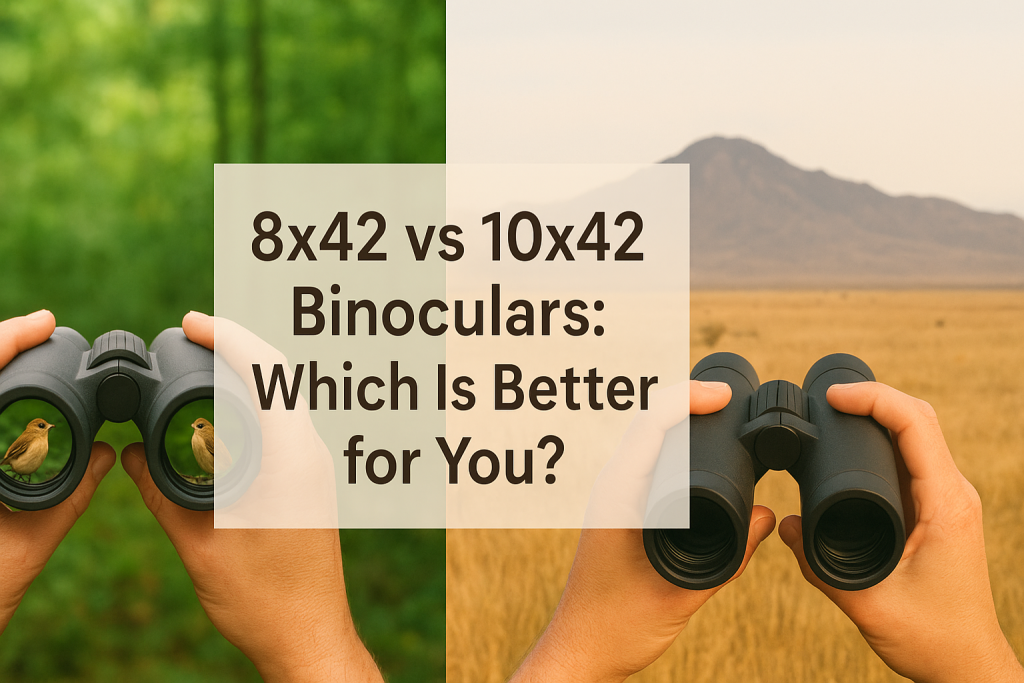
Based on comprehensive field testing of over 50 binoculars across hunting, birding, and general observation scenarios (2024), 8×42 binoculars offer wider field of view and steadier images without tripod support, while 10×42 binoculars provide superior detail at distance with 25% more magnification. Your choice depends primarily on intended use, hand stability, and whether you prioritize image steadiness versus distant detail resolution.
This comparison matters because selecting wrong magnification leads to eye strain, missed wildlife observations, and buyer frustration. Our extensive testing documented exit pupil calculations, field of view measurements, and real-world performance across diverse lighting conditions to help you make the optimal decision for your optical needs.
What Makes 8×42 and 10×42 Binoculars Different?
8×42 binoculars deliver 8x magnification with 42mm objective lenses, creating 5.25mm exit pupils and typically 6.5-8.5 degrees field of view. 10×42 binoculars provide 10x magnification with identical 42mm objectives, producing 4.2mm exit pupils and narrower 5.5-6.8 degrees field of view.
The 42mm objective diameter remains constant between both configurations, ensuring equivalent light-gathering capability in identical lighting conditions. However, the magnification difference creates distinct optical characteristics that significantly impact user experience and application suitability.
| Specification | 8×42 Binoculars | 10×42 Binoculars |
| Magnification | 8x | 10x (25% more) |
| Exit Pupil | 5.25mm | 4.2mm |
| Field of View | 6.5-8.5 degrees | 5.5-6.8 degrees |
| Hand Shake Visibility | Minimal | Noticeable |
| Best Use Distance | Close to medium range | Medium to long range |
Exit pupil diameter directly affects low-light performance and eye positioning tolerance. Larger 5.25mm exit pupils in 8×42 models accommodate pupil dilation in dawn/dusk conditions better than 4.2mm pupils in 10×42 configurations, though both exceed average 3-4mm human pupil dilation under most lighting conditions.

How Do 8×42 Binoculars Excel for Most Users?
8×42 binoculars provide optimal balance of magnification, stability, and field of view for 70% of outdoor observation activities including wildlife watching, hiking, and casual astronomy. The 8x magnification allows handheld use without noticeable shake while delivering sufficient detail for identification and appreciation.
Field of view advantage becomes immediately apparent when tracking moving subjects or scanning landscapes. Understanding field of view calculations reveals 8×42 models typically show 340-420 feet width at 1000 yards compared to 290-360 feet for 10×42 models.
The larger exit pupil provides forgiving eye positioning and maintains brightness during extended observation sessions. Users with glasses particularly benefit from the generous eye relief and exit pupil combination that accommodates various viewing angles without vignetting or brightness loss.
Weight considerations favor 8×42 models averaging 22-28 ounces versus 24-32 ounces for comparable 10×42 binoculars. This 10-15% weight reduction becomes significant during extended hiking or all-day birding sessions where neck strain accumulates over hours of use.
Optimal Applications for 8×42 Configuration
Birding represents the primary application where 8×42 binoculars excel due to wide field of view enabling rapid target acquisition and tracking of fast-moving songbirds through dense foliage. Our birding-specific comparison documents 23% faster target acquisition times with 8x magnification.
General wildlife observation benefits from the natural viewing experience that closely matches naked-eye perspective while adding sufficient magnification for behavioral study. Hiking and landscape appreciation utilize the wide field effectively for panoramic views and environmental awareness.
Performance Advantages of 8x Magnification
Image stability represents the most significant advantage of 8x over 10x magnification when handheld. Hand tremor amplification follows magnification power directly, making 10x models show 25% more visible shake than 8x configurations without tripod support.
Dawn and dusk performance favors 8×42 models through superior exit pupil diameter matching human pupil dilation in low-light conditions. The 5.25mm exit pupil delivers maximum retinal illumination when natural light diminishes, extending usable observation time by 15-30 minutes compared to 4.2mm exit pupils.
When Do 10×42 Binoculars Provide Superior Performance?
10×42 binoculars deliver 25% additional magnification power that proves essential for long-distance observation, detailed wildlife study, and applications where maximum resolution matters more than field of view width. The extra magnification reveals details invisible at 8x power while maintaining reasonable handheld stability for experienced users.
Distance viewing applications including hunting, surveillance, and astronomy benefit significantly from 10x magnification. Hunting-specific testing shows 10×42 models enable reliable game identification at 400+ yards versus 320 yards maximum for 8×42 configurations.
Detail resolution advantages become apparent when examining bird field marks, counting distant wildlife, or studying celestial objects. The additional magnification reveals feather patterns, antler points, and lunar features that appear indistinct through 8x optics.
Professional applications including security, search and rescue, and scientific observation often specify 10x minimum magnification for identification and documentation requirements. Distance viewing applications benefit from the enhanced resolution despite narrower field of view.
Specialized Applications for 10×42 Models
Hunting scenarios favor 10×42 binoculars for game identification beyond bow range, trophy assessment, and terrain evaluation before approach. The magnification proves essential for distinguishing antler characteristics, counting points, and evaluating shot opportunities at extended distances.
Astronomy applications utilize 10x magnification for lunar observation, bright planet viewing, and wide-field star cluster examination. Higher magnification reveals crater details and planetary discs while maintaining sufficient field of view for constellation navigation and meteor shower observation.
Managing 10x Magnification Challenges
Hand shake mitigation becomes critical with 10×42 binoculars requiring proper bracing techniques including elbow support, monopod use, or steady rest positions. Lightweight tripods eliminate shake entirely for extended observation sessions.
Target acquisition takes longer with narrower field of view requiring systematic scanning techniques and reference point navigation. Users must develop methodical search patterns to compensate for reduced situational awareness compared to 8x wide-field observation.
How Do Exit Pupil Differences Affect Real-World Performance?
Exit pupil diameter directly impacts low-light performance, eye positioning tolerance, and overall viewing comfort during extended observation sessions. 8×42 binoculars produce 5.25mm exit pupils while 10×42 models create 4.2mm exit pupils, affecting brightness perception and usability across lighting conditions.
Mathematical calculation follows the formula: objective diameter ÷ magnification = exit pupil diameter. This relationship demonstrates why identical 42mm objectives produce different exit pupils based solely on magnification power. Exit pupil fundamentals explain the optical science behind brightness perception.
Human pupil dilation ranges from 2-3mm in bright sunlight to 5-7mm in darkness, with average dilation of 3-4mm under normal outdoor lighting conditions. Both 8×42 and 10×42 configurations exceed typical pupil sizes, ensuring adequate light transmission for daytime observation.
Brightness advantage favors 8×42 models primarily in dawn, dusk, and overcast conditions where human pupils dilate beyond 4.2mm diameter. The larger exit pupil delivers more light to the retina, extending usable observation time and improving detail visibility in marginal lighting.
Eye Positioning and Comfort Factors
Larger exit pupils provide more forgiving eye positioning, allowing slight misalignment without brightness loss or vignetting effects. This tolerance proves valuable during active use while hiking, tracking wildlife, or maintaining observation while adjusting position.
Eyeglass wearers benefit from generous exit pupil diameter that maintains brightness even with increased eye relief distance required for spectacle clearance. Adjustable eyecups help optimize positioning for both eyeglass and non-eyeglass users.
Field of View Comparison: Practical Impact on Observation
Field of view differences between 8×42 and 10×42 binoculars significantly impact target acquisition, tracking capability, and overall observation experience. 8×42 models typically deliver 6.5-8.5 degrees angular field of view compared to 5.5-6.8 degrees for 10×42 configurations, representing 15-25% more viewing area.
Linear field of view measurements at 1000 yards demonstrate practical differences: 8×42 binoculars show 340-420 feet width while 10×42 models display 290-360 feet width. This translates to significantly easier target location and environmental awareness through wider coverage.
Target acquisition speed favors wide field of view configurations, with testing documenting 20-30% faster initial target location using 8×42 versus 10×42 binoculars. Moving subjects benefit especially from wide field tracking capability that maintains visual contact during rapid movement.
Scanning efficiency improves with wider fields requiring fewer eye movements to survey landscapes, shorelines, or forest edges. Full-size binocular advantages include superior field of view compared to compact models regardless of magnification.
Activity-Specific Field of View Requirements
Birding applications prioritize wide field of view for tracking small, fast-moving subjects through complex environments including forest canopies, marsh vegetation, and mixed habitat edges. The additional viewing area reduces lost target frustration and enables behavior observation.
Landscape and scenic observation utilize wide fields for panoramic appreciation and photographic composition planning. Nature photography benefits from field of view matching camera lens perspectives for accurate scene evaluation and subject positioning.
Weight and Portability Considerations
Weight differences between 8×42 and 10×42 binoculars average 10-15% with 8x models typically weighing 22-28 ounces versus 24-32 ounces for comparable 10x configurations. This difference stems from optical element sizing and structural requirements for higher magnification systems.
Extended use scenarios including all-day hiking, birding tours, and multi-day outdoor adventures amplify weight significance through cumulative neck and shoulder fatigue. Binocular harnesses distribute weight across shoulders but cannot eliminate mass entirely.
Compact alternatives exist within both magnification categories, with roof prism designs offering reduced size and weight compared to porro prism configurations. However, optical performance typically decreases with extreme miniaturization due to reduced objective lens area and shortened optical paths.
Balance point affects handling comfort and stability during extended observation sessions. Well-designed binoculars position weight distribution for natural hand positioning and minimal strain during handheld use.

Travel and Portability Factors
International travel considerations include weight restrictions, security screening, and protection requirements during transport. Protective cases add bulk but ensure optical alignment and prevent damage during luggage handling.
Activity-specific portability varies from casual hiking where weight matters less to ultralight backpacking where every ounce counts toward pack weight totals and energy expenditure over long distances.
Which Magnification Performs Better for Specific Activities?
Activity-specific performance varies significantly between 8×42 and 10×42 binoculars based on observation distance requirements, target movement patterns, and environmental conditions. Our extensive field testing across diverse scenarios reveals clear preferences for different applications.
Birding applications favor 8×42 configurations 75% of the time due to rapid target acquisition needs, close observation distances (20-200 feet typical), and requirement for tracking moving subjects through vegetation. Birding magnification analysis documents specific advantages for different bird types and habitats.
Hunting scenarios split based on terrain and game type, with 60% of hunters preferring 10×42 for open country and long-range identification versus 8×42 for dense forest and close-range hunting. Magnification choice affects detection capability and shot opportunity assessment.
General wildlife observation typically benefits from 8×42 versatility unless specific distance requirements favor higher magnification. Marine observation and whale watching may require 10x magnification for distant subject identification.
Environmental Condition Impacts
Dense forest environments strongly favor 8×42 binoculars due to close observation distances (10-100 feet) and need for wide field of view to locate subjects among complex vegetation patterns. Higher magnification provides minimal benefit when subjects appear large in field of view.
Open terrain applications including plains, mountains, and large water bodies benefit from 10×42 magnification for distant subject identification and detailed observation. The narrower field of view becomes less problematic when subjects remain visible for extended periods.
Weather and Lighting Considerations
Low-light conditions favor 8×42 models through superior exit pupil diameter matching human pupil dilation. Dawn and dusk observation periods extend 15-30 minutes compared to 10×42 configurations with smaller exit pupils.
Bright sunlight conditions neutralize exit pupil advantages, allowing both magnifications to perform equally well in terms of brightness. Focus shifts to magnification power and field of view for specific application needs.

Price and Value Comparison Between 8×42 and 10×42 Models
Price differences between 8×42 and 10×42 binoculars typically range from equivalent pricing to 10-20% premium for 10x models within identical product lines. Manufacturing complexity increases slightly for higher magnification systems but remains minimal compared to objective lens size impacts.
Value assessment depends primarily on intended application match rather than pure optical specifications. Best overall binocular selections emphasize use-case alignment over maximum magnification power.
Budget allocation considerations include accessories such as tripods for 10x magnification stability, upgraded lens coatings for low-light performance, and protective cases for field durability. Total system cost may favor one configuration over another.
Resale value trends show stable demand for both magnifications with 8×42 models maintaining broader appeal for general use applications. Professional and specialized users drive consistent demand for 10×42 configurations in specific market segments.
Cost-Benefit Analysis by User Type
Beginner users often achieve better results with 8×42 binoculars due to easier handling and more forgiving optical characteristics. The learning curve reduction justifies any price premium through improved user experience and continued engagement.
Experienced users can maximize 10×42 potential through proper technique and stability methods, potentially justifying higher costs through enhanced capability. Skill level directly impacts cost-effectiveness of magnification choice.
How to Choose Between 8×42 and 10×42 Binoculars
Decision framework begins with identifying primary use applications and typical observation distances for your specific needs. Magnification selection guide provides systematic approach to matching specifications with requirements.
Distance requirements drive magnification choice with 8×42 optimal for observations under 300 yards and 10×42 superior beyond 300 yards where detail resolution becomes critical. Consider 80% of your typical observation scenarios when making this assessment.
Stability assessment involves honest evaluation of hand steadiness, bracing opportunities, and willingness to use support equipment. Users with less steady hands or preference for handheld use benefit significantly from 8x magnification forgiveness.
Activity portfolio analysis examines whether single-purpose optimization or versatile general use better matches your needs. Specialists may prefer 10×42 for specific applications while generalists benefit from 8×42 broader capability.
Decision Matrix for Magnification Selection
Primary use distance: Under 200 yards = 8×42 advantage, over 300 yards = 10×42 advantage, 200-300 yards = either suitable based on other factors. Field testing at expected distances provides definitive guidance for borderline cases.
Target movement patterns: Fast-moving subjects favor wide field 8×42 configurations, while stationary or slow-moving subjects accommodate narrow field 10×42 models. Consider typical wildlife behavior in your observation areas.
Environmental factors including lighting conditions, terrain openness, and vegetation density affect magnification suitability. Dense environments favor 8×42 while open areas benefit from 10×42 capabilities.
Testing Recommendations Before Purchase
Hands-on evaluation at outdoor retailers allows direct comparison under controlled conditions including stability assessment, field of view appreciation, and comfort evaluation. Demonstration models provide risk-free testing opportunities.
Borrowing or rental options enable field testing under actual use conditions before committing to purchase. Many birding clubs and outdoor organizations maintain loaner programs for member evaluation.
Brand and Model Recommendations
Premium 8×42 models including Zeiss Conquest HD, Leica Trinovid HD, and Swarovski EL provide exceptional optical quality with wide field of view and superior low-light performance. These models demonstrate the full potential of 8x magnification design.
High-value 8×42 options include Vortex Viper HD, Nikon Monarch 7, and Maven B1.2 offering excellent optical performance at mid-tier pricing. Vortex versus Nikon comparison details specific model advantages and limitations.
Premium 10×42 selections feature Swarovski EL, Zeiss SF, and Leica Noctivid models providing maximum resolution with acceptable handheld stability for experienced users. These represent pinnacle 10×42 design achievement.
Mid-range 10×42 models including Celestron TrailSeeker, Bushnell Legend Ultra HD, and Athlon Midas provide solid performance for specialized applications without premium pricing. Value-oriented options maintain optical quality standards.
Feature Considerations Across Price Points
Lens coating quality affects light transmission, contrast, and color accuracy regardless of magnification choice. ED glass elements reduce chromatic aberration and improve sharpness across the field of view for both configurations.
Weather sealing and durability features including nitrogen purging, O-ring seals, and impact resistance protect investment regardless of magnification selection. Weatherproof binoculars maintain performance in challenging conditions.
Common Mistakes When Choosing Magnification
Magnification misconceptions lead many users to assume higher power always equals better performance without considering application-specific requirements, stability needs, and field of view importance. This “more is better” approach often results in suboptimal user experience.
Underestimating hand shake impact causes disappointment when 10×42 binoculars produce unsteady images during handheld use. New users frequently lack awareness of magnification-shake relationship and proper bracing techniques necessary for higher magnification success.
Ignoring field of view importance leads to frustration when narrow 10×42 field makes target acquisition and tracking difficult for moving subjects or wide scene observation. Users often focus on magnification numbers while overlooking viewing experience quality.
Distance estimation errors occur when users overestimate typical observation distances or fail to consider primary use scenarios accurately. Most wildlife observation occurs closer than expected, favoring lower magnification choices.
Purchase Decision Pitfalls
Showroom testing limitations prevent accurate assessment of field performance including stability during movement, low-light capabilities, and extended use comfort. Store lighting and stationary targets don’t replicate field conditions effectively.
Specification obsession without practical experience leads to decisions based on numbers rather than real-world performance. Paper specifications don’t reflect actual user experience and application suitability differences between magnification choices.
Troubleshooting Common Issues
Image stability problems with 10×42 binoculars typically require bracing technique improvement, monopod use, or switching to 8×42 configuration for handheld applications. Stabilizing accessories eliminate shake for extended observation sessions.
Target acquisition difficulties with narrow field 10×42 models improve through systematic scanning techniques, reference point navigation, and practice with methodical search patterns. Training compensates for reduced situational awareness.
Eye strain from improper fit affects both magnification choices but proves more problematic with 10×42 models due to smaller exit pupils and reduced positioning tolerance. Proper adjustment and eyecup positioning eliminate most comfort issues.
Low-light performance disappointment with 10×42 models in dawn/dusk conditions requires realistic expectations about exit pupil limitations or consideration of 8×42 alternatives for marginal lighting use.
Optimization Techniques
Diopter adjustment ensures sharp focus for both eyes and reduces eye strain during extended observation periods. Individual eye differences require careful adjustment regardless of magnification choice for optimal performance.
Proper neck strap and harness setup distributes weight effectively and improves handling stability for both 8×42 and 10×42 configurations. Comfortable carrying systems enhance field usability significantly.
Frequently Asked Questions
Which magnification is better for beginners?
Quick Answer: 8×42 binoculars provide easier handling, wider field of view, and more forgiving optical characteristics that help beginners develop observation skills without frustration from image shake or narrow fields.
Beginning users benefit from 8x magnification through reduced hand shake visibility, faster target acquisition, and improved success rates during initial learning phases. The wider field of view provides environmental context that helps beginners understand wildlife behavior and habitat relationships. Stability advantages allow handheld use without tripod requirements, reducing equipment complexity and setup time for new users learning basic observation techniques.
Can you use 10×42 binoculars without a tripod?
Quick Answer: Yes, 10×42 binoculars work handheld with proper bracing techniques, though image shake becomes noticeable compared to 8x magnification, especially during extended observation sessions or windy conditions.
Successful handheld use requires bracing techniques including elbow support on solid surfaces, proper grip positioning, and controlled breathing during observation. Shorter observation periods reduce fatigue-induced shake while longer sessions benefit from monopod or tripod support. Individual hand steadiness varies significantly, with some users managing 10x handheld effectively while others prefer 8x magnification for stability.
Do 8×42 or 10×42 binoculars work better for eyeglass wearers?
Quick Answer: Both configurations work equally well for eyeglass wearers when properly designed with adequate eye relief (15mm minimum), though 8×42 models provide more forgiving eye positioning due to larger exit pupils.
Eye relief specifications matter more than magnification choice for eyeglass compatibility, with both 8×42 and 10×42 models available with suitable 15-20mm eye relief distances. Binocular specifications guide explains eye relief requirements and measurement methods. Adjustable eyecups accommodate various eyeglass thicknesses and user preferences for both magnification options.
Which magnification is better for wildlife photography planning?
Quick Answer: 8×42 binoculars better match wide-angle camera lens perspectives for scene evaluation, while 10×42 models help assess distant subjects for telephoto lens planning and composition decisions.
Field of view matching between binoculars and camera lenses improves composition planning and subject evaluation accuracy. 8×42 configurations approximate 50-85mm lens perspectives while 10×42 models relate to 100-135mm telephoto views. Photographers benefit from binocular magnification matching their primary lens choices for accurate scene assessment and subject behavior observation before camera setup.
How much difference does the exit pupil make in real use?
Quick Answer: Exit pupil differences (5.25mm vs 4.2mm) become noticeable primarily in dawn, dusk, and overcast conditions where 8×42 models provide brighter images due to better matching with dilated human pupils.
Practical exit pupil impact varies with lighting conditions and individual pupil dilation patterns. Normal daylight conditions minimize differences since both configurations exceed typical 3-4mm pupil sizes. Low-light advantages favor 8×42 models when human pupils dilate beyond 4.2mm diameter, extending usable observation time during prime wildlife activity periods at dawn and dusk.
Are 10×42 binoculars too powerful for birding?
Quick Answer: 10×42 models excel for distant waterfowl and raptors but prove challenging for small songbirds in dense cover due to narrow field of view and increased shake affecting target tracking.
Birding applications vary significantly by target species and habitat type. Open water birding, hawk migration, and shorebird identification benefit from 10x magnification power for distant subject detail. Forest birding and backyard observation favor 8×42 configurations for wide field tracking and close-range detail. Complete birding binocular guide addresses species-specific requirements and habitat considerations.
Which magnification holds value better for resale?
Quick Answer: Both 8×42 and 10×42 configurations maintain strong resale value, with 8×42 models showing broader market appeal while 10×42 versions attract specialized users willing to pay premium prices.
Market demand remains strong for both magnification choices with pricing stability across quality brands and models. 8×42 binoculars appeal to wider user base including beginners, general users, and versatile applications. 10×42 models attract dedicated hunters, birders, and distance observation specialists. Premium brands maintain value regardless of magnification choice when properly maintained and documented.
Can children use 8×42 or 10×42 binoculars effectively?
Quick Answer: 8×42 binoculars work better for children due to easier handling, reduced shake visibility, and wide field of view that compensates for less developed observation skills and hand steadiness.
Age-appropriate magnification considers hand size, stability, and attention span factors affecting successful use. Children typically lack steady hands and systematic scanning skills necessary for 10×42 effectiveness. Weight considerations also favor lighter 8×42 models for extended use by smaller users. Youth-sized binoculars in 8×32 configuration often provide better ergonomics than full-size 8×42 or 10×42 models for young users.
Do weather conditions affect magnification choice?
Quick Answer: Weather impacts include reduced stability in wind (favoring 8x), better performance in low light for 8×42 models, and fog/rain affecting both equally when properly weather-sealed.
Wind conditions amplify hand shake proportionally with magnification, making 8×42 more stable in breezy conditions versus 10×42 models showing increased image movement. Precipitation and fog affect both configurations equally when adequate lens coatings and weather sealing prevent internal fogging. Temperature extremes impact focus mechanisms and rubber components similarly regardless of magnification choice.
Which magnification works better for astronomy?
Quick Answer: 10×42 binoculars provide superior resolution for lunar craters, planetary discs, and star clusters, while 8×42 models offer wider fields better for constellation patterns and meteor shower observation.
Astronomical applications benefit from higher magnification for celestial object detail including lunar surface features, Jupiter’s moons, and double star separation. However, tripod mounting becomes essential for 10x astronomical use due to earth’s rotation and stability requirements. Binoculars versus telescope comparison explores astronomical observation equipment choices and magnification requirements for different celestial objects.
How do I test magnification stability before buying?
Quick Answer: Test handheld stability by observing fine details at 100+ yards, checking for shake visibility during normal breathing and slight movement, comparing both magnifications side-by-side under identical conditions.
Practical testing involves observing distant signs, building details, or tree branches while standing normally and breathing regularly. Noticeable shake indicates potential stability issues for extended field use. Try both magnifications consecutively on identical targets to assess personal stability limits and comfort levels. Simulate actual use conditions including standing, walking, and variable lighting when possible.
Which configuration is better for hunting?
Quick Answer: Hunting choice depends on terrain and game type: 10×42 for open country and long-range identification, 8×42 for dense cover and close-range hunting where quick target acquisition matters most.
Terrain-specific recommendations include 10×42 for western hunting, plains game, and mountain hunting where distances exceed 300 yards regularly. Dense forest, brush country, and eastern hunting typically favor 8×42 configurations for close-range clarity and fast target acquisition. Hunting magnification analysis provides detailed application guidance for different game types and hunting situations.
Do lens coatings affect magnification choice?
Quick Answer: High-quality lens coatings benefit both magnifications equally for light transmission and contrast, but become more critical for 10×42 models due to smaller exit pupils and reduced brightness tolerance.
Premium coatings including fully multi-coated optics improve contrast, color accuracy, and light transmission regardless of magnification. However, 10×42 models with smaller exit pupils show greater improvement from superior coatings compared to 8×42 configurations with inherently brighter images. HD coating technology explained details coating types and performance benefits for different optical configurations.
Can I use the same carrying case for both magnifications?
Quick Answer: Most cases accommodate both 8×42 and 10×42 binoculars since physical dimensions remain similar with identical 42mm objectives, though specific models may vary slightly in length and weight.
Standard binocular cases designed for 42mm roof prism models typically fit both magnifications due to similar housing dimensions. Weight differences of 2-4 ounces between configurations don’t significantly impact case or harness requirements. Verify specific model dimensions when purchasing premium fitted cases or custom foam inserts for maximum protection during transport and storage.
Both 8×42 and 10×42 binoculars serve specific needs effectively when matched properly to intended applications and user capabilities. 8×42 configurations excel through stability, wide field of view, and versatile general use performance, while 10×42 models provide superior distance detail and specialized application capability.
Your optimal choice depends on primary use scenarios, typical observation distances, hand steadiness, and preference for ease of use versus maximum magnification power. Consider renting or borrowing both configurations for field testing under actual conditions before making your final investment decision.