
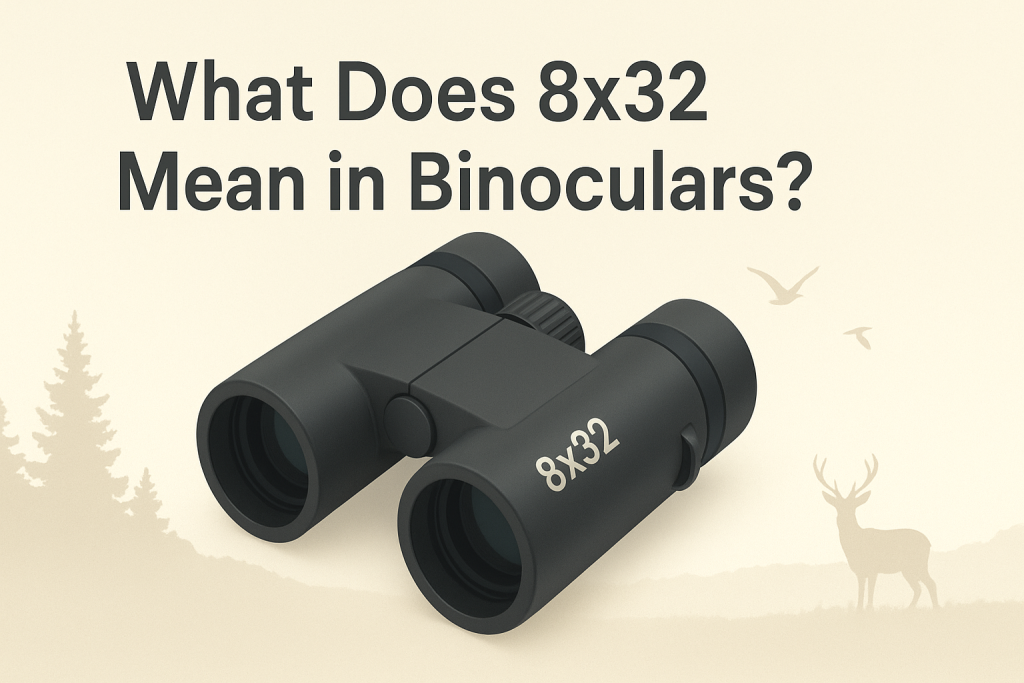
The designation 8×32 in binoculars refers to two critical optical specifications: 8x magnification power and 32mm objective lens diameter. The 8x magnification enlarges distant objects to appear 8 times closer than viewing with naked eyes, while the 32mm objective lenses gather light to form the image.
This compact configuration delivers a calculated 4mm exit pupil (32mm ÷ 8x = 4mm), providing adequate brightness for most daylight observation while maintaining exceptional portability at typically 18-24 ounces. Understanding these specifications matters because choosing incorrect magnification or objective size directly impacts your observation success, image stability, and field performance during hunting, birding, or outdoor activities.
What Does the First Number (8x) Mean in Binoculars?
The first number 8x represents magnification power, meaning objects appear 8 times larger and closer than when viewed with unaided vision. An elk standing 400 yards away appears as if positioned just 50 yards away (400 ÷ 8 = 50 yards perceived distance).
This magnification level provides optimal balance for handheld viewing without excessive image shake that plagues higher powers. Most hunters and birders can hold 8x magnification steady for 30-60 seconds during unsupported observation, while 10x or 12x magnification often requires tripod stabilization for sharp imaging.
How 8x Magnification Affects Image Stability
Lower magnification like 8x amplifies hand movement less than higher powers, creating more stable images during handheld use. Every slight hand tremor gets magnified by the same factor as the image, so 8x binoculars show 8 times the hand shake while 12x models amplify movement 12 times.
Professional hunting guides recommend 8x for Eastern whitetail hunting in thick cover where quick target acquisition matters more than extreme detail resolution. The steadier image allows faster scanning of dense timber and brush without losing target animals to excessive bounce.
Field of View Advantages with 8x Power
8x magnification typically provides 420-450 feet field of view at 1,000 yards, significantly wider than 10x magnification (330-360 feet) or 12x magnification (280-310 feet). This expanded view helps locate moving targets like birds in flight or game animals crossing openings.
Birders benefit enormously from 8x field of view when tracking fast-moving species through forest canopy or following flocks across open water. The wider perspective reduces the likelihood of losing subjects that dart outside the viewing area during observation.
What Does the Second Number (32mm) Mean in Binoculars?
The second number 32mm indicates objective lens diameter measured across the front glass elements that gather light to create the magnified image. Larger objective lenses collect more light but add significant weight and bulk to binocular design.
32mm objectives represent the compact category, prioritizing portability over maximum light gathering capability. These smaller lenses still provide adequate brightness for most daytime applications while keeping total binocular weight under 24 ounces for comfortable extended carry.
Light Gathering Comparison: 32mm vs Larger Objectives
32mm objectives gather substantially less light than 42mm (standard) or 50mm (large) alternatives, directly affecting low-light performance capabilities. The difference becomes pronounced during dawn and dusk observation periods when wildlife activity peaks.
A 32mm objective at 8x magnification produces 4mm exit pupil, while 42mm objectives at the same magnification deliver 5.25mm exit pupil. Human pupils dilate to 5-7mm in low light (decreasing with age), so the larger objective provides noticeably brighter images when lighting conditions deteriorate.
Weight and Portability Benefits of 32mm Design
32mm objective binoculars typically weigh 18-24 ounces compared to 26-32 ounces for 42mm models and 35-45 ounces for 50mm versions. This 8-15 ounce savings matters significantly during all-day carry or backpack hunting where every ounce affects fatigue levels.
Compact 32mm designs fit easily in cargo pockets, small backpack compartments, or under lightweight clothing without creating bulk or printing. This discretion benefits wildlife photographers, urban birders, or hunters requiring concealed optics positioning.
How to Calculate Exit Pupil and Why It Matters
Exit pupil diameter equals objective lens diameter divided by magnification power, so 8×32 binoculars produce 4mm exit pupil (32mm ÷ 8x = 4mm). This measurement determines image brightness delivered to your eye and indicates low-light performance capability.
Human pupils dilate to maximum 5-7mm diameter in darkness, decreasing to 5-6mm for ages 40 and older. Exit pupils smaller than your pupil diameter waste potential brightness, while exit pupils larger than pupil dilation provide no additional benefit since excess light cannot enter your eye.
Optimal Exit Pupil for Different Lighting Conditions
4mm exit pupil from 8×32 configuration works well for bright daylight observation but becomes limiting during dawn, dusk, or overcast conditions when maximum brightness improves target identification. Most wildlife remains active during these marginal light periods, creating observation challenges.
For optimal low-light performance, exit pupils of 5-6mm prove ideal, achieved through 8×40, 8×42, or 10×50 configurations. However, these larger objectives add 6-12 ounces weight and increased bulk that many users find unacceptable for extended carry.
Age-Related Exit Pupil Considerations
Aging reduces maximum pupil dilation, making exit pupil calculations more critical for older users. Ages 20-30 typically dilate to 6-7mm, ages 40-50 reach 5-6mm maximum, while ages 60+ often max at 4-5mm diameter.
An 8×32 binocular’s 4mm exit pupil matches the reduced pupil dilation of users over 60, making this configuration actually optimal for mature hunters and birders who no longer benefit from larger exit pupils their eyes cannot utilize. Understanding your personal pupil dilation helps optimize binocular selection based on age-related vision changes.
When to Choose 8×32 vs Other Configurations
Select 8×32 binoculars when portability and all-day comfort outweigh maximum optical performance, particularly for backpack hunting, urban birding, travel, or situations requiring extended carry without tripod support. These excel in bright conditions where 4mm exit pupil provides adequate brightness.
Choose larger configurations like 8×42 or 10×42 when low-light observation, maximum image quality, or extended glassing sessions take priority over weight savings. The additional optical performance justifies increased bulk and weight for serious hunting or professional birding applications.
Best Applications for 8×32 Binoculars
8×32 binoculars excel for day hiking, casual wildlife observation, sporting events, travel, and situations where binoculars spend hours in backpacks or around necks. Their compact size encourages more frequent use since they don’t create carry burden.
Backpack hunters pursuing high-country game across multiple miles benefit from 8×32 weight savings while retaining adequate magnification for game identification at 200-500 yard distances. The steadier image from 8x magnification helps during winded observation after steep climbs to glassing positions.
When 8×32 Becomes Limiting
8×32 binoculars struggle during dawn and dusk periods when larger exit pupils provide brighter images for wildlife identification in marginal light. Serious hunters targeting game during prime movement periods need 8×42 or 10×42 configurations for optimal performance.
Extended glassing sessions lasting 30+ minutes benefit from tripod-mounted larger binoculars that reduce eye fatigue through superior optics and stable mounting. The compact 8×32 design becomes uncomfortable for prolonged observation due to smaller exit pupil requiring more precise eye placement.
Comparing 8×32 to Popular Alternatives
8×32 competes directly with 8×42, 10×32, and 10×42 configurations across different priorities: maximum portability (8×32), balanced performance (8×42), compact detail (10×32), or versatile capability (10×42). Each serves specific applications and user preferences.
Weight differences prove significant: 8×32 averages 20-24 ounces, 8×42 weighs 26-30 ounces, 10×32 runs 22-26 ounces, while 10×42 tips 28-35 ounces. These 6-15 ounce variations affect carry comfort during extended use and influence selection based on application demands.
| Configuration | Exit Pupil | Typical Weight | Field of View | Best Use |
| 8×32 | 4.0mm | 20-24 oz | 420-450 ft | Compact portability |
| 8×42 | 5.25mm | 26-30 oz | 420-450 ft | Low-light performance |
| 10×32 | 3.2mm | 22-26 oz | 330-360 ft | Compact detail |
| 10×42 | 4.2mm | 28-35 oz | 330-360 ft | Versatile performance |
8×32 vs 8×42: Weight vs Brightness Trade-off
8×42 binoculars provide 31% larger exit pupil (5.25mm vs 4mm) delivering noticeably brighter images during marginal light conditions, but add 6-8 ounces weight that affects extended carry comfort. This trade-off defines the primary decision between these configurations.
Professional guides typically choose 8×42 for clients who glass extensively during dawn and dusk periods, while backpack hunters often prefer 8×32 for weight savings during long approaches. Our detailed comparison of 8×32 versus 8×42 field performance across measured brightness levels and carry comfort scenarios documents specific applications where each configuration excels.
8×32 vs 10×42: Magnification vs Stability
10×42 provides 25% higher magnification for superior detail resolution at distance but creates more hand shake requiring steadier holding technique or tripod support. 8×32 remains stable during handheld use while 10×42 often shows noticeable bounce during unsupported viewing.
Both configurations produce similar exit pupils (4mm for 8×32, 4.2mm for 10×42) providing comparable brightness, making magnification stability the primary differentiator. Choose 8×32 for mobile observation, 10×42 for stationary glassing with support options available.
Best 8×32 Binoculars by Application
Top-performing 8×32 models optimize different priorities: optical quality (premium ED glass), durability (waterproof construction), weight (ultra-light materials), or value (performance per dollar). Understanding these categories helps match specific models to intended applications and budgets.
Premium models like Zeiss Terra ED 8×32 achieve 90%+ light transmission through ED glass and advanced coatings, while budget options like Bushnell Legend L-Series 8×32 provide solid performance at $150-200 price points suitable for casual users.
Premium 8×32 Models for Serious Use
Zeiss Terra ED 8×32 delivers exceptional optical clarity through ED glass reducing chromatic aberration by 85% compared to standard glass, combined with Schmidt-Pechan roof prism design achieving 90% light transmission. Weight remains manageable at 21 ounces with nitrogen purging ensuring fogproof performance.
Leupold BX-4 Pro Guide HD 8×32 features Twilight Max HD lens system providing enhanced low-light performance despite 4mm exit pupil limitation, backed by Leupold’s Golden Ring Full Lifetime Guarantee covering all damage regardless of cause. Field-tested compact binoculars specifically optimized for birding applications and close-focus performance includes detailed analysis of premium 8×32 models.
Budget-Friendly 8×32 Options
Bushnell Legend L-Series 8×32 provides solid optical performance at $180-220 price point, featuring fully multi-coated lenses, phase-corrected roof prisms, and IPX7 waterproofing. Performance approaches premium models for basic observation needs without advanced ED glass or exotic coatings.
Nikon Prostaff P3 8×32 offers reliable Japanese construction at $140-180, delivering good optical clarity for casual hunting and birding applications. Limited Lifetime Warranty covers manufacturing defects while 13.1-foot close focus enables detailed near-field observation.
Understanding Field of View in 8×32 Binoculars
8×32 binoculars typically provide 420-450 feet field of view at 1,000 yards, translating to 7.2-7.7 degrees angular field of view depending on optical design and eyepiece configuration. This wide perspective helps locate and track moving subjects compared to higher magnification alternatives.
Field of view varies between manufacturers based on eyepiece design, with some models achieving 460+ feet at 1,000 yards through wide-angle eyepieces that may introduce edge distortion or reduce eye relief for eyeglass wearers.
How Field of View Affects Target Acquisition
Wider field of view enables faster target location when scanning for wildlife, game animals, or birds across varied terrain. The expanded view reduces time spent searching and increases likelihood of spotting movement or subjects at frame edges.
Bird watchers particularly benefit from 8x magnification’s wide field when following fast-moving species through forest canopy or tracking flocks across open areas. Comprehensive analysis of field of view calculations and practical applications for different observation scenarios explains how angular and linear measurements translate to real-world performance.
Field of View vs Image Quality Trade-offs
Ultra-wide field of view eyepieces often sacrifice edge sharpness or introduce distortion in outer 20-30% of the viewing area. Premium models maintain sharp edge-to-edge performance across the entire field, while budget options may show softness or chromatic aberration near field edges.
Consider your observation style when evaluating field of view specifications: casual scanning benefits from maximum width even with slight edge softness, while detailed identification requires sharp performance across the entire viewing area.
8×32 for Hunting Applications
8×32 binoculars serve hunting applications where weight savings outweigh maximum optical performance, particularly for spot-and-stalk hunting requiring extensive hiking, tree stand hunting with limited space, or situations where binoculars remain carried rather than actively used for extended periods.
The 4mm exit pupil limits effective use during prime hunting hours (dawn and dusk) when larger exit pupils provide brighter images for game identification. Consider hunting style and typical lighting conditions when evaluating 8×32 versus 8×42 or 10×42 alternatives.
Backpack Hunting Advantages
Western hunters pursuing elk, mule deer, or sheep across multi-mile approaches benefit from 8×32 weight savings totaling 6-12 ounces compared to standard configurations. This reduction becomes significant when combined with rifle, pack, and camping gear during week-long hunts.
8x magnification provides adequate detail for game identification at 300-600 yard distances typical during glassing from ridges or valleys. Specialized analysis of compact binoculars designed for backcountry hunting applications and weight-saving priorities covers specific models optimized for extreme portability without sacrificing essential optical performance.
Tree Stand and Blind Hunting
8×32 binoculars work well for tree stand hunting where space limitations favor compact design and observation distances remain under 200 yards in most situations. The steady 8x image helps identify approaching game without excessive magnification creating shaky images.
Ground blind hunters appreciate 8×32 portability when moving between locations or setting up in tight quarters where larger binoculars become cumbersome. Quick deployment and comfortable handling matter more than maximum optical performance in these applications.
8×32 for Birding and Wildlife Observation
8×32 binoculars excel for active birding involving extensive walking, travel birding with flight weight restrictions, or urban birding where discretion and portability outweigh maximum optical performance. The wide field of view aids in locating and following active species.
Serious birders often use 8×32 as secondary optics for travel or backup while maintaining 8×42 or 10×42 as primary observation tools. This approach provides options based on specific birding conditions and portability requirements.
Close Focus Performance
Many 8×32 models achieve close focus distances of 4-8 feet, enabling detailed observation of butterflies, flowers, insects, and near-field subjects that larger binoculars cannot focus on adequately. This capability expands usage beyond distant wildlife observation.
Close focus performance varies significantly between 8×32 models: premium designs often focus to 4-5 feet while budget models may require 8-12 feet minimum distance. Comprehensive testing of 8×32 binoculars specifically for birding applications including close-focus measurement and optical quality assessment provides detailed comparisons of focusing capabilities.
Travel and Urban Birding Benefits
8×32 binoculars pack easily in carry-on luggage, fit discretely in urban environments, and provide adequate performance for most birding situations encountered during travel. Weight and size restrictions favor compact designs for international travel or city exploration.
Urban birders benefit from 8×32 discretion when observing in parks, waterfronts, or populated areas where larger binoculars attract unwanted attention. The compact design enables casual carrying and quick deployment without appearing overly conspicuous.
Lens Coatings and Optical Quality in 8×32 Models
8×32 binoculars require high-quality lens coatings to maximize light transmission through the compact optical system. Fully multi-coated lenses achieve 85-90% light transmission while basic coated models may transmit only 70-80%, creating noticeable brightness differences.
Premium 8×32 models incorporate ED (Extra-low Dispersion) glass reducing chromatic aberration by 80-90% compared to standard crown glass. This improvement becomes particularly noticeable when observing high-contrast subjects like birds against bright sky backgrounds.
Phase Correction in Roof Prism Designs
Most 8×32 binoculars use roof prism optical designs requiring phase correction coatings to maintain image sharpness and contrast. Without phase correction, roof prism binoculars show reduced resolution and contrast compared to porro prism alternatives.
Premium manufacturers apply dielectric mirror coatings achieving 99%+ reflectivity compared to 87-95% for standard silver mirror coatings. This 4-12% improvement in light efficiency helps compensate for the inherent brightness limitation of 32mm objectives.
Anti-Reflective Coating Technology
Multi-layer anti-reflective coatings on all air-to-glass surfaces reduce light loss and eliminate internal reflections that degrade image contrast. Premium 8×32 models feature 6-10 coating layers per surface optimized for specific wavelengths.
XR (Extended Range) coatings or similar proprietary treatments extend anti-reflective properties across broader wavelength ranges, improving color fidelity and contrast in varied lighting conditions. These advanced coatings add $100-300 to manufacturing costs but provide measurable optical improvements.
Durability and Weather Protection
Quality 8×32 binoculars feature O-ring sealing and nitrogen or argon purging preventing internal fogging and water infiltration. IPX7 waterproof rating withstands 1-meter submersion for 30 minutes, suitable for most outdoor applications including marine use.
Magnesium alloy or aircraft-grade aluminum construction provides durability while minimizing weight compared to traditional materials. Rubber armoring protects against impacts and provides secure gripping during field use.
Waterproof vs Water-Resistant Specifications
True waterproof 8×32 binoculars maintain internal dryness during complete submersion, while water-resistant models handle rain and surface moisture but fail if submerged. Understanding these distinctions helps select appropriate protection levels for intended applications.
Nitrogen purging displaces internal moisture and prevents condensation formation on internal lens surfaces during temperature changes. Argon purging provides superior protection but increases manufacturing costs typically reflected in premium pricing.
Impact Resistance and Field Durability
8×32 binoculars endure significant abuse during outdoor activities: drops onto rocks, impacts against trees, extreme temperature variations, and constant vibration during transport. Quality construction withstands these stresses without optical misalignment.
Shock-absorbing rubber armoring protects internal components while providing secure grip surfaces. Premium models feature reinforced stress points and internal shock mounting isolating optical elements from external impacts that could affect collimation.
Price Ranges and Value Analysis
8×32 binoculars span price ranges from $80 budget models to $2,000+ premium optics, with performance improvements correlating generally with price increases. Sweet spot for most users falls between $200-500 where significant optical improvements justify costs.
Budget tier ($80-200) provides basic functionality with acceptable optical performance for casual use. Mid-range ($200-500) offers substantial quality improvements through better glass, coatings, and construction. Premium tier ($500-2000+) delivers maximum optical performance with exotic glass and precision manufacturing.
| Price Range | Typical Features | Best For | Example Models |
| $80-200 | Basic coatings, standard glass | Casual observation | Bushnell H2O, Celestron Nature |
| $200-500 | Multi-coated, phase correction | Regular outdoor use | Vortex Diamondback, Nikon Prostaff |
| $500-1000 | ED glass, premium coatings | Serious enthusiasts | Zeiss Terra ED, Leupold BX-4 |
| $1000+ | Fluoride glass, exotic coatings | Professional use | Swarovski CL, Leica Trinovid |
Cost vs Performance Analysis
Optical performance improvements follow diminishing returns: moving from $100 to $300 provides dramatic image quality gains, while jumping from $800 to $1500 yields subtle improvements noticeable primarily to experienced users under direct comparison.
Consider intended use intensity when evaluating price points: casual weekend users achieve satisfaction with $200-400 models, while professional guides or serious enthusiasts benefit from $600-1200 investments through superior durability and optical performance.
Long-term Value Considerations
Premium 8×32 binoculars often include unconditional lifetime warranties covering all damage regardless of cause, while budget models provide limited warranties excluding user damage. These warranty differences affect long-term ownership costs and replacement considerations.
Quality construction maintains optical alignment and coating integrity over decades, while budget models may develop issues after 2-5 years of regular use. Calculating cost per year of expected service helps justify initial investment in quality optics.
Maintenance and Care for 8×32 Binoculars
Proper maintenance extends 8×32 binocular life and maintains optical performance through regular cleaning, appropriate storage, and damage prevention. Lens surfaces require special care to avoid coating damage that degrades light transmission and image quality.
Clean objective and eyepiece lenses using lens cleaning kit with microfiber cloths and optical cleaning solution designed specifically for coated optics. Avoid paper towels, clothing, or household cleaners that scratch coatings or leave residue.
Cleaning Procedures for Coated Lenses
Remove loose debris using soft brush or compressed air before wiping lens surfaces to prevent scratching during cleaning. Apply optical cleaning solution to microfiber lens cloth rather than directly to lens to control amount and distribution.
Wipe lenses using circular motions from center outward, avoiding back-and-forth scrubbing that can damage anti-reflective coatings. Allow surfaces to air dry completely before storing binoculars to prevent moisture trapped under lens caps.
Storage and Protection Guidelines
Store 8×32 binoculars in dry environment with desiccant packs preventing moisture buildup that can damage internal components or cause fungus growth on lens surfaces. Avoid temperature extremes that stress rubber components and optical cements.
Use protective case during transport to prevent impacts and maintain optical alignment. Lens caps protect front and rear elements from scratches and debris when binoculars are not in use.
Common Problems and Solutions
8×32 binoculars experience typical optical issues including double vision from dropped or impacted units, focusing problems from debris in mechanisms, and reduced image quality from dirty or damaged lens coatings. Most problems have specific solutions or indicate need for professional service.
Understanding common failure modes helps identify repairable issues versus irreparable damage requiring replacement. Many problems result from improper care or maintenance rather than manufacturing defects.
Double Vision and Collimation Issues
Double vision or inability to merge left and right images indicates optical misalignment usually caused by drops or impacts. This collimation problem requires professional repair as attempting DIY fixes often worsens the alignment.
Test collimation by observing distant vertical line (fence post, building edge) and checking for perfect single image merger. Any splitting, ghosting, or eye strain during extended viewing indicates alignment problems requiring factory service.
Focus Mechanism Problems
Stiff or unresponsive focus wheels often result from debris infiltration, lubricant degradation, or moisture damage. Gentle cleaning with compressed air may resolve minor issues, while mechanical problems require disassembly by qualified technicians.
Focus drift where binoculars lose sharp focus during observation typically indicates worn internal components or improper assembly. This problem worsens over time and necessitates professional service to restore proper operation.
Frequently Asked Questions About 8×32 Binoculars
Are 8×32 binoculars good for hunting?
8×32 binoculars work well for hunting applications prioritizing portability over maximum optical performance, particularly backpack hunting, tree stand use, or situations requiring extensive carrying without active glassing. The 4mm exit pupil provides adequate brightness for daylight observation but becomes limiting during dawn and dusk periods when larger exit pupils deliver brighter images for game identification.
Choose 8×32 for mobile hunting styles where weight savings matter more than maximum low-light capability. For serious glassing during prime hunting times, consider 8×42 or 10×42 configurations providing larger exit pupils (5.25mm and 4.2mm respectively) for improved performance in marginal lighting conditions.
What is the exit pupil of 8×32 binoculars?
8×32 binoculars produce 4mm exit pupil calculated by dividing objective lens diameter by magnification (32mm ÷ 8x = 4mm). This exit pupil size matches the pupil dilation of users over age 60 but limits brightness for younger users whose pupils dilate to 5-7mm in low light.
4mm exit pupil provides adequate brightness for most daylight conditions but becomes limiting during dawn, dusk, or overcast situations when larger exit pupils deliver noticeably brighter images. Compare to 8×42 binoculars producing 5.25mm exit pupil for superior low-light performance at the cost of additional weight.
How far can you see with 8×32 binoculars?
8×32 binoculars magnify objects to appear 8 times closer, so a deer at 800 yards appears as if positioned 100 yards away (800 ÷ 8 = 100). Maximum useful range depends on object size, atmospheric conditions, and optical quality rather than magnification alone.
For hunting applications, 8x magnification provides adequate detail for game identification and antler evaluation at 300-600 yards under good conditions. Beyond 600 yards, higher magnification (10x, 12x) offers better detail resolution but requires steadier holding or tripod support for sharp imaging.
Are 8×32 better than 10×42 binoculars?
8×32 and 10×42 serve different priorities: 8×32 excels in portability (typically 6-10 ounces lighter) and image stability, while 10×42 provides superior magnification detail and slightly better low-light performance through larger exit pupil (4.2mm vs 4mm). Neither is universally better across all applications.
Choose 8×32 for applications requiring extensive carrying, handheld stability, or weight-conscious activities like backpacking. Select 10×42 when magnification detail matters more than portability, or when stationary observation allows tripod stabilization for the higher magnification.
Do I need image stabilization with 8×32 binoculars?
Image stabilization is not necessary for 8×32 binoculars since 8x magnification remains within most users’ ability to hold steady during typical observation periods. 8x magnification amplifies hand shake minimally compared to 10x, 12x, or higher powers that benefit significantly from stabilization technology.
Save the additional cost, weight, and complexity of image stabilization for higher magnification binoculars (12x and above) where hand shake becomes problematic. Focus budget on superior optical quality through ED glass and premium coatings rather than stabilization for 8×32 applications.
Can you use 8×32 binoculars for astronomy?
8×32 binoculars work for basic astronomical observation of moon phases, brighter star clusters, and large constellation identification, but the 4mm exit pupil limits performance compared to larger objectives optimized for night vision. Astronomy benefits from exit pupils matching maximum human pupil dilation (5-7mm).
For serious astronomical use, consider 8×42, 8×50, or larger configurations providing exit pupils of 5.25-6.25mm that deliver brighter images of faint celestial objects. 8×32 serves casual astronomical observation but lacks the light-gathering capability for detailed deep-sky viewing.
What is the field of view for 8×32 binoculars?
8×32 binoculars typically provide 420-450 feet field of view at 1,000 yards (7.2-7.7 degrees angular), varying by manufacturer and eyepiece design. This wide field of view exceeds 10x or 12x magnification alternatives, making target location and tracking easier for moving subjects.
Field of view specifications appear as linear feet at 1,000 yards or angular degrees. Detailed explanation of binocular specifications including field of view calculations and practical applications covers how these measurements translate to real-world observation performance.
Are 8×32 binoculars good for birding?
8×32 binoculars excel for active birding involving extensive walking, travel situations, or when portability outweighs maximum optical performance. The wide field of view aids in locating and following fast-moving species, while compact size encourages more frequent carrying and use.
Serious birders often use 8×32 as secondary or travel optics while maintaining 8×42 or 10×42 as primary tools for home territory birding. The 4mm exit pupil limits performance during dawn chorus or dusk observation when many species are most active and larger exit pupils provide brighter images.
How much should I spend on 8×32 binoculars?
Budget $200-500 for quality 8×32 binoculars providing significant optical improvements over sub-$200 models without reaching premium pricing territory. This range offers fully multi-coated lenses, phase correction, quality construction, and decent warranties suitable for regular outdoor use.
Casual users achieve satisfaction with $200-350 models from established manufacturers like Vortex, Nikon, or Bushnell. Enthusiasts benefit from $350-500 investments featuring ED glass and premium coatings. Beyond $500, improvements become subtle and mainly benefit professional or extremely demanding applications.
Can eyeglass wearers use 8×32 binoculars?
Eyeglass wearers require minimum 14mm eye relief, preferably 17mm+ for comfortable viewing without vignetting (black edges). Many 8×32 models provide adequate eye relief, but specification varies significantly between manufacturers and should be verified before purchase.
Look for twist-up or fold-down eyecups allowing proper eye positioning with glasses. Some 8×32 models achieve 18-20mm eye relief accommodating all eyeglass wearers comfortably, while others provide only 12-14mm limiting usability for those wearing glasses.
What accessories do I need for 8×32 binoculars?
Essential accessories include comfortable harness for extended carrying, lens cleaning kit with microfiber cloths and optical solution, and protective lens caps preventing scratches during storage and transport.
Optional accessories include tripod adapter for extended observation sessions, rain guard protecting eyepieces during weather, and floating strap for marine use. Choose accessories based on specific applications and environmental conditions.
How do I test 8×32 binoculars before buying?
Test binocular optical quality by observing distant high-contrast subjects (building edges against sky) checking for chromatic aberration, edge sharpness, and color fidelity. Evaluate focus speed and smoothness across the entire focusing range from minimum distance to infinity.
Assess comfort by holding binoculars for 5-10 minutes checking ergonomics, eye relief adequacy, and image stability during handheld viewing. Compare exit pupil brightness by viewing same subjects with different models under identical lighting conditions. Test close focus capability if near-field observation matters for intended applications.
Do 8×32 binoculars work in low light?
8×32 binoculars function in low light but with limitations compared to larger objectives producing bigger exit pupils. The 4mm exit pupil provides adequate brightness for most dawn and dusk observation but cannot match the performance of 5-6mm exit pupils from 8×42 or 10×50 configurations.
Performance in low light depends on several factors beyond exit pupil: lens coating quality (fully multi-coated vs basic), glass type (ED vs standard), and optical design precision. Premium 8×32 models with superior coatings achieve 90%+ light transmission partially compensating for smaller objective lens limitation.
What is the close focus distance of 8×32 binoculars?
Close focus distance varies significantly among 8×32 models, ranging from 4 feet for premium designs to 12+ feet for budget alternatives. This specification matters for butterfly watching, flower observation, or detailed examination of near-field subjects.
Premium 8×32 binoculars often achieve 4-6 feet close focus enabling detailed observation of insects, birds at feeders, or botanical subjects. Budget models may require 8-15 feet minimum distance limiting close-range versatility. Verify close focus specification if near-field observation is important for intended applications.
Are 8×32 binoculars waterproof?
Quality 8×32 binoculars feature O-ring sealing and nitrogen purging providing true waterproof protection rated IPX7 (submersible to 1 meter for 30 minutes) or higher. Budget models may offer only water-resistant protection suitable for rain but not submersion.
Waterproof construction prevents internal fogging through gas purging (nitrogen or argon) displacing moisture-containing air. This protection maintains optical performance during temperature changes and humid conditions common in outdoor environments. Verify waterproof rating rather than assuming all modern binoculars provide submersible protection.
Selecting optimal 8×32 binoculars requires balancing portability advantages against optical limitations, understanding that 4mm exit pupil restricts low-light performance compared to larger configurations while providing exceptional all-day carry comfort at 18-24 ounces total weight. Prioritize exit pupil calculation for brightness needs, verify eye relief for eyeglass compatibility, and confirm waterproof construction through O-ring sealing and gas purging for reliable field performance.
Focus selection criteria on primary application requirements: choose 8×32 for weight-conscious activities like backpack hunting or travel birding where portability outweighs maximum optical capability, or select 8×42 and 10×42 alternatives when low-light performance and extended glassing sessions take priority over compact size. Test multiple models under actual field conditions evaluating optical clarity, focus smoothness, and comfort during extended holding before making final purchase decisions.