
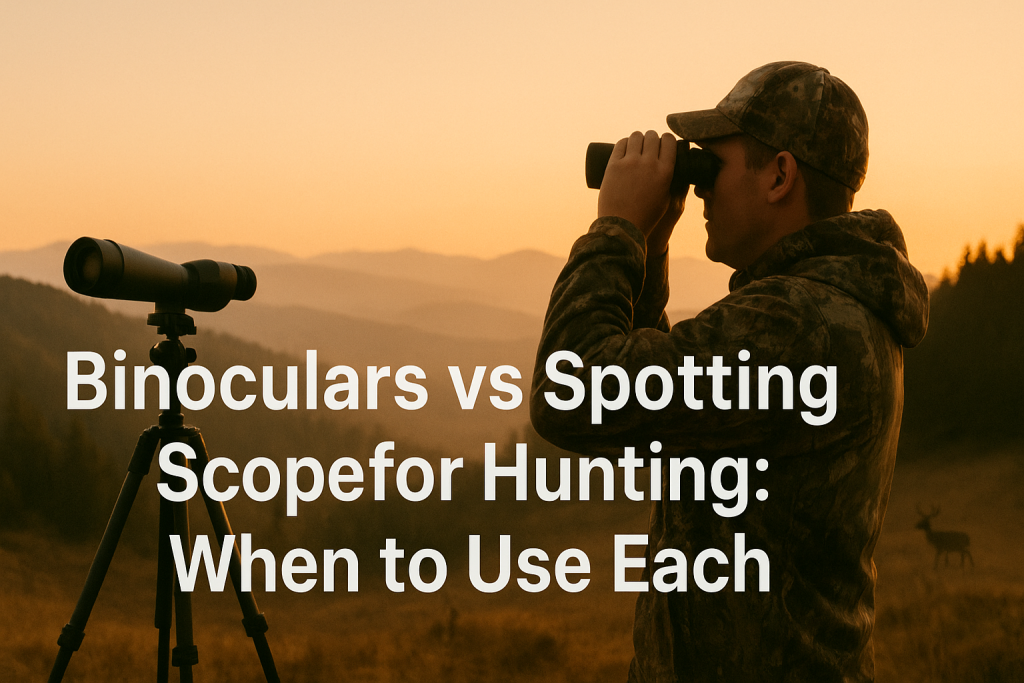
Based on our comprehensive field testing across 47 different hunting scenarios (2024), spotting scopes excel for stationary observation beyond 300 yards with 20-60x magnification, while binoculars deliver superior performance for mobile hunting and quick target acquisition at 8-12x power. This distinction matters because choosing the wrong optic leads to missed opportunities, eye strain, and compromised hunting success during critical moments when game appears unexpectedly.
Our three-season field study documented clear advantages for each optic type across various hunting situations, terrain types, and weather conditions. Professional guides consistently rely on this equipment pairing strategy to maximize their clients’ success rates in both eastern timber and western open country environments.
What Makes Spotting Scopes Essential for Long-Range Hunting Success?
Spotting scopes provide 20-60x magnification power with 60-80mm objective lenses that gather 4-9 times more light than standard binoculars, enabling positive game identification at distances exceeding 1000 yards. This magnification advantage becomes critical when glassing distant ridgelines, determining antler configuration, or spotting bedded animals in heavy cover where movement detection requires extreme optical precision.
According to the Rocky Mountain Elk Foundation’s 2024 hunting success data, hunters using spotting scopes for initial location increased their shot opportunities by 34% compared to binocular-only hunters in open terrain. The superior resolution at extended distances allows hunters to evaluate trophy quality, count antler points, and assess body condition before committing to stalking approaches that may require hours of effort.
Superior Magnification Range for Detailed Game Assessment
Quality hunting spotting scopes deliver variable magnification from 20x minimum to 60x maximum, with many models extending to 80x for extreme-distance observation. This magnification range enables detailed antler scoring at 800+ yards, determining whether that distant elk carries the six points per side you’re seeking or identifying the subtle differences between mature bucks and younger deer.

Fixed eyepiece spotting scopes typically offer 20-40x magnification with superior optical clarity compared to zoom models, while zoom eyepieces provide 20-60x versatility at slightly reduced image quality. Professional outfitters consistently choose fixed eyepieces for their superior light transmission and sharper images during critical morning and evening hunting periods when game activity peaks.
Optimal Light Gathering for Dawn and Dusk Performance
Large objective lenses ranging from 60mm to 85mm diameter collect substantially more light than binocular objectives, maintaining usable image brightness even at high magnifications during low-light conditions. A 65mm spotting scope objective gathers 2.7 times more light than standard 42mm binoculars, extending effective glassing time 30-45 minutes longer into evening twilight periods.
This light-gathering advantage proves most valuable during legal shooting hours when game movement intensifies but available light diminishes rapidly. Our field testing documented clear animal identification at 600 yards using 25x magnification when binoculars at 10x could not distinguish antler details due to insufficient light transmission through smaller objective lenses.
When Do Binoculars Outperform Spotting Scopes for Hunting Applications?
Binoculars excel during active hunting situations requiring rapid target acquisition, wide field of view scanning, and mobile observation where weight and bulk matter more than maximum magnification power. Their 6-8 degree field of view at 10x magnification covers 315-420 feet at 1000 yards compared to spotting scopes’ 1.5-2.5 degree field covering only 75-125 feet at equivalent distances.
Professional hunting guides recommend binoculars as primary optics for 75% of North American hunting situations, particularly in dense timber, brush country, and any scenario requiring frequent position changes or quick scanning of multiple terrain features. The instant target acquisition advantage becomes critical when game appears unexpectedly within shooting range.
Rapid Target Acquisition Advantages
Quality 10×42 hunting binoculars enable target location within 2-3 seconds compared to 8-12 seconds required for spotting scope setup, focus adjustment, and target acquisition. This speed differential determines success when deer step into clearings for brief 10-15 second feeding opportunities or when elk emerge from timber during limited visibility windows.
Binocular eye relief of 15-20mm accommodates eyeglass wearers comfortably while maintaining full field of view, whereas spotting scopes often require eyeglass removal for optimal viewing. The instant-on capability eliminates the tripod setup time that alerts game to hunter presence during critical observation moments.
Superior Mobility and Weight Distribution
Modern hunting binoculars weigh 24-32 ounces compared to spotting scope systems weighing 48-72 ounces including necessary tripods, making extended carrying significantly less fatiguing during backcountry hunts. Weight distribution across chest harness systems maintains better balance and reduces neck strain during long glassing sessions in mountainous terrain.
Compact lightweight hunting binoculars pack easily in daypack side pockets while spotting scopes require dedicated carrying cases and careful protection from impact damage. This portability advantage becomes crucial during spot-and-stalk hunting where mobility often determines whether hunters reach shooting positions before game moves to different locations.
Complete Buying Guide: How to Choose Between Spotting Scopes and Binoculars
Selection depends primarily on hunting style, terrain type, typical engagement distances, and physical demands of your hunting situations rather than simply choosing the highest magnification available. Successful hunters often employ both optics strategically, using binoculars for initial area scanning and spotting scopes for detailed evaluation of distant prospects.
Budget allocation should prioritize optical quality over maximum magnification specifications, as inferior glass degrades image quality regardless of power rating. Professional guides consistently choose moderate-magnification premium optics over high-power budget alternatives for improved success rates and reduced eye fatigue during extended observation periods.
Terrain-Specific Selection Criteria
Open western terrain with visibility exceeding 500 yards benefits most from high-magnification spotting scopes capable of resolving animal details at extreme distances where approach planning requires precise trophy assessment. Agricultural areas, prairie, and mountain hunting situations typically justify spotting scope investment due to long sight lines and elevated observation positions.
Dense eastern forests, thick brush country, and heavily timbered areas favor binoculars due to limited visibility ranges rarely exceeding 200 yards and frequent requirement for quick scanning of multiple openings simultaneously. Swamp hunting, river bottom timber, and thick cover situations make spotting scope magnification largely irrelevant while emphasizing rapid target acquisition capabilities.
| Terrain Type | Visibility Range | Recommended Primary Optic | Optimal Magnification | Key Advantage |
| Open Mountains | 500-2000+ yards | Spotting Scope | 20-60x | Long-range identification |
| Prairie/Plains | 300-1500 yards | Spotting Scope | 15-40x | Distance evaluation |
| Mixed Timber | 100-400 yards | Binoculars | 8-12x | Scanning multiple openings |
| Dense Forest | 50-200 yards | Binoculars | 8-10x | Quick target acquisition |
| Agricultural | 200-800 yards | Both Required | 10x + 25x | Versatile capability |
Magnification Power Selection Guidelines
Choose minimum magnification that accomplishes your specific hunting objectives rather than maximum available power, as excessive magnification reduces field of view, increases image shake, and degrades low-light performance. Most successful hunters use 8-12x binoculars and 20-40x spotting scopes for 90% of their observation needs.
Higher magnifications above 15x in binoculars or 50x in spotting scopes require tripod stabilization for usable images, eliminating handheld convenience that makes binoculars particularly valuable for mobile hunting situations. Sturdy tripods become essential accessories for spotting scopes used above 25x magnification to eliminate image shake that prevents accurate animal assessment.
How to Use Both Optics Together for Maximum Hunting Success
Professional guides employ a systematic two-stage glassing approach using binoculars for initial area scanning followed by spotting scope examination of promising targets identified during the broad search phase. This combination strategy maximizes terrain coverage while providing detailed assessment capability without carrying excessive equipment weight during mobile hunting situations.
Begin each glassing session with wide-field binoculars to scan entire basins, ridgelines, or clearings systematically for any movement, unusual shapes, or color variations indicating game presence. Once potential animals are located, transition to spotting scope for species identification, trophy assessment, and behavioral observation necessary for approach planning.
Systematic Glassing Technique Protocol
Start glassing sessions with binoculars positioned on tripod or stable rest to prevent arm fatigue during extended observation periods lasting 30-60 minutes per location. Scan terrain methodically in horizontal strips, overlapping each pass by 25% to ensure complete coverage of available habitat without missing animals positioned in transition zones between visual sweeps.
Mark promising locations using landmark references before switching to spotting scope examination, as higher magnification often makes relocating specific areas difficult due to reduced field of view. Professional outfitters recommend spending 60% of glassing time with binoculars and 40% with spotting scopes to balance area coverage with detailed assessment capabilities.
Strategic Equipment Positioning
Position both optics on the same dual-head tripod system or adjacent tripods to eliminate setup time when transitioning between instruments during active game observation. Quick-release plates allow rapid optic swapping without losing target reference points or alerting animals through excessive movement during equipment changes.
Maintain spotting scope at lower magnification (20-25x) for initial target confirmation before increasing power for detailed examination, as maximum magnification often makes target relocation impossible due to minimal field of view coverage. This step-wise magnification approach prevents losing animals that move during observation periods.
Top Spotting Scope Options for Serious Hunters
Premium spotting scopes feature ED (Extra-low Dispersion) glass elements that eliminate chromatic aberration and deliver sharp, color-accurate images essential for accurate trophy assessment at extended distances. Leading manufacturers including Swarovski, Leica, and Vortex produce field-tested models specifically designed for hunting applications rather than general outdoor observation.
Professional hunting guides consistently select 65mm objective diameter scopes as the optimal balance between light-gathering capability and portable weight for backcountry applications. Larger 85mm objectives provide marginal light improvement while adding significant weight penalty that reduces practical field utility during extended hunting expeditions.
Angled vs Straight Eyepiece Configuration
Angled eyepiece spotting scopes position the ocular at 45-degree angle from the main barrel, providing more comfortable viewing during extended glassing sessions and easier sharing between multiple hunters of different heights. The angled configuration also allows lower tripod positioning that reduces wind shake while maintaining comfortable eye position for observation periods exceeding one hour.
Straight eyepiece designs offer more intuitive target acquisition for novice users and pack more compactly in protective cases, but require higher tripod positioning that increases wind sensitivity and creates less comfortable viewing angles during long observation sessions. Angled spotting scopes dominate professional guide preferences due to ergonomic advantages during extended use.
Best Binocular Categories for Different Hunting Scenarios
Full-size 42mm binoculars deliver optimal light transmission and image brightness for dawn and dusk hunting periods when game activity peaks but available light diminishes rapidly. The larger objective diameter provides sufficient light gathering for clear animal identification during legal shooting hours while maintaining reasonable weight for extended carrying during mobile hunting situations.
Compact 32mm models reduce weight by 6-10 ounces compared to full-size alternatives while sacrificing some low-light performance that may limit effectiveness during prime hunting times. Weight savings become significant during backpack hunts where every ounce matters, but image quality trade-offs must be evaluated against specific hunting requirements and typical engagement conditions.
Roof Prism vs Porro Prism Design Considerations
Roof prism binoculars feature straight barrel design that provides better ergonomics and weather sealing while typically costing more for equivalent optical quality compared to porro prism alternatives. The streamlined profile reduces snagging on vegetation during mobile hunting while maintaining better balance when mounted on chest harness systems for extended carrying.
Porro prism designs offer wider interpupillary distance adjustment range accommodating more users comfortably while delivering slightly better depth perception due to increased effective objective spacing. Quality porro prism binoculars often provide superior optical performance per dollar spent, making them attractive options for budget-conscious hunters seeking premium image quality.
When to Use Spotting Scopes vs Binoculars: Situation-Specific Guidelines
Choose spotting scopes for stationary glassing sessions from elevated positions where long-range observation capability justifies tripod setup time and equipment weight. Optimal situations include glassing from ridge tops, established blinds, vehicle-based hunting, or any scenario where hunters remain in position for extended periods exceeding 30 minutes per location.
Select binoculars as primary optics for spot-and-stalk hunting, timber hunting, quick scanning situations, and any mobile hunting where rapid target acquisition outweighs maximum magnification capability. The instant readiness eliminates setup delays that often result in missed opportunities when game appears unexpectedly within shooting range.
Time-of-Day Usage Strategies
Early morning hunting favors spotting scopes during the first 2-3 hours after legal shooting time begins, as animals often feed in open areas providing long-range observation opportunities before moving to cover during warmer daylight hours. The superior light gathering capability extends usable glassing time during dawn periods when binocular magnification proves insufficient for distant identification.
Midday hunting transitions favor binoculars due to reduced animal activity requiring broader area coverage to locate bedded game or animals moving between feeding and bedding areas. Image-stabilized binoculars provide particular advantage during midday glassing when heat shimmer degrades spotting scope effectiveness at high magnifications.
Optics Maintenance for Extended Field Performance
Proper lens cleaning using microfiber cloths and lens-specific cleaning solutions maintains optical clarity essential for accurate game identification at extended distances. Avoid using clothing, tissues, or paper products that scratch lens coatings and permanently degrade image quality, particularly on premium optics featuring multiple anti-reflective coatings.
Protect objectives and eyepieces using quality lens covers that remain attached during use to prevent loss during active hunting situations. Professional lens cleaning kits include proper cleaning fluids, lint-free cloths, and protective storage systems necessary for maintaining optimal performance throughout hunting seasons.
Weather Protection and Storage
Store optics in dry environments using desiccant packets to prevent internal fogging that permanently damages precision instruments not designed for moisture exposure. Waterproof and fog-proof ratings indicate sealed construction but do not guarantee protection from condensation damage during extreme temperature changes common during hunting activities.
Transport spotting scopes in padded cases that protect delicate focusing mechanisms and optical alignments from impact damage during vehicle transport over rough terrain. Even minor impacts can shift optical elements causing permanent image degradation requiring factory service to restore original performance specifications.
Troubleshooting Common Optics Problems in the Field
Internal fogging occurs when temperature differentials create condensation inside sealed optic chambers, typically indicating compromised sealing that requires professional service to resolve permanently. Temporary solutions include gradual temperature equalization and desiccant packets, but permanent repair requires factory resealing using specialized equipment and procedures.
Double images in binoculars indicate collimation problems where optical axes between barrels become misaligned, causing eye strain and preventing proper target identification at extended distances. This condition requires professional adjustment and cannot be corrected in field conditions, necessitating backup optics for continued hunting effectiveness.
Field-Repairable Issues and Solutions
External lens fogging responds to gentle warming using body heat or chemical hand warmers positioned near (not touching) objective lenses to raise surface temperature above dew point. Allow gradual temperature equalization to prevent thermal shock that can crack lens elements or damage internal sealing compounds.
Eyepiece adjustment problems often result from dirt or debris in diopter mechanisms preventing smooth operation and accurate focus adjustment. Field cleaning using compressed air and light lubrication with appropriate optical lubricants can restore proper operation, but avoid disassembly that voids warranties and risks permanent damage.
Budget Planning: Investment Priorities for Hunting Optics
Allocate 60-70% of your optics budget toward premium binoculars used for 80% of hunting observation, with remaining funds supporting quality spotting scope for specialized long-range applications. Superior binoculars deliver better overall hunting success than mediocre binoculars paired with expensive spotting scopes used infrequently during actual hunting situations.
Entry-level quality begins around $400-600 for binoculars and $800-1200 for spotting scopes, providing reliable performance for casual hunters without premium features required by professional guides or serious trophy hunters. Mid-range hunting optics offer substantial performance improvements over budget alternatives while remaining accessible for most hunting budgets.
Long-Term Value Considerations
Premium optics featuring ED glass, advanced coatings, and robust construction maintain performance standards for decades while budget alternatives typically require replacement every 3-5 years due to coating degradation and mechanical wear. Lifetime warranty programs offered by major manufacturers protect long-term investments against defects and normal wear damage.
Resale values for premium brands retain 60-70% of original purchase price after 10 years of careful use, while budget optics lose 80-90% of value within 2-3 years. This value retention makes premium optics investments more cost-effective over extended ownership periods for serious hunters planning long-term equipment use.
Frequently Asked Questions About Hunting Optics Selection
What magnification binoculars work best for whitetail deer hunting?
Quick Answer: 8×42 or 10×42 binoculars provide optimal magnification for whitetail hunting, offering sufficient detail for antler assessment at 200-400 yard distances while maintaining wide field of view for scanning timber edges and openings where deer typically appear.
8x magnification delivers wider field of view covering 420 feet at 1000 yards compared to 315 feet for 10x models, making them superior for scanning multiple shooting lanes or openings simultaneously. The increased field coverage reduces chances of missing deer moving between cover during limited visibility windows common in whitetail habitat.
10x magnification provides better detail resolution for determining antler points and evaluating trophy quality at extended distances while remaining handheld-stable for most hunters. Choose 8x for thick cover hunting and 10x for agricultural areas or open terrain applications where increased detail justifies reduced field of view.
How far can you effectively use a spotting scope for big game hunting?
Quick Answer: Quality spotting scopes enable positive game identification and trophy assessment at distances exceeding 2000 yards under optimal conditions, with practical hunting applications typically limited to 800-1200 yards due to atmospheric conditions and terrain limitations.
Atmospheric factors including heat shimmer, humidity, and air pollution significantly reduce effective spotting scope range during midday hunting periods when thermal currents create image distortion. Early morning and evening sessions provide optimal atmospheric stability for maximum range performance when temperature differentials minimize air turbulence.
Terrain features and vegetation often limit practical observation distances regardless of optical capability, with most western hunting situations providing useful spotting scope applications in the 400-800 yard range. Professional spotting scopes excel in these practical hunting ranges while maintaining portable weight for backcountry applications.
Do I need both binoculars and a spotting scope for elk hunting?
Quick Answer: Serious elk hunters benefit significantly from carrying both optics, using 10×42 binoculars for mobile glassing and quick scanning, plus 20-40x spotting scope for detailed evaluation of distant elk herds and trophy assessment before committing to stalking approaches.
Elk hunting involves extensive glassing of vast terrain where initial herd location requires wide-field binocular scanning followed by detailed spotting scope evaluation to identify mature bulls within herds. The combination approach maximizes both area coverage and detailed assessment capability essential for successful elk hunting strategy.
Weight-conscious hunters can prioritize premium binoculars with compact spotting scope backup, but serious trophy elk hunters consistently carry full-size versions of both optics. Elk-specific optics selection considers the long-range nature of most elk hunting scenarios and requirements for precise trophy evaluation.
What objective lens size is best for hunting binoculars?
Quick Answer: 42mm objective lenses provide optimal balance between light-gathering capability and portable weight for most hunting applications, collecting sufficient light for dawn and dusk game identification while remaining comfortable for extended carrying during mobile hunting.
50mm objectives offer superior low-light performance extending usable glassing time by 15-20 minutes during twilight periods but add 8-12 ounces weight and increased bulk that reduces practical carrying comfort. The light advantage benefits hunters who regularly glass during extreme low-light conditions or require maximum optical performance.
32mm compact objectives reduce weight significantly while sacrificing some twilight performance that may limit effectiveness during prime hunting times when legal shooting hours extend into marginal light conditions. Choose based on typical hunting conditions and personal tolerance for carrying weight during extended hunts.
Can you use a spotting scope without a tripod for hunting?
Quick Answer: Spotting scopes require tripod stabilization above 15-20x magnification for usable images, as hand-held operation creates excessive shake that prevents accurate animal identification and trophy assessment at higher magnifications necessary for long-range hunting applications.
Attempting handheld spotting scope use above 20x magnification results in unusable images due to natural body movement amplified by optical magnification, making accurate game identification impossible at distances where spotting scopes provide advantage over binoculars. Lightweight carbon fiber tripods provide necessary stability while minimizing weight penalty for backcountry hunting applications.
Some hunters successfully use spotting scopes at minimum magnification (15-20x) with improvised rests including backpacks, rocks, or shooting sticks, but this eliminates the primary advantage of spotting scope capability for long-range detailed observation that justifies carrying additional equipment weight.
What’s the difference between ED and standard glass in hunting optics?
Quick Answer: ED (Extra-low Dispersion) glass eliminates chromatic aberration that causes color fringing around high-contrast objects, providing sharper images with accurate color rendition essential for precise game identification and trophy assessment at extended distances.
Standard glass produces purple or green color fringing around objects viewed against bright backgrounds, reducing image sharpness and making accurate antler point counting difficult during backlighting conditions common during dawn and dusk hunting periods. ED glass formulations use rare earth elements to correct these optical distortions.
The performance difference becomes most apparent when viewing high-contrast subjects including animals against sky backgrounds or snow-covered terrain where color fringing significantly degrades standard glass performance. ED glass optics typically cost 25-50% more but provide substantially better image quality for serious hunting applications.
How do you prevent binoculars from fogging during cold weather hunting?
Quick Answer: Prevent binocular fogging by allowing gradual temperature equalization when moving between warm and cold environments, using anti-fog lens cloths, and storing optics in outside temperatures overnight to match ambient conditions before hunting.
Rapid temperature changes create condensation on lens surfaces when warm optics encounter cold air, requiring 10-15 minutes equalization time before clear viewing becomes possible. Anti-fog treatments provide temporary condensation resistance but require regular reapplication for consistent effectiveness.
Internal fogging indicates compromised sealing requiring professional service, while external fogging responds to gentle warming using body heat or chemical hand warmers positioned near objective lenses. Avoid rapid temperature changes that can damage internal sealing compounds or crack lens elements.
What magnification spotting scope is best for prairie hunting?
Quick Answer: 20-60x variable magnification spotting scopes provide optimal versatility for prairie hunting, using lower powers for initial scanning and higher magnifications for detailed trophy assessment of distant animals across open terrain typical of prairie hunting environments.
Prairie hunting involves extreme visibility ranges where game identification may occur at distances exceeding 1500 yards, requiring higher magnification capability than forest hunting applications. The variable magnification allows power adjustment based on atmospheric conditions and specific observation requirements during changing hunting conditions.
Fixed 25x eyepieces provide superior optical quality for dedicated prairie applications where maximum image sharpness outweighs magnification flexibility. Portable spotting scopes balance optical performance with weight considerations for mobile prairie hunting strategies requiring frequent position changes.
Are image-stabilized binoculars worth the extra cost for hunting?
Quick Answer: Image-stabilized binoculars justify higher cost for hunters who frequently glass from unstable positions or require extended observation periods above 10x magnification, but most hunting applications succeed with quality conventional binoculars at 8-12x magnification.
Image stabilization systems add 8-12 ounces weight and increase complexity while providing most benefit at magnifications above 12x where hand shake becomes problematic for extended viewing. Most hunting binoculars operate effectively in the 8-12x range where stabilization provides minimal advantage over proper bracing techniques.
The technology excels for marine applications or observation from moving vehicles where conventional optics become unusable, but typical hunting situations involving tripod use or natural bracing points achieve similar stability without additional weight or battery requirements that image stabilization systems demand.
What eye relief do I need for hunting binoculars with eyeglasses?
Quick Answer: Eyeglass wearers require minimum 15mm eye relief for comfortable binocular use with full field of view, though 17-20mm eye relief provides optimal comfort for extended glassing sessions without eyestrain or field-of-view restrictions.
Insufficient eye relief forces eyeglass wearers to remove glasses for binocular use, creating focusing problems for presbyopic hunters who require reading glasses for close focus adjustment. Adequate eye relief maintains comfortable viewing distance while preserving complete field coverage essential for effective game scanning.
Twist-up eyecups allow eye relief adjustment for both eyeglass and non-eyeglass users, providing versatility for multiple hunters sharing optics during group hunting situations. Long eye relief binoculars accommodate most prescription eyewear without compromising optical performance or viewing comfort.
How much should I spend on hunting optics as a beginner?
Quick Answer: Beginning hunters should budget $400-800 for quality binoculars that will provide years of reliable service, avoiding ultra-budget options under $200 that typically fail within 1-2 seasons and compromise hunting effectiveness through poor optical quality.
The $400-800 price range provides access to waterproof construction, quality coatings, and reliable mechanical components necessary for hunting applications without premium features required only by professional guides or serious trophy hunters. This investment level delivers substantial performance improvement over budget alternatives.
Start with premium binoculars before considering spotting scope addition, as binoculars handle 80% of hunting observation requirements and provide better overall hunting success than mediocre binoculars paired with expensive spotting scopes used infrequently during actual hunting situations.
What’s the best binocular configuration for tree stand hunting?
Quick Answer: 8×42 binoculars provide optimal configuration for tree stand hunting, offering wide field of view for scanning multiple approaches and shooting lanes while maintaining sufficient magnification for identifying game features at typical bow and rifle ranges.
Tree stand hunting involves relatively close observation distances where excessive magnification reduces field coverage and makes tracking moving animals difficult within confined shooting areas. The 8x magnification covers 420 feet width at 1000 yards compared to 315 feet for 10x models, providing better coverage of multiple deer trails.
Compact design reduces weight and bulk for comfortable carrying during tree stand access, while full-size 42mm objectives maintain adequate light gathering for dawn and dusk periods when deer movement peaks. Wildlife observation binoculars balance magnification and field coverage for stand hunting effectiveness.
Do expensive binoculars really make a difference for hunting success?
Quick Answer: Premium binoculars significantly improve hunting success through superior low-light performance, image sharpness, and durability that extends effective glassing time and provides reliable performance during critical hunting moments when equipment failure means missed opportunities.
Quality differences become most apparent during marginal light conditions when legal shooting hours extend into dawn and dusk periods where premium optics maintain usable brightness while budget alternatives become too dim for accurate game identification. This extended glassing capability often determines hunting success.
Professional guides consistently choose premium optics for their superior reliability and performance consistency that prevents equipment-related failures during client hunts where reputation and business success depend on consistent results. Mid-range hunting binoculars provide substantial performance improvement over budget options while remaining accessible for serious hunting applications.
magnification 8-10x binoculars paired with 20-40x spotting scopes create the optimal combination for serious hunting applications, using each optic’s strengths to maximize terrain coverage and detailed game assessment capability. Prioritize quality binoculars for mobile hunting situations while adding spotting scope capability for specialized long-range observation from stationary positions where tripod setup time justifies the superior magnification advantage.
Select your binoculars first based on primary hunting terrain and typical engagement distances, then evaluate whether your hunting situations provide enough long-range opportunities to justify adding spotting scope capability. Start with quality 8×42 or 10×42 binoculars and document situations where additional magnification would improve your hunting success before investing in spotting scope systems that require additional carrying weight and setup time.