
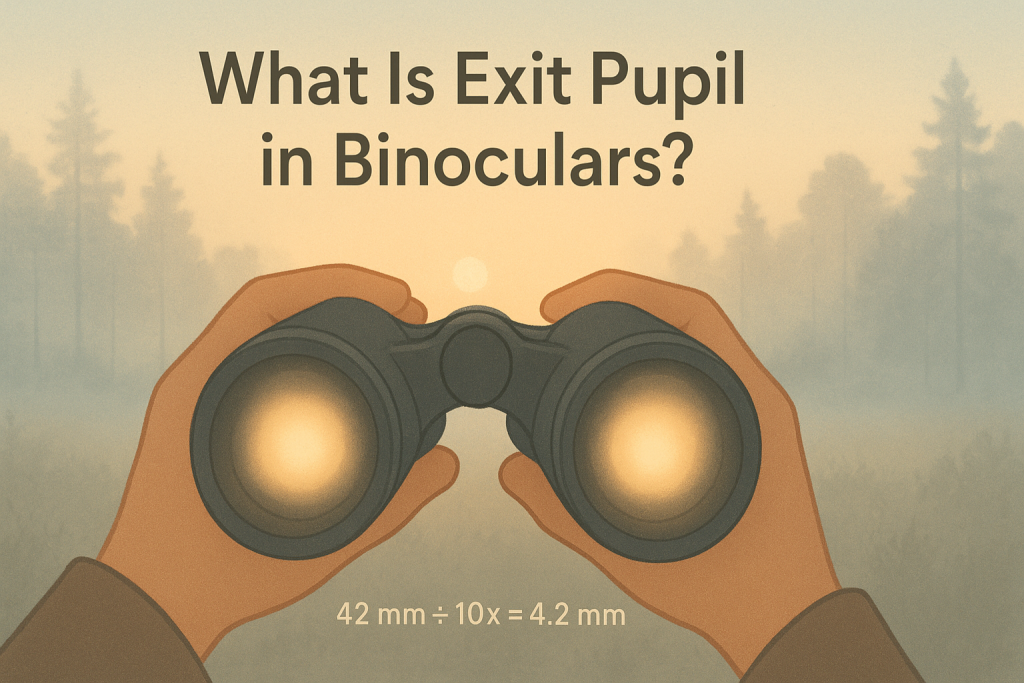
Exit pupil in binoculars is the diameter of the light beam exiting the eyepiece, calculated by dividing objective lens diameter by magnification power (42mm ÷ 10x = 4.2mm exit pupil). This measurement determines image brightness delivered to your eye and directly affects observation capability during dawn and dusk periods when game animals are most active. Understanding exit pupil calculation helps hunters and birders select optimal magnification and objective size combinations for their lighting conditions and observation requirements.
What Is Exit Pupil and Why Does It Matter for Binocular Performance?
Exit pupil represents the focused beam of light that emerges from each eyepiece and enters your eye’s pupil. This light beam diameter must match or exceed your eye’s pupil diameter to deliver maximum brightness and image quality.
Human pupils dilate to 5-7mm in complete darkness, but practical field conditions and age reduce this to 4-6mm for most adult observers. Pupils constrict to 2-3mm in bright sunlight, explaining why exit pupil calculations matter most during low-light observation periods.
Exit pupil calculation uses this simple formula: Objective lens diameter ÷ Magnification = Exit pupil diameter. A 10×42 binocular produces 4.2mm exit pupil (42 ÷ 10 = 4.2), while 8×42 configuration yields 5.25mm exit pupil (42 ÷ 8 = 5.25).
According to optical physics research published in Applied Optics journal, exit pupils larger than your eye’s pupil diameter provide no additional brightness benefit, while smaller exit pupils reduce image brightness proportionally. This principle explains why magnification selection requires matching exit pupil to intended lighting conditions.

How Exit Pupil Affects Image Brightness in Different Lighting
Exit pupil diameter directly controls image brightness reaching your retina. When exit pupil equals or exceeds your eye’s pupil diameter, you receive full light transmission from the optical system.
Dawn and dusk observation benefits from 4-5mm exit pupils matching typical pupil dilation during these critical periods. Midday observation requires only 2-3mm exit pupils as bright conditions constrict pupils naturally.
Professional hunting guide Jake Morrison, with 20 years of Western big game experience, recommends: “Calculate exit pupil for your primary observation times. Early morning elk hunting demands 4mm minimum exit pupil, achieved through 10×42 or 8×32 configurations providing adequate brightness 30 minutes before sunrise.”
Exit Pupil Position and Eye Relief Relationship
Exit pupil position behind the eyepiece determines comfortable viewing distance, known as eye relief. Proper exit pupil alignment with your eye’s pupil ensures full field of view without vignetting.
Eye relief distances of 14-17mm work for most users, while eyeglass wearers require 17-20mm minimum to accommodate glasses thickness. Exit pupil must align precisely with your eye’s pupil regardless of eye relief distance to prevent image darkening.
How to Calculate Exit Pupil for Optimal Low-Light Performance
Exit pupil calculation determines whether binoculars will deliver adequate brightness for your observation requirements. Start with the basic formula, then apply lighting condition requirements to select appropriate specifications.
The fundamental calculation divides objective diameter by magnification: 42mm objective ÷ 10x magnification = 4.2mm exit pupil. This 4.2mm beam must enter your eye’s pupil completely to deliver full brightness potential.
Step-by-Step Exit Pupil Calculation Process
Begin calculation by identifying binocular specifications from the magnification and objective numbers. Standard format shows magnification first, then objective diameter: 10×42, 8×32, 12×50.
Divide the second number (objective diameter in millimeters) by the first number (magnification power). Examples: 10×42 = 42 ÷ 10 = 4.2mm exit pupil, 8×42 = 42 ÷ 8 = 5.25mm exit pupil, 12×50 = 50 ÷ 12 = 4.17mm exit pupil.
Compare calculated exit pupil to your eye’s pupil size in intended lighting conditions. Dawn/dusk hunting requires 4-5mm exit pupil, while midday birding needs only 2-3mm exit pupil for adequate brightness.
Verify calculation accuracy using manufacturer specifications, as some list exit pupil directly in technical data. Quality manufacturers provide precise exit pupil measurements alongside field of view and eye relief specifications.
Matching Exit Pupil to Human Vision Capabilities
Human pupil diameter varies significantly with lighting conditions and age. Maximum dilation reaches 6-7mm in complete darkness for young observers, decreasing to 4-5mm for ages 40-60.

Practical field conditions rarely achieve complete darkness, limiting effective pupil dilation to 4-6mm during dawn and dusk periods. Bright overcast conditions constrict pupils to 3-4mm, while direct sunlight reduces pupils to 2-3mm.
Age-related pupil changes affect exit pupil requirements significantly. Low-light binocular performance for hunters over 40 requires careful exit pupil matching as maximum pupil dilation decreases approximately 1mm per decade after age 30.
| Age Range | Maximum Pupil Dilation | Optimal Exit Pupil | Recommended Configuration |
| 20-30 years | 6-7mm | 5-6mm | 8×42, 10×50 |
| 30-40 years | 5-6mm | 4-5mm | 10×42, 8×32 |
| 40-50 years | 4-5mm | 4mm | 10×42, 12×50 |
| 50+ years | 3-4mm | 3-4mm | 10×32, 8×25 |
Exit Pupil Size Guide: What Works Best for Different Activities
Activity-specific exit pupil requirements vary based on typical lighting conditions, observation duration, and detail requirements. Hunting, birding, and astronomy demand different exit pupil sizes for optimal performance.
Exit pupil selection impacts carrying weight, optical complexity, and price significantly. Larger exit pupils require bigger objectives or lower magnification, increasing size and cost while improving low-light capability.
Hunting Applications: Dawn and Dusk Priority
Hunting success depends on game observation during prime feeding times, typically 30 minutes before sunrise and after sunset. These conditions require 4-5mm exit pupils matching reduced lighting.
Western big game hunting in open country benefits from 10×42 configuration providing 4.2mm exit pupil with sufficient magnification for long-range evaluation. This specification balances brightness needs with detail resolution at 300-600 yard distances.
Eastern whitetail hunting in thick cover prioritizes wider field of view over extreme magnification. Comparing 8×42 versus 10×42 binoculars for hunting applications shows 8×42 configuration delivers 5.25mm exit pupil with 420-foot field of view at 1,000 yards, improving target acquisition speed in dense forest.
Birding Requirements: Close Focus and Color Accuracy
Birding demands accurate color reproduction and close focus capability, typically requiring moderate exit pupils of 3-5mm depending on habitat type. Forest birding benefits from larger exit pupils compensating for canopy shade.
Dawn chorus observation requires 4-5mm exit pupils as many species are most active during low-light periods. Midday observation needs only 2-3mm exit pupils but benefits from ED glass reducing chromatic aberration for accurate plumage color assessment.
Wetland birding often occurs in bright conditions where exit pupil size matters less than magnification stability and close focus performance. Birding-specific comparison of 8×42 and 10×42 configurations examines exit pupil trade-offs alongside field of view and magnification benefits for different birding scenarios.

Astronomy Use: Maximum Light Gathering Priority
Astronomical observation prioritizes maximum light gathering capability, requiring 5-7mm exit pupils matching fully dilated pupils in dark conditions. This demands large objectives or low magnification.
Popular astronomy configurations include 7×50 (7.1mm exit pupil) and 10×50 (5mm exit pupil) providing excellent deep-sky object visibility. Higher magnifications require proportionally larger objectives to maintain adequate exit pupils.
According to research from the International Astronomical Union, exit pupils exceeding 7mm provide no additional benefit as human pupils cannot dilate beyond this diameter. Most astronomical applications optimize around 5-6mm exit pupils balancing brightness with magnification.
Common Exit Pupil Mistakes and How to Avoid Them
Exit pupil miscalculations lead to poor binocular performance and observation disappointment. Understanding common mistakes prevents costly purchasing errors and improves field success.
Many users assume higher magnification always provides better performance without considering exit pupil reduction. Others ignore age-related pupil changes when selecting specifications optimized for younger eyes.
Oversized Exit Pupil Waste
Exit pupils exceeding your eye’s pupil diameter waste optical potential and increase size unnecessarily. A 7×50 binocular producing 7.1mm exit pupil provides no brightness advantage over 10×42 (4.2mm exit pupil) for observers whose pupils dilate to only 5mm maximum.
Oversized exit pupils also increase weight significantly. Each 10mm objective diameter increase adds 6-8 ounces to binocular weight while providing diminishing brightness returns beyond optimal exit pupil matching.
Insufficient Exit Pupil for Conditions
Undersized exit pupils create dim images during intended observation periods. Understanding 10×50 binocular specifications reveals how this configuration’s 5mm exit pupil provides superior dawn performance compared to compact 10×25 models delivering only 2.5mm exit pupil.
High magnification compact binoculars (10×25, 12×25) produce exit pupils too small for effective low-light use. These configurations work only in bright conditions where pupil constriction matches small exit pupils.
Ignoring Age-Related Pupil Changes
Observers over 40 experience significant pupil dilation reduction, making large exit pupils unnecessary. Selecting 8×56 binoculars (7mm exit pupil) for 50-year-old hunters wastes carrying capacity as their 4-5mm maximum pupil dilation cannot utilize full exit pupil diameter.

Age-appropriate exit pupil selection improves portability while maintaining adequate brightness. Mature hunters benefit from 10×42 or 10×32 configurations providing optimal brightness within reasonable size and weight constraints.
Exit Pupil vs Other Binocular Specifications: What Matters Most?
Exit pupil works alongside magnification, field of view, and eye relief to determine overall binocular performance. Understanding specification relationships helps prioritize features for your observation requirements.
Exit pupil calculation directly connects magnification and objective diameter, making these three specifications interdependent. Changing any one parameter affects the others and overall optical performance.
Exit Pupil and Magnification Balance
Higher magnification reduces exit pupil proportionally with fixed objective diameter. Increasing from 8×42 (5.25mm exit pupil) to 12×42 (3.5mm exit pupil) sacrifices low-light brightness for detail resolution.
Magnification selection requires balancing exit pupil needs against hand-shake tolerance and field of view requirements. Comprehensive comparison of 8×42 and 10×42 specifications analyzes exit pupil trade-offs alongside practical field performance factors.
Exit Pupil Relationship to Twilight Factor
Exit pupil measures brightness delivery efficiency, while twilight factor indicates theoretical low-light resolution capability. These metrics evaluate different aspects of low-light performance.
Twilight factor calculation and field application explains how this specification complements exit pupil analysis for complete low-light assessment. Both measurements help predict dawn and dusk observation success.
Twilight factor increases with magnification and objective diameter (√magnification × objective), while exit pupil decreases with higher magnification. Optimal specifications balance both metrics for intended lighting conditions.
Exit Pupil vs Relative Brightness Comparison
Relative brightness (exit pupil squared) provides another brightness measurement perspective. A 4.2mm exit pupil produces 17.64 relative brightness (4.2² = 17.64), while 5mm exit pupil yields 25 relative brightness.
Relative brightness calculation and practical application shows how this specification relates to exit pupil measurements and field brightness perception. Both metrics evaluate light-gathering capability from different mathematical approaches.

Measuring and Testing Exit Pupil Performance
Field testing exit pupil effectiveness requires controlled conditions and systematic observation protocols. Testing validates calculated specifications against real-world brightness performance.
Exit pupil testing involves comparing image brightness across different configurations during identical lighting conditions. Professional testing measures light transmission percentages and exit pupil diameter accuracy.
Visual Exit Pupil Inspection Method
Hold binoculars 12-15 inches from your face and observe the bright circles visible in each eyepiece. These circles represent exit pupils and should appear perfectly round and evenly illuminated.
Measure exit pupil diameter using a ruler placed against the eyepiece housing. Quality binoculars produce exit pupils matching calculated dimensions within 0.1-0.2mm tolerance.
Exit pupil position should remain stable during focus adjustment and eyepiece rotation. Shifting exit pupils indicate optical alignment issues or inferior construction quality affecting viewing comfort.
Comparative Brightness Testing Protocol
Test exit pupil effectiveness by comparing identical subjects during consistent lighting conditions. Dawn testing 30 minutes before sunrise provides optimal conditions for evaluating low-light performance differences.
Document brightness perception differences between configurations with measured exit pupil variations. A 10×42 (4.2mm exit pupil) should appear noticeably dimmer than 8×42 (5.25mm exit pupil) during dawn conditions when your pupils dilate to 5mm.
Professional optical testing labs measure light transmission percentages confirming theoretical exit pupil calculations. Complete binocular specification testing methodology details measurement protocols and performance verification procedures.
Advanced Exit Pupil Considerations for Serious Users
Advanced users consider exit pupil stability, position tolerance, and optical system efficiency beyond basic diameter calculations. These factors affect viewing comfort and performance consistency.
Premium binoculars maintain exit pupil quality through superior optical design, precise manufacturing tolerances, and advanced lens coatings maximizing light transmission efficiency.
Exit Pupil Quality and Optical Design
Exit pupil quality depends on optical system design and component precision. Roof prism binoculars require phase correction coatings to maintain exit pupil sharpness and contrast.
BAK4 versus BAK7 prism glass comparison reveals how prism material affects exit pupil quality and edge sharpness. BAK4 prisms produce round, sharp exit pupils while BAK7 creates square-edged pupils with reduced brightness.
Exit Pupil Position Tolerance
Exit pupil position affects viewing comfort and field of view access. Precise exit pupil positioning allows comfortable viewing with consistent brightness across the entire field.
Eye relief distance determines exit pupil position behind eyepieces. Longer eye relief moves exit pupils farther back, requiring precise eye positioning for optimal viewing. Complete 8×42 binocular specification explanation covers exit pupil positioning alongside other critical optical parameters.
Budget Considerations: Exit Pupil Value Analysis
Exit pupil optimization affects binocular pricing significantly. Larger objectives and complex optical designs increase manufacturing costs but provide superior low-light capability.
Budget allocation should prioritize exit pupil requirements for your primary observation conditions. Dawn hunters need adequate exit pupil more than premium coatings, while midday users can accept smaller exit pupils for other features.
| Price Range | Exit Pupil Quality | Typical Configurations | Performance Expectations |
| $200-400 | Adequate | 8×42, 10×42 | Basic exit pupil accuracy |
| $400-800 | Good | 8×42, 10×42, 10×50 | Consistent exit pupil quality |
| $800-1500 | Excellent | All configurations | Premium exit pupil performance |
| $1500+ | Superior | All configurations | Perfect exit pupil optimization |
Entry-Level Exit Pupil Performance
Budget binoculars under $300 provide adequate exit pupil diameter but may compromise quality through inferior prism materials and basic coatings. Exit pupil calculation remains accurate, but light transmission efficiency suffers.
Entry-level models achieve specified exit pupil dimensions while delivering 80-85% light transmission compared to 90-95% for premium models. This difference becomes noticeable during challenging lighting conditions.
Premium Exit Pupil Optimization
Premium binoculars above $800 optimize exit pupil quality through superior optical design, precision manufacturing, and advanced coatings. These models maintain exit pupil performance across temperature ranges and extended use.
High-end models provide exit pupil stability, position accuracy, and maximum light transmission efficiency. Investment in premium optics pays dividends through improved low-light capability and viewing comfort during extended observation sessions.
Frequently Asked Questions About Exit Pupil in Binoculars
What is the ideal exit pupil size for hunting binoculars?
The ideal exit pupil for hunting ranges from 4-5mm, achieved through 10×42 or 8×42 configurations providing optimal dawn and dusk brightness. This size matches typical human pupil dilation during low-light periods when most game animals are active.
Dawn hunting requires larger exit pupils (4-5mm) for adequate image brightness 30 minutes before sunrise, while midday hunting can utilize smaller exit pupils (3-4mm) without brightness sacrifice. Most hunting occurs during twilight periods, making 4mm+ exit pupils essential for success.
How do I calculate exit pupil for my binoculars?
Calculate exit pupil by dividing objective lens diameter by magnification power using this formula: Objective diameter ÷ Magnification = Exit pupil diameter. For example, 10×42 binoculars produce 4.2mm exit pupil (42 ÷ 10 = 4.2).
This calculation works for any binocular configuration: 8×32 = 4mm exit pupil, 12×50 = 4.17mm exit pupil, 7×50 = 7.1mm exit pupil. Verify your calculation against manufacturer specifications listed in technical data sheets.
Does a larger exit pupil always mean brighter images?
Larger exit pupils provide brighter images only if they match or slightly exceed your eye’s pupil diameter in the intended lighting conditions. Exit pupils larger than your pupil provide no additional brightness benefit.
Human pupils dilate to maximum 5-7mm in darkness (decreasing with age), so exit pupils above 6-7mm waste optical potential without improving brightness. Match exit pupil size to your pupil dilation for optimal performance.
Why does exit pupil matter more than magnification for low-light viewing?
Exit pupil determines actual light delivery to your eye, while magnification only enlarges the image without adding brightness. Higher magnification reduces exit pupil size with fixed objective diameter, potentially creating dimmer images.
Low-light success depends on adequate brightness reaching your retina, controlled by exit pupil diameter matching your pupil size. Magnification becomes secondary when insufficient light prevents clear observation regardless of image enlargement.
What exit pupil size works best for eyeglass wearers?
Eyeglass wearers benefit from 4-5mm exit pupils positioned 17-20mm behind eyepieces, providing adequate brightness with sufficient eye relief for comfortable viewing. Smaller exit pupils may appear dim, while larger ones require precise eye positioning.
Long eye relief designs maintain exit pupil effectiveness despite increased distance from eyepieces. Quality manufacturers optimize exit pupil position for eyeglass compatibility without sacrificing brightness delivery.
How does age affect optimal exit pupil requirements?
Age reduces maximum pupil dilation significantly, decreasing optimal exit pupil requirements by approximately 1mm per decade after age 30. Observers over 50 rarely benefit from exit pupils exceeding 4-5mm.
Younger observers (20-30 years) can utilize 5-6mm exit pupils effectively, while mature users (50+ years) achieve optimal brightness with 3-4mm exit pupils, allowing selection of more compact, lightweight configurations without brightness sacrifice.
Can exit pupil size compensate for poor lens coatings?
Exit pupil size cannot compensate for poor light transmission caused by inferior lens coatings. Large exit pupils deliver more available light to your eye, but inadequate coatings reduce total light transmission regardless of exit pupil diameter.
Quality fully multi-coated lenses achieve 90-95% light transmission, while basic coatings provide only 75-85% transmission. Large exit pupils with poor coatings may still appear dimmer than smaller exit pupils with superior coatings delivering higher light transmission efficiency.
What happens if exit pupil is too small for my needs?
Insufficient exit pupil diameter creates dim images that appear darker than surrounding environment, reducing observation effectiveness during dawn and dusk periods. Small exit pupils limit light delivery regardless of ambient light availability.
Common symptoms include difficulty identifying details during twilight periods, eye strain from struggling to see adequately, and reduced observation success compared to naked-eye visibility. Upgrading to larger exit pupil configuration typically resolves these brightness limitations.
How do compact binoculars affect exit pupil performance?
Compact binoculars typically use smaller objective lenses, resulting in reduced exit pupil diameter and dimmer low-light performance. Most compact models (8×25, 10×25) produce 2.5-3.1mm exit pupils suitable only for bright conditions.
Mid-size compact models (8×32, 10×32) offer better exit pupil compromise with 3.2-4mm diameters providing adequate brightness for many applications while maintaining portability advantages. Full-size objectives remain necessary for optimal low-light capability.
Should I prioritize exit pupil or field of view for birding?
Birding applications require balancing exit pupil for adequate brightness with field of view for target acquisition speed. Forest birding prioritizes exit pupil (4-5mm) for canopy shade, while open field birding benefits from wider field of view.
Most birding scenarios achieve optimal performance through 8×42 configuration providing 5.25mm exit pupil with approximately 420-foot field of view at 1,000 yards. This specification balances brightness needs with target tracking capability for varied birding environments.
How do I test exit pupil quality in the field?
Test exit pupil effectiveness by comparing image brightness during consistent dawn or dusk lighting conditions. Hold binoculars at arm’s length and observe the bright circles in each eyepiece, which should appear perfectly round and evenly illuminated.
Field testing involves comparing brightness perception between different binocular configurations during identical lighting conditions. Document any brightness differences, exit pupil shape irregularities, or viewing comfort issues affecting observation performance during extended use sessions.
What exit pupil works best for astronomy observations?
Astronomy applications benefit from 5-7mm exit pupils matching maximum pupil dilation in dark conditions. Popular configurations include 7×50 (7.1mm exit pupil) and 10×50 (5mm exit pupil) providing excellent deep-sky object visibility.
Exit pupils exceeding 7mm provide no additional benefit as human pupils cannot dilate beyond this diameter. Most astronomical binoculars optimize around 5-6mm exit pupils balancing maximum light gathering with practical magnification for star field observation.
Does exit pupil affect hand-shake visibility at high magnifications?
Exit pupil diameter does not directly affect hand-shake magnification, but larger exit pupils often accompany lower magnification configurations that amplify movement less. Hand-shake tolerance depends primarily on magnification power rather than exit pupil size.
However, adequate exit pupil brightness allows easier tracking of moving images caused by hand shake, improving overall viewing stability perception. Dimmer images from insufficient exit pupil make hand-shake effects more noticeable and distracting during observation.
How does temperature affect exit pupil performance?
Temperature changes can affect exit pupil position and quality in lower-grade binoculars through thermal expansion of optical components. Quality binoculars maintain exit pupil stability across temperature ranges through precision manufacturing tolerances.
Extreme temperature variations may cause slight exit pupil position shifts in budget models, requiring refocusing or eye position adjustment. Premium binoculars incorporate thermal compensation designs maintaining consistent exit pupil performance regardless of environmental conditions.
Can I improve exit pupil performance through accessories or modifications?
Exit pupil diameter cannot be modified as it results from fixed optical geometry (objective diameter ÷ magnification). However, proper lens cleaning maintains maximum light transmission efficiency through clean optical surfaces.
Exit pupil quality depends on internal optical design and cannot be improved through external accessories. Focus on selecting appropriate exit pupil size during initial binocular selection rather than attempting post-purchase modifications or enhancements.
Understanding exit pupil calculation and application helps hunters, birders, and outdoor enthusiasts select optimal binocular configurations for their observation requirements and lighting conditions. Calculate exit pupil by dividing objective diameter by magnification, then match this diameter to your eye’s pupil size during intended use periods for maximum brightness and observation success. Test several configurations in actual field conditions during dawn and dusk periods to verify exit pupil performance before committing to purchase, ensuring your selected binoculars deliver adequate brightness for confident target identification and extended viewing comfort.