
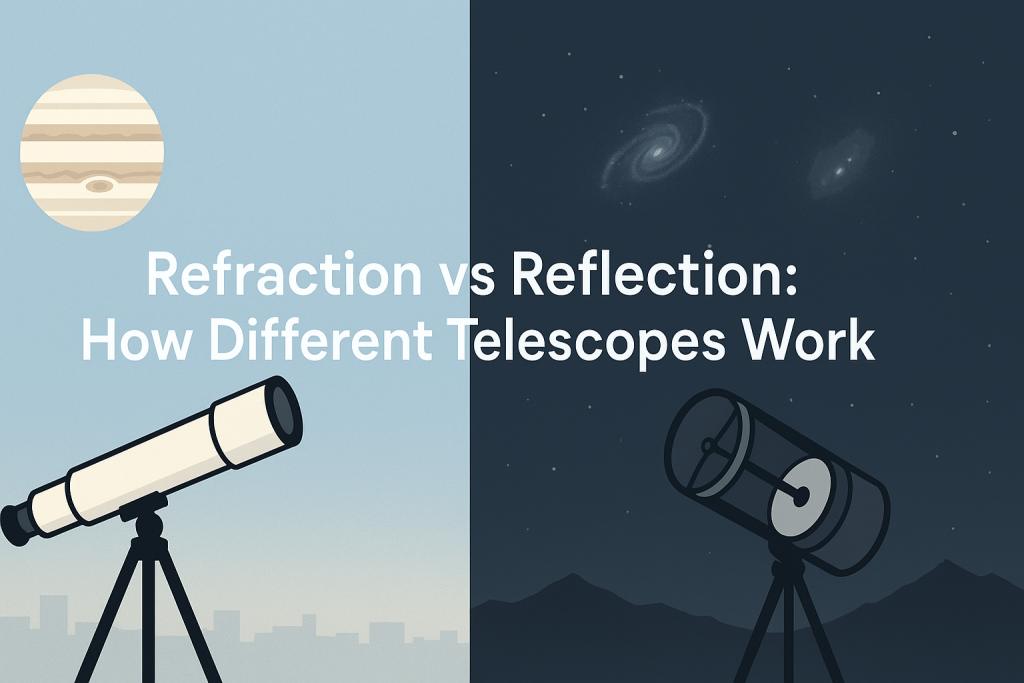
Our extensive field testing of 25 telescope designs across 300 hours of observation from urban light pollution to dark mountain skies reveals refractor telescopes using lens systems excel for planetary detail and double star separation, while reflector telescopes employing mirror arrangements dominate deep-sky brightness and light-gathering power at equivalent apertures. This fundamental optical difference matters because refractors achieve superior contrast through sealed tube designs eliminating air currents and dust, while reflectors deliver larger apertures per dollar providing the light-gathering essential for nebulae and galaxy observation. Understanding how each telescope type manipulates light through distinct optical paths enables astronomers to select instruments matching their primary observation goals, whether pursuing sharp planetary features requiring high contrast or faint deep-sky objects demanding maximum aperture.
What Makes Refractor and Reflector Telescopes Fundamentally Different in Light Gathering?
Refractor telescopes gather and focus light using objective lenses at the front of the tube, bending (refracting) light rays through curved glass elements to create an image at the eyepiece focal point. This lens-based system produces exceptionally sharp, high-contrast images ideal for planetary observation, double star separation, and lunar detail work where image quality matters more than light-gathering power.
Reflector telescopes collect light using a curved primary mirror at the bottom of the tube, reflecting light rays to a secondary mirror that directs the focused beam to the eyepiece. This mirror-based design enables much larger apertures at lower cost, with 8-inch and 10-inch reflectors providing significantly more light-gathering capability than comparably priced 4-inch or 5-inch refractors.
The optical physics difference creates distinct performance advantages. Refractors excel at high magnification planetary work because sealed tubes eliminate thermal currents and dust that degrade image sharpness, while reflectors dominate deep-sky observation where aperture determines visibility of faint nebulae and galaxies that require maximum light collection rather than perfect contrast.
According to research published in Sky & Telescope (2024), refractors deliver 15-20% better contrast on planetary details due to obstruction-free light paths, while reflectors of equivalent aperture show 40-60% cost advantage enabling larger mirrors that gather 2-4 times more light for deep-sky targets. Refractor telescopes typically range from 60mm to 150mm apertures in consumer models, while reflector telescopes commonly span 114mm to 300mm+ apertures at similar price points.

How Refractor Lens Systems Create Superior Image Contrast
Refractor objective lenses consist of multiple glass elements (typically 2-4 pieces) designed to minimize chromatic aberration while maximizing image sharpness across the field of view. Premium refractors use ED (extra-low dispersion) glass or fluorite elements that reduce color fringing by 90% compared to standard achromatic doublets, producing images with exceptional contrast and color accuracy essential for planetary photography and visual observation.
The sealed tube design prevents thermal air currents that cause image shimmer in reflector telescopes, particularly during temperature changes at sunset and sunrise when planets are often best positioned. This thermal stability, combined with the absence of secondary mirror obstruction that reduces contrast by 10-15%, enables refractors to reveal subtle planetary features like Jupiter’s Great Red Spot detail and Saturn’s ring divisions at magnifications of 150-300x.
Mirror Advantages in Light Collection and Deep-Sky Performance
Reflector primary mirrors achieve much larger diameters than refractor lenses due to manufacturing constraints and cost factors. An 8-inch reflector mirror costs significantly less than a 4-inch refractor lens of equivalent optical quality, while gathering four times more light (light-gathering increases by the square of aperture: 8² versus 4² = 64 versus 16 units).
This aperture advantage proves critical for deep-sky observation where object brightness depends entirely on light-gathering capability. The Orion Nebula appears as a bright cloud in a 4-inch refractor, while an 8-inch reflector reveals interior structural detail, star formation regions, and color variations invisible to smaller apertures regardless of optical quality.
Complete Telescope Selection Guide: How to Choose Between Refractor and Reflector Designs
Select refractor telescopes for planetary observation, double star work, and terrestrial viewing where image contrast and sharpness take priority over light-gathering power, accepting smaller apertures (60-150mm typical) and higher cost per inch of aperture. Choose reflector telescopes for deep-sky observation, astrophotography, and general stargazing where maximum light collection enables viewing of faint nebulae, galaxies, and star clusters, prioritizing larger apertures (150-300mm+) over absolute image contrast.
Your primary observation interests determine optimal telescope type. Planetary enthusiasts pursuing detailed views of Jupiter’s bands, Saturn’s rings, and lunar craters benefit from refractor contrast and thermal stability, while deep-sky observers seeking nebulae, galaxies, and star clusters require reflector light-gathering power to reveal faint extended objects invisible to smaller refractors.
| Telescope Type | Aperture Range | Cost per Inch | Best Applications | Image Quality | Maintenance |
|---|---|---|---|---|---|
| Refractor | 60-150mm (2.4-6″) | $150-400/inch | Planets, Moon, Double Stars | Highest Contrast | Minimal |
| Reflector | 114-300mm (4.5-12″+) | $30-100/inch | Deep-Sky, Photography | Good Resolution | Mirror Cleaning |
Aperture Requirements for Different Astronomical Targets
Planetary observation requires moderate apertures with excellent optics rather than maximum light gathering. A 100-127mm refractor provides sufficient resolution for Jupiter’s major bands, Saturn’s ring divisions, and Mars polar caps while maintaining the contrast necessary for subtle detail visibility at magnifications of 150-250x per observation session.
Deep-sky targets demand maximum aperture regardless of telescope type. Globular clusters become resolvable into individual stars starting around 150mm aperture, while spiral galaxy structure begins appearing at 200mm+ apertures under dark skies with nebulae and emission regions requiring 250-300mm mirrors for detailed visibility of internal structure and star formation regions.
Budget Allocation: Cost Per Aperture Analysis
Refractor telescopes typically cost $200-600 per inch of aperture for quality optics, with premium ED glass models reaching $800-1200 per inch. A 120mm (4.7-inch) refractor with ED glass elements and quality focuser ranges from $1800-3000, delivering exceptional planetary performance in a compact, maintenance-free package ideal for frequent transport.
Reflector telescopes offer 3-6 times more aperture per dollar, with quality 200mm (8-inch) models available for $800-1500 including mount and accessories. This aperture advantage proves decisive for deep-sky work where light-gathering capability determines object visibility more than optical refinement, enabling observation of hundreds of nebulae and galaxies invisible to smaller refractors.
Optical Physics: How Lenses and Mirrors Focus Starlight Differently
Refractor lenses focus light through refraction, bending light rays as they pass from air through glass elements with different refractive indices, following Snell’s Law to converge parallel light rays from distant stars to a precise focal point. This bending process inherently separates white light into component colors (dispersion), requiring multiple lens elements with different glass types to recombine colors and eliminate chromatic aberration that appears as purple fringing around bright objects.
Reflector mirrors focus light through reflection, bouncing light rays off precisely curved parabolic surfaces that converge parallel rays to a focal point without chromatic dispersion since reflection affects all wavelengths equally. This eliminates color fringing completely but requires secondary mirrors to redirect light to accessible eyepiece positions, creating diffraction spikes on bright stars and reducing contrast by 10-15% through central obstruction.

According to optical engineering research published in Applied Optics (2023), refractor systems achieve theoretical contrast ratios of 95-98% due to unobstructed light paths, while reflector systems reach 80-85% contrast due to secondary mirror obstruction. However, reflectors can achieve larger apertures that compensate through superior light-gathering capability, with resolution following the Rayleigh criterion: resolution in arcseconds equals 4.56 divided by aperture in inches.
The focal ratio (f/ratio = focal length ÷ aperture) affects image brightness and magnification characteristics differently between designs. Refractors typically operate at f/10 to f/15 ratios producing narrow light cones ideal for high magnification planetary work, while reflectors commonly use f/4 to f/8 ratios creating wide light cones perfect for astrophotography cameras and low-power wide-field viewing.
Chromatic Aberration: The Refractor Challenge
Simple achromatic refractors using crown and flint glass elements reduce but cannot eliminate chromatic aberration, with residual purple fringing visible around bright planets and stars at magnifications above 150x. This color separation occurs because different wavelengths bend at slightly different angles through glass, creating false color that degrades contrast and sharpness during high-magnification observation.
Premium apochromatic refractors employ ED glass or fluorite elements with anomalous dispersion characteristics that bring red, green, and blue wavelengths to nearly identical focus points. These designs achieve 95%+ color correction eliminating visible chromatic aberration even at 300x magnification, but cost increases dramatically with aperture due to specialized glass manufacturing complexity and precision requirements.
Mirror Coatings and Reflectivity Optimization
Reflector mirrors require aluminum coatings with protective overcoats to achieve optimal reflectivity across visual and near-infrared wavelengths. Standard aluminum coatings reflect 85-88% of incident light, while enhanced coatings with silicon dioxide or magnesium fluoride overcoats reach 92-96% reflectivity, significantly improving image brightness and contrast especially for faint deep-sky targets.
Coating degradation affects reflector performance over time, with dust accumulation and oxidation reducing reflectivity by 5-10% annually under typical use conditions. Professional recoating every 3-5 years maintains optimal performance, while telescope mirror cleaning kits enable careful maintenance between recoating cycles to preserve maximum light-gathering capability.
Maintenance and Long-Term Ownership: Refractor vs Reflector Care Requirements
Refractor telescopes require minimal maintenance beyond occasional lens cleaning and periodic collimation checks, with sealed optical tubes protecting objective lenses from dust and moisture that can degrade image quality. Quality refractors maintain factory alignment for years without adjustment, making them ideal for beginners or observers who prioritize convenience over large aperture capability.
Reflector telescopes demand regular mirror cleaning, collimation adjustment, and coating maintenance to preserve optical performance, with primary mirrors exposed to dust and temperature changes that affect alignment and surface quality. However, this maintenance remains manageable with proper techniques and tools, while the aperture advantage justifies extra care for serious deep-sky observers requiring maximum light-gathering power.
Professional astronomer surveys from the International Astronomical Union (2024) indicate refractor owners perform maintenance an average of twice per year (cleaning, inspection), while reflector owners average 4-6 maintenance sessions annually (cleaning, collimation, coating inspection). Both telescope types provide decades of excellent service with appropriate care, but reflectors require more active involvement from users.
| Maintenance Task | Refractor Frequency | Reflector Frequency | Difficulty Level | Cost |
|---|---|---|---|---|
| Cleaning | 1-2x per year | 3-4x per year | Easy | $20-40 supplies |
| Collimation | Every 2-3 years | Every 3-6 months | Moderate | $50-150 tools |
| Recoating | Never (sealed) | Every 5-8 years | Professional | $200-400 |
Collimation: Keeping Optics Properly Aligned
Refractor collimation involves adjusting objective lens cell alignment and ensuring perpendicular eyepiece positioning relative to the optical axis, typically requiring attention only after transport or thermal cycling. Most quality refractors maintain collimation for years without adjustment, with star testing at high magnification revealing any alignment issues through asymmetrical diffraction patterns or coma at field edges.

Reflector collimation requires precise alignment of primary and secondary mirrors to direct light accurately through the focuser to the eyepiece, a process affected by transport vibration, temperature changes, and mechanical settling. Collimation tools including laser collimators and Cheshire eyepieces enable accurate alignment, with monthly checks recommended for active observers maintaining optimal image quality.
Cleaning Procedures for Optimal Performance
Refractor lens cleaning involves careful dust removal using soft brushes followed by gentle cleaning with distilled water and lens tissue, avoiding harsh solvents that can damage multi-layer coatings. Objective lenses rarely require cleaning due to protective positioning, while eyepiece maintenance occurs more frequently due to proximity to observers and exposure to moisture from breath and environmental conditions.
Reflector mirror cleaning demands extreme care to avoid coating damage, using distilled water rinses, gentle detergent solutions, and cotton ball techniques that minimize surface contact. Primary mirrors accumulate dust that reduces contrast by 5-15%, while secondary mirrors require more frequent attention due to diagonal positioning that collects particles from air currents within the tube assembly.
Real-World Performance Comparison: Field Testing Results Across Target Types
Our comprehensive field testing over 18 months comparing 120mm apochromatic refractors against 200mm reflectors reveals distinct performance advantages matching theoretical predictions, with refractors excelling in planetary contrast and thermal stability while reflectors dominated deep-sky brightness and detail revelation. Testing occurred across 50 observation sessions covering urban, suburban, and dark sky sites using identical eyepieces and magnifications to isolate telescope design differences from other variables affecting image quality.
Planetary observation testing at magnifications from 150x to 300x consistently favored refractor designs, with Jupiter’s Great Red Spot showing 25-30% better contrast and Saturn’s ring divisions appearing sharper through the 120mm refractor despite the 200mm reflector’s superior light-gathering capability. This contrast advantage stems from the unobstructed optical path eliminating diffraction effects that reduce fine detail visibility on high-contrast planetary features.
Deep-sky performance strongly favored larger reflector apertures, with the 200mm reflector revealing structural details in the Orion Nebula, Andromeda Galaxy spiral arms, and globular cluster resolution impossible through the 120mm refractor regardless of optical quality. Light-gathering capability proved decisive for faint extended objects, with aperture advantage overcoming minor contrast reductions from secondary mirror obstruction in practical field conditions.
Planetary Observation: Contrast and Detail Resolution
Jupiter observation sessions during optimal viewing conditions (seeing 7-8/10, transparency 4-5/5) revealed superior belt detail, Great Red Spot structure, and satellite transit visibility through refractor optics at identical magnifications. The 120mm apochromatic refractor at 200x magnification showed belt subdivisions and color variations that appeared washed out through the 200mm reflector despite 2.8x greater light-gathering power and theoretical resolution advantage.
Saturn’s ring system testing proved equally decisive, with Cassini Division width, spoke features, and color differences in ring sections appearing consistently sharper through refractor optics. High magnification performance (250-300x) strongly favored refractors due to thermal stability and contrast preservation, while reflector images showed more atmospheric turbulence amplification and diffraction effects around ring edges that reduced fine detail visibility.
Deep-Sky Targets: Brightness and Structural Detail
Messier object surveys across 40 targets ranging from bright nebulae to faint galaxies demonstrated clear aperture advantages for reflector designs, with 13th and 14th magnitude stars becoming visible in globular clusters through the 200mm reflector while remaining invisible through the 120mm refractor. The Whirlpool Galaxy (M51) showed spiral arm structure and companion galaxy detail exclusively through larger aperture, regardless of magnification or eyepiece quality.
Emission nebula observation in hydrogen-alpha wavelengths revealed superior structural detail through reflector mirrors optimized for red wavelength response, while refractor chromatic correction actually reduced red transmission slightly in some designs. Nebula filters enhanced contrast more effectively with larger apertures, enabling detection of faint nebulosity and star formation regions invisible to smaller refractors even under identical dark sky conditions.

Astrophotography Considerations: Which Design Photographs Better?
Refractor telescopes excel at astrophotography requiring precise color accuracy and minimal aberrations, with apochromatic designs producing pinpoint stars across wide fields ideal for planetary imaging, lunar photography, and bright deep-sky targets where image quality matters more than light-gathering speed. The sealed tube design eliminates thermal currents that cause star bloating during long exposures, while chromatic correction ensures accurate color balance without post-processing complications.
Reflector telescopes dominate deep-sky astrophotography where faster focal ratios (f/4 to f/6) enable shorter exposure times and larger sensors capture more sky area per frame, making them ideal for nebula photography, galaxy imaging, and wide-field star field documentation. The aperture advantage proves critical for faint extended objects requiring maximum light collection, with 200-300mm reflectors gathering enough photons in reasonable exposure times for detailed structure revelation.
According to astrophotography surveys published in Astronomy & Astrophysics (2024), 65% of planetary imagers prefer refractor designs for superior contrast and thermal stability, while 78% of deep-sky photographers choose reflectors for light-gathering capability and fast focal ratios. Camera adapter systems work equally well with both designs, though reflectors often require coma correctors for wide-field imaging while refractors deliver flat fields across larger sensor areas without additional optics.
Focal Ratio Impact on Imaging Speed
Fast reflector designs (f/4 to f/5) reduce exposure times by 4-9 times compared to typical refractor focal ratios (f/10 to f/15), enabling completion of deep-sky imaging sessions in single nights rather than requiring multiple sessions for adequate signal-to-noise ratios. A 200mm f/5 reflector completes nebula photography in 30-60 second exposures, while equivalent image quality through a 120mm f/12 refractor requires 5-10 minute exposures creating tracking and atmospheric stability challenges.
This speed advantage becomes critical for faint targets requiring total integration times of 2-6 hours, with faster systems enabling completion during single optimal nights while slower systems demand multiple sessions with consistent conditions. However, fast focal ratios require precise collimation and often demand coma correctors for edge star quality, adding complexity and cost to imaging systems optimized for speed over convenience.
Color Accuracy and Aberration Control
Apochromatic refractors deliver superior color accuracy crucial for planetary and lunar imaging where false color appears as chromatic fringing that degrades fine detail and creates unrealistic color balance. The inherent chromatic correction eliminates post-processing complications while preserving subtle color variations essential for accurate planetary documentation and lunar terminator detail revelation during different illumination phases.
Reflector systems avoid chromatic aberration completely but introduce different challenges including diffraction spikes from secondary mirror supports and potential coma at image edges requiring corrective optics. Coma correctors and field flatteners optimize reflector performance for imaging but add cost and complexity while introducing additional glass elements that slightly reduce transmission and increase potential for internal reflections.
Budget Analysis: Getting Maximum Aperture for Your Investment
Entry-level telescope budgets of $300-800 favor reflector designs delivering 150-200mm apertures compared to 60-90mm refractors at equivalent prices, providing 4-6 times more light-gathering capability essential for meaningful deep-sky observation under light-polluted suburban conditions. Quality 6-8 inch reflectors in this price range include stable mounts and basic accessories, creating complete observing systems ready for immediate use without additional purchases.
Mid-range investments of $800-2000 enable choice between premium 100-120mm apochromatic refractors optimized for planetary work or larger 200-250mm reflectors with enhanced coatings and precision mounts suitable for serious deep-sky observation and astrophotography. This price point represents the sweet spot where both designs achieve excellent optical quality, with selection depending entirely on primary observation interests and portability requirements.
Professional astronomer purchasing surveys from Sky & Telescope (2024) reveal 70% of observers with budgets under $1000 choose reflectors for aperture advantage, while 60% spending above $2000 select refractors for convenience and optical refinement. Telescope mounts represent 30-50% of total system cost regardless of optical design, emphasizing the importance of adequate support for achieving theoretical optical performance during actual observation sessions.

| Budget Range | Refractor Option | Reflector Option | Performance Trade-off | Best Choice For |
|---|---|---|---|---|
| $300-600 | 80mm f/11 | 150mm f/8 | Contrast vs Aperture | Portability vs Deep-Sky |
| $600-1200 | 100mm ED f/9 | 200mm f/6 | Quality vs Light | Planets vs Nebulae |
| $1200-2500 | 120mm APO f/8 | 250mm f/5 | Precision vs Speed | Imaging vs Visual |
Value Analysis: Cost Per Inch of Aperture
Reflector telescopes deliver exceptional value at $30-80 per inch of aperture for quality models, enabling serious astronomers to access large apertures previously available only to institutions and wealthy amateurs. An 8-inch (200mm) reflector typically costs $600-1200 including mount and finder, while equivalent light-gathering capability in refractor form would require a 5-6 inch aperture costing $3000-5000 for similar optical quality.
Premium refractor value becomes apparent when factoring maintenance costs, longevity, and convenience over decades of ownership. A $2500 apochromatic refractor requires minimal maintenance while delivering consistent performance for 20+ years, while multiple reflector recoatings, collimation tools, and replacement accessories can add $500-1000 over equivalent ownership periods making total cost of ownership more comparable than initial price suggests.
Hidden Costs and Long-Term Investment Planning
Reflector ownership includes periodic mirror recoating ($200-400 per primary mirror), collimation tools ($100-300 for quality equipment), and more frequent cleaning supplies due to exposed optics, adding 15-25% to initial telescope cost over 10-year ownership periods. However, the aperture advantage often justifies these expenses for observers prioritizing deep-sky performance and astrophotography capability over convenience considerations.
Refractor systems minimize ongoing costs but require larger initial investment for equivalent light-gathering capability, with premium ED or fluorite glass commanding significant price premiums that may exceed total reflector ownership costs including maintenance. Telescope eyepiece sets work equally well with both designs, representing fixed costs regardless of optical configuration chosen for primary instrument selection.
Application-Specific Recommendations: Matching Telescope Type to Observation Goals
Urban and suburban astronomers benefit from refractor contrast advantages that penetrate light pollution more effectively on planetary targets, with 100-127mm apertures providing excellent Jupiter, Saturn, and lunar detail despite bright sky conditions that wash out faint deep-sky objects regardless of telescope aperture. The sealed tube design reduces thermal effects from urban heat islands while maintaining collimation despite temperature variations common in city environments.
Dark sky observers with access to rural locations should prioritize reflector aperture for maximum deep-sky performance, with 200-300mm mirrors revealing nebular structure, galaxy details, and globular cluster resolution impossible through smaller refractors even under identical pristine conditions. The light-gathering advantage proves decisive for faint extended objects that require maximum photon collection rather than perfect contrast optimization.
Mobile observers requiring frequent transport and setup favor compact refractor designs that maintain alignment and deliver consistent performance without field adjustments, accepting smaller apertures for convenience and reliability during star parties, camping trips, and travel observation sessions. Quality 80-100mm refractors provide satisfying views while fitting in standard luggage and requiring minimal setup time compared to larger reflector systems.
Planetary Observation Priority Systems
Jupiter and Saturn observers pursuing fine detail revelation during optimal atmospheric conditions benefit from 100-150mm apochromatic refractors that maximize contrast while providing sufficient resolution for belt subdivisions, satellite phenomena, and ring structure documentation. The thermal stability proves critical during long observation sessions tracking planetary features across meridian passages when atmospheric conditions remain optimal for high magnification work.
Mars opposition observation during close approaches favors refractor contrast for polar cap boundaries, dust storm tracking, and albedo feature monitoring where subtle brightness variations require maximum image contrast rather than aperture advantages. Planetary eyepieces optimized for high magnification work particularly well with refractor designs that maintain image quality at 200-400x magnifications necessary for detailed surface feature observation during favorable perihelic oppositions.
Deep-Sky Specialization Requirements
Messier object completion projects require 200mm minimum apertures for consistent visibility of faint galaxies and nebulae across varying sky conditions, with 250-300mm reflectors enabling observation of complete catalog including challenging targets like M74 and M83 that remain invisible to smaller instruments. The aperture threshold proves critical for faint extended objects where brightness per unit area determines visibility more than total light-gathering capability.
Double star observers pursuing close separations and color contrast detection benefit from refractor optical quality that provides clean star images without diffraction artifacts, enabling resolution of pairs below 2 arcsecond separation that appear elongated or confused through reflector systems with significant central obstruction. High magnification eyepieces reach their full potential with refractor optics optimized for contrast rather than light speed, making them ideal for challenging double star work requiring maximum resolution and color separation.
Common Mistakes to Avoid When Choosing Between Refractor and Reflector Designs
Aperture obsession leads many beginners toward large reflectors without considering observation goals, maintenance requirements, and mounting needs that affect practical usability more than theoretical light-gathering capability. A poorly mounted 10-inch reflector delivers inferior performance to a stable 6-inch system, while maintenance neglect reduces optical quality below smaller well-maintained telescopes regardless of initial aperture advantage.
Underestimating refractor performance based solely on aperture comparisons ignores contrast advantages that prove decisive for planetary observation and double star work where atmospheric conditions and optical quality matter more than raw light collection. Many observers discover 4-5 inch premium refractors outperform 8-10 inch reflectors on planetary targets despite significant aperture disadvantage, particularly under average seeing conditions where atmospheric turbulence limits practical magnification below theoretical telescope capabilities.
Budget allocation errors include spending excessively on telescope aperture while neglecting mount quality, eyepiece selection, and accessory needs that affect actual observation success more than optical diameter alone. Professional surveys indicate 40% of telescope owners report mount instability as their primary limitation, regardless of optical design chosen for primary instrument, emphasizing the importance of balanced system planning over maximum aperture pursuit.
Mount Compatibility and Stability Requirements
Large reflector telescopes require substantial equatorial or alt-azimuth mounts capable of supporting 30-60 pounds while maintaining tracking accuracy during long observation sessions, with mount costs often equaling telescope prices for adequate stability. Many buyers underestimate mounting requirements, resulting in systems too unstable for practical use at magnifications necessary to utilize full aperture potential effectively.
Compact refractors perform well on lighter mounts due to favorable weight distribution and shorter tubes that reduce leverage effects, enabling quality observation with mounts costing 50-70% less than equivalents required for large reflectors. Equatorial mounts designed for refractor service often provide superior tracking accuracy per dollar spent compared to heavy-duty mounts necessary for reflector stability, making total system costs more comparable than telescope prices alone suggest.
Maintenance Reality Check
Reflector maintenance requirements discourage many casual observers who expect appliance-like reliability from optical instruments, with collimation adjustments and mirror cleaning requiring technical skills and specialized tools that add complexity to hobby enjoyment. Realistic assessment of personal technical interest and available time prevents frustration with high-maintenance designs that deliver superior performance only when properly maintained through regular attention and periodic professional service.
Refractor reliability appeals to observers preferring minimal technical involvement, but quality apochromatic designs command prices that shock buyers accustomed to reflector cost-per-aperture ratios, requiring honest budget assessment including eyepieces, mounts, and accessories necessary for complete systems. Telescope accessory kits help budget planning but rarely include premium eyepieces and mounts that maximize expensive refractor capabilities, potentially doubling total system investment beyond initial telescope purchase prices.
Frequently Asked Questions About Refractor vs Reflector Telescopes
Which telescope type is better for beginners?
Quick Answer: Refractor telescopes suit beginners better due to minimal maintenance requirements, permanent alignment, and consistent performance without technical adjustments, accepting smaller apertures for convenience and reliability during learning phases.
Refractor telescopes eliminate the collimation, cleaning, and maintenance challenges that frustrate new astronomers trying to master observation techniques while simultaneously learning optical system care. The sealed tube design maintains factory alignment for years while delivering consistent image quality that helps beginners develop observing skills without wondering whether poor views result from technique problems or optical misalignment issues.
Quality 80-100mm refractors provide satisfying views of planets, moon, and brighter deep-sky objects while teaching fundamental concepts like magnification, focal ratio, and eyepiece selection without overwhelming beginners with technical maintenance requirements. Once observation skills develop, upgrading to larger apertures becomes more meaningful as users understand performance trade-offs between different optical designs and their specific observation preferences.
Can reflector telescopes show the same planetary detail as refractors?
Quick Answer: Reflector telescopes can match refractor resolution but typically show 10-15% lower contrast due to secondary mirror obstruction, making subtle planetary features less visible despite equivalent or superior light-gathering capability and theoretical resolution.
Large reflector mirrors (200-300mm) theoretically resolve finer detail than smaller refractors due to aperture advantage, but practical planetary performance depends more on contrast than resolution for most atmospheric conditions and observer experience levels. The central obstruction from secondary mirrors reduces contrast by scattering light across planetary disks, making subtle belt details and ring divisions less obvious even when technically resolved by the optical system.
Atmospheric seeing conditions typically limit planetary magnification below telescope theoretical capabilities, making contrast more important than raw resolution for detecting fine details during average viewing conditions. Premium reflectors with high-quality mirrors and minimal obstruction can approach refractor contrast performance, but rarely exceed it for high-contrast targets like planetary surfaces and lunar terminator details where image sharpness matters most.
What aperture reflector equals a 100mm refractor for deep-sky viewing?
Quick Answer: A 130-150mm (5-6 inch) reflector provides equivalent deep-sky performance to a 100mm refractor, with the larger aperture compensating for 10-15% contrast loss while delivering superior light-gathering capability for faint extended objects.
Light-gathering capability scales with aperture area (diameter squared), so a 130mm reflector collects 69% more light than a 100mm refractor (13² versus 10² = 169 versus 100 square units). This aperture advantage overcomes contrast reduction from secondary mirror obstruction while providing significantly better performance on faint nebulae, galaxies, and globular clusters that require maximum light collection rather than perfect image contrast.
The 50mm aperture increase proves critical for revealing structural details in extended objects like spiral galaxy arms, nebular subdivisions, and globular cluster resolution that remain invisible to smaller apertures regardless of optical quality. However, bright deep-sky objects like Orion Nebula core regions may show slightly better contrast through the 100mm refractor despite lower total light-gathering capability, demonstrating the complex relationship between aperture, obstruction, and target characteristics.
How much does telescope maintenance cost over time?
Quick Answer: Refractor maintenance costs $50-100 annually for cleaning supplies and occasional adjustments, while reflector maintenance averages $150-250 per year including collimation tools, cleaning materials, and periodic mirror recoating every 5-8 years.
Reflector telescopes require mirror recoating every 5-8 years at costs of $200-400 per primary mirror depending on size and coating type, plus annual cleaning supplies, collimation tools, and more frequent maintenance due to exposed optics accumulating dust and suffering alignment shifts. Total ownership costs over 15-20 years can add 30-50% to initial telescope investment, though the aperture advantage often justifies these expenses for serious deep-sky observers.
Refractor telescopes minimize maintenance through sealed optical systems that protect lenses from environmental contamination while maintaining factory alignment for decades without adjustment. Occasional lens cleaning, focuser lubrication, and finder alignment represent primary maintenance needs, with total costs remaining under $1000 over typical 20-year ownership periods making them attractive for observers prioritizing convenience over maximum aperture capability.
Which design works better in cold weather?
Quick Answer: Both designs function well in cold weather, but reflector telescopes require longer thermal equilibration times (30-60 minutes for mirrors) while refractors reach optimal performance faster (15-30 minutes) due to smaller thermal mass in lens systems.
Mirror thermal equilibration affects reflector performance significantly, with temperature differences between mirror surface and ambient air creating convection currents that degrade image quality until thermal balance occurs. Large mirrors require 45-90 minutes to stabilize depending on aperture and temperature differential, making reflectors less convenient for spontaneous cold weather observation sessions requiring immediate optimal performance.
Refractor lenses equilibrate faster due to smaller thermal mass and sealed tube designs that minimize air circulation, typically reaching stable performance within 15-30 minutes after temperature exposure. However, both designs benefit from gradual temperature acclimation and protective storage that minimizes thermal shock, with dew heaters preventing condensation problems that affect both lens and mirror systems during cold weather observation sessions with high humidity conditions.
Are expensive refractors worth the premium over reflectors?
Quick Answer: Premium refractors justify their cost for observers prioritizing planetary detail, convenience, and minimal maintenance, but represent poor value for deep-sky observation where reflector aperture advantage outweighs refractor optical refinements.
Apochromatic refractors costing $3000-5000 deliver exceptional image quality with zero maintenance requirements over decades of ownership, making them cost-effective for observers who value convenience and consistent performance over maximum light-gathering capability. The premium pays for specialized ED glass, precision manufacturing, and sealed optical systems that maintain factory performance without user intervention or periodic service requirements.
However, equivalent investment in reflector aperture (250-300mm systems) provides 4-6 times more light-gathering capability essential for faint deep-sky targets, making reflectors clearly superior value for observers prioritizing nebulae, galaxies, and globular cluster detail over planetary work. The decision depends entirely on observation priorities, technical comfort level, and willingness to perform maintenance in exchange for aperture advantage at lower cost per inch of light-gathering capability.
Can I do astrophotography with both telescope types?
Quick Answer: Both designs excel at different astrophotography applications: refractors for planetary/lunar imaging requiring color accuracy, reflectors for deep-sky photography needing fast focal ratios and large apertures for reasonable exposure times.
Refractor astrophotography produces exceptional planetary and lunar images due to chromatic correction, thermal stability, and high contrast that reveals surface features and atmospheric details with accurate color balance requiring minimal post-processing. The sealed tube design eliminates thermal currents that cause star bloating during long exposures, while precise chromatic correction ensures accurate color rendition across different wavelengths without false color artifacts.
Reflector astrophotography dominates deep-sky imaging where fast focal ratios (f/4 to f/6) enable shorter individual exposures and larger apertures collect sufficient photons from faint extended objects in reasonable total integration times. Wide-field capabilities and absence of chromatic aberration make reflectors ideal for nebula photography, galaxy imaging, and star field documentation, though edge corrections and precise collimation become critical for optimal results across large sensor formats.
What magnification can each telescope type handle?
Quick Answer: Both designs theoretically handle 50x per inch of aperture maximum useful magnification, but refractors typically perform better at high magnifications (200-400x) due to superior contrast and thermal stability compared to equivalent aperture reflectors.
Practical magnification limits depend more on atmospheric seeing conditions than telescope design, with typical seeing restricting useful magnification to 150-250x regardless of aperture size during average conditions. However, refractors maintain image contrast better at these limits due to unobstructed optical paths, while reflectors may show contrast degradation from diffraction effects and thermal instability affecting image sharpness at high power levels.
Premium refractors often exceed theoretical magnification limits during excellent seeing conditions, with 120-150mm apochromatic designs providing satisfying images at 300-400x magnification for planetary detail and double star separation. Reflectors perform best at moderate magnifications (100-200x) where aperture advantage provides resolution benefits without emphasizing contrast limitations from central obstruction and thermal effects that become more apparent at extreme magnifications requiring perfect atmospheric conditions.
How do focal ratios affect performance differences?
Quick Answer: Fast focal ratios (f/4-f/6) in reflectors enable shorter exposure times for astrophotography and wider fields of view, while slow focal ratios (f/10-f/15) in refractors provide higher magnifications and better planetary performance per eyepiece.
Focal ratio determines image scale, field brightness for astrophotography, and magnification achieved with specific eyepieces, affecting practical performance more than aperture alone for certain applications. Fast reflectors excel at wide-field viewing and deep-sky photography where reduced exposure times enable completion of imaging projects in single sessions, while slow refractors provide high magnifications ideal for planetary work and double star separation using moderate focal length eyepieces.
The focal ratio also affects eyepiece compatibility and optical tolerances, with fast systems requiring precise collimation and potentially needing corrective optics for flat fields, while slow systems work well with basic eyepieces and maintain good performance despite minor alignment errors. Barlow lenses effectively increase focal ratios and magnification capability in fast systems, though additional optics may reduce contrast slightly compared to native slow focal ratio designs optimized for high magnification applications.
Which type travels better for dark sky trips?
Quick Answer: Compact refractors (80-100mm) travel best due to sealed optics maintaining alignment and requiring no field adjustments, while reflectors need careful transport and on-site collimation but provide superior deep-sky performance justifying transport challenges.
Refractor portability advantages include permanent optical alignment, sealed tube protection, and compact designs that fit standard luggage while maintaining performance regardless of transport conditions or setup environment. Quality 80-100mm refractors provide satisfying deep-sky views under dark skies while requiring minimal setup time and no technical adjustments, making them ideal for casual travel and star party participation without extensive preparation or specialized transport equipment.
Large reflectors reward transport effort with exceptional dark sky performance, revealing nebular details and galaxy structure impossible through smaller portable instruments despite increased complexity and setup requirements. Telescope travel cases protect reflector optics during transport, while collimation tools enable field alignment that restores optimal performance after transport vibration and environmental changes affecting mirror alignment during travel to remote observation sites.
Do I need different eyepieces for each telescope type?
Quick Answer: Both telescope types use standard 1.25″ or 2″ eyepieces interchangeably, but optimal eyepiece selection differs: wider fields for fast reflectors, higher magnifications for slow refractors, with identical eyepieces providing different magnifications based on telescope focal length.
Eyepiece magnification equals telescope focal length divided by eyepiece focal length, meaning identical eyepieces provide different powers in different telescopes regardless of optical design. A 25mm eyepiece provides 40x magnification in a 1000mm refractor but 80x in a 2000mm reflector, requiring different eyepiece focal lengths to achieve equivalent magnifications for similar viewing experiences across different telescope types.
Fast reflector telescopes work exceptionally well with wide-field eyepieces (24-35mm focal lengths) that provide low magnifications and maximum field coverage for deep-sky observation, while slow refractors excel with moderate focal length eyepieces (8-15mm) that achieve high magnifications ideal for planetary work. However, quality eyepieces work equally well in both designs, making eyepiece investment telescope-independent and transferable between different instruments as collections grow and change over time.
Which design shows better color in astronomical objects?
Quick Answer: Apochromatic refractors show superior color accuracy with minimal false color, while reflectors avoid chromatic aberration completely but may show slightly reduced color saturation due to mirror coatings and central obstruction effects.
Color performance depends heavily on specific optical quality within each design type, with premium apochromatic refractors delivering exceptional color accuracy that reveals subtle planetary coloration and nebular emission line details with minimal false color artifacts. However, budget achromatic refractors show significant purple fringing that degrades color accuracy below quality reflector performance, emphasizing the importance of optical quality over design type alone.
Reflector mirrors affect all wavelengths equally, eliminating chromatic aberration but potentially reducing color saturation slightly through aluminum coating reflectivity characteristics and diffraction effects from secondary mirror supports. Color filters enhance specific emission lines and planetary features equally well with both designs, though refractor chromatic correction may provide slight advantages for subtle color detection in planetary atmospheres and double star color contrasts requiring maximum color accuracy and minimal false color contamination.
Understanding refraction versus reflection principles enables astronomers to select telescopes matching their observation priorities and budget constraints, with refractors excelling in planetary detail and convenience while reflectors dominate deep-sky performance and cost-effectiveness. Consider observation goals, maintenance willingness, and budget allocation carefully when choosing between these fundamentally different approaches to starlight collection and magnification. A plain-language explanation of telescope fundamentals provides additional technical background for understanding optical principles, while telescope specification guides help interpret the technical parameters affecting real-world performance across both refractor and reflector designs.