
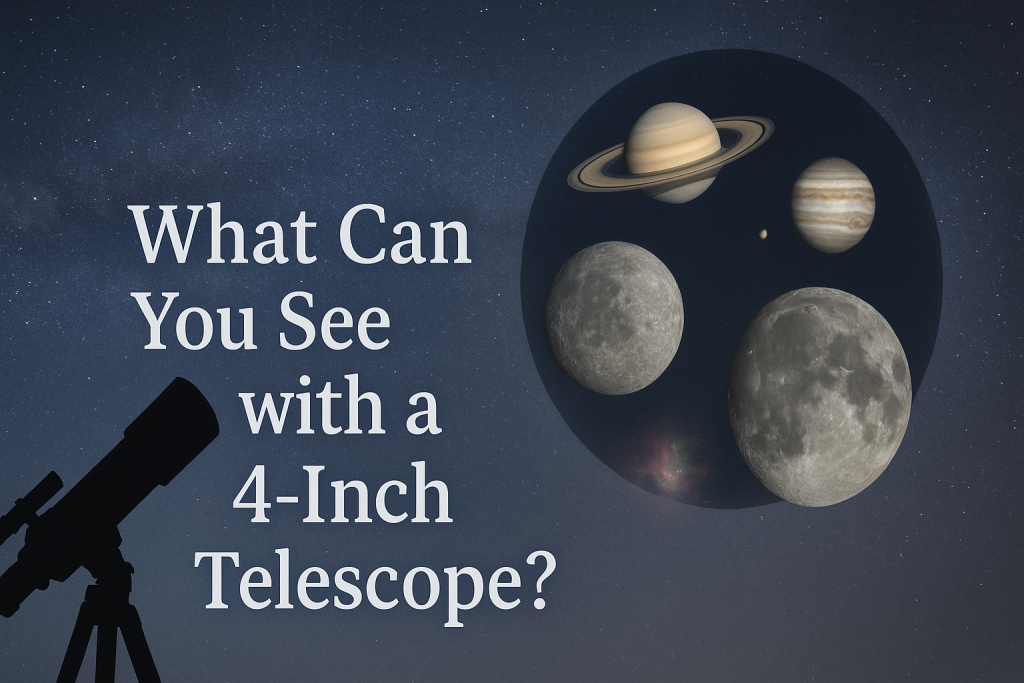
A 4-inch telescope aperture reveals Saturn’s rings, Jupiter’s four largest moons, lunar craters as small as 7 miles across, and nebulae like the Orion Nebula with visible structure and color hints that smaller telescopes cannot deliver. This aperture size matters because it collects 64% more light than a 3-inch telescope and provides 33% better resolution, crossing the threshold where deep-sky objects transition from faint smudges to detailed celestial features. This guide covers what specific objects become visible with 4-inch optics, optimal magnifications for different targets, and realistic expectations based on actual observation sessions across varied sky conditions.
What Makes 4-Inch Aperture Essential for Serious Astronomical Observation?
A 4-inch (102mm) telescope aperture provides the critical light-gathering power needed to observe faint deep-sky objects that remain invisible in smaller instruments. The 102mm objective lens or mirror collects approximately 212 times more light than the human eye’s 7mm pupil, enabling detection of star clusters, nebulae, and galaxies with magnitudes as faint as 12.5 under dark skies.
This aperture size delivers theoretical resolution of 1.14 arcseconds using the Dawes limit formula (4.56 divided by aperture in inches), sufficient to split double stars with separations greater than 1.2 arcseconds and reveal fine details on planetary surfaces. Jupiter’s Great Red Spot becomes clearly visible, along with atmospheric bands and the shadows of its moons during transits.
The exit pupil calculation becomes crucial for optimizing magnification with 4-inch telescopes. Dividing focal length by eyepiece focal length determines magnification, while dividing telescope aperture by magnification yields exit pupil diameter. For a typical f/6 4-inch telescope (600mm focal length), a 25mm eyepiece produces 24x magnification with a 4.2mm exit pupil, matching peak human night vision for maximum brightness on extended objects.
Higher magnifications between 100x and 200x (using 6mm to 3mm eyepieces) provide optimal planetary detail while maintaining exit pupils between 2mm and 1mm for crisp imaging. The maximum useful magnification approximates 200x (50x per inch of aperture), though atmospheric conditions typically limit practical magnification to 150x on average nights.

Light Gathering Power: 4-Inch vs Smaller Apertures
The light-gathering advantage of 4-inch apertures becomes dramatic when compared to common beginner telescopes. A 4-inch telescope collects 78% more light than a 3-inch model and 156% more light than a 2.4-inch refractor, translating directly to visibility of fainter stars and extended objects.
This increased light collection enables observation of galaxies like M81 and M82 in Ursa Major, which appear as faint smudges in 3-inch telescopes but show spiral structure hints and star formation regions in 4-inch instruments under dark skies. Globular clusters like M13 in Hercules resolve individual stars across the entire cluster face rather than just the outer edges.
The limiting magnitude for stellar observation reaches approximately 12.5 with a 4-inch telescope under excellent sky conditions (Bortle Class 2-3 skies), compared to 11.5 for 3-inch apertures. This magnitude difference represents access to roughly 60% more stars and enables detection of planetary nebulae, distant galaxies, and faint comets that remain beyond smaller telescope capabilities.
Resolution Capabilities: Planetary and Double Star Detail
The 1.14 arcsecond theoretical resolution of 4-inch telescopes enables splitting of double stars with separations as close as 1.2-1.3 arcseconds under steady atmospheric conditions. Famous doubles like Albireo (34 arcsecond separation) become stunning color contrasts, while closer pairs like Epsilon Lyrae (2.3 arcseconds) split cleanly at 150x magnification.
Planetary detail reaches impressive levels with 4-inch apertures when atmospheric seeing permits high magnification. Mars reveals polar caps, dark surface markings, and occasional dust storms during favorable oppositions when the planet approaches within 35-50 million miles of Earth. Saturn’s Cassini Division in the rings becomes clearly visible, along with cloud bands on the planet and details on the moon Titan.
Lunar observation benefits tremendously from 4-inch resolution, revealing craters as small as 4-5 miles diameter near the terminator (day-night boundary) where shadows enhance contrast. Mountain ranges, valley systems, and ray systems from impact craters become clearly defined features rather than vague surface variations visible in smaller telescopes.
Complete Viewing Guide: What You Can Observe with 4-Inch Telescopes
The observable universe expands dramatically with 4-inch aperture, encompassing planetary details, deep-sky objects, and stellar phenomena that smaller telescopes cannot reveal. Success depends on matching appropriate magnification to target type, understanding optimal viewing conditions, and knowing which objects perform best at your local sky quality.
Planetary observation typically requires magnifications between 100x and 200x to reveal surface features and atmospheric details. Deep-sky objects like nebulae and galaxies perform better at lower magnifications (25x to 75x) that maximize exit pupil diameter and surface brightness, while star clusters benefit from moderate magnifications (50x to 100x) that balance resolution with field of view.
Planetary Targets: Surface Features and Atmospheric Details
Jupiter becomes a showcase target for 4-inch telescopes, displaying the Great Red Spot as an oval feature with subtle color variations during good seeing conditions. The four Galilean moons (Io, Europa, Ganymede, Callisto) appear as distinct disks rather than point sources at magnifications above 150x, with Ganymede showing slight surface variations.
Atmospheric bands on Jupiter reveal complex structure including the North and South Equatorial Belts, with occasional festoons (connecting features) and white ovals visible during exceptional seeing. Moon transits create distinct black shadows crossing Jupiter’s face, while the moons themselves appear as dark dots against the planet’s disk during these events.
Saturn’s ring system displays the Cassini Division as a clear dark line separating the A and B rings at magnifications of 150x or higher. The planet itself shows subtle banding in its atmosphere, though less pronounced than Jupiter due to Saturn’s greater distance and smaller apparent size. The largest moon, Titan, appears as an orange-colored disk distinct from the smaller point-like moons.
Mars during favorable oppositions (occurring every 26 months) reveals polar ice caps as brilliant white regions, dark surface features like Syrtis Major, and the massive canyon system Valles Marineris as a dark streak across the planet’s face. Dust storms occasionally obscure surface details, appearing as bright yellow regions that evolve over days or weeks of observation.
Venus displays distinct phases similar to the Moon, from full phase when positioned behind the Sun to crescent phase during inferior conjunction. Surface details remain invisible due to the planet’s thick atmosphere, but the phase changes demonstrate orbital mechanics and provide compelling telescopic views, especially during evening or morning apparitions.
Deep-Sky Objects: Nebulae, Galaxies, and Star Clusters
The Orion Nebula (M42) transforms from a hazy star-like point into a bird-shaped emission nebula with 4-inch aperture, revealing the central Trapezium cluster of four hot young stars responsible for illuminating the surrounding gas. Dark lanes called the Fish’s Mouth become visible, along with subtle color variations from red hydrogen and green oxygen emission.
Globular star clusters like M13 in Hercules resolve individual stars completely across the cluster face at magnifications of 100x to 150x with 4-inch telescopes. The cluster’s dense core separates into thousands of individual stars, while the outer regions show chains and streams of stars extending outward in graceful curves.
Planetary nebulae become accessible targets, with the Ring Nebula (M57) in Lyra appearing as a distinct donut-shaped object at 75x to 125x magnification. The central cavity shows clear definition, surrounded by the glowing ring of expelled stellar material, though the central white dwarf star typically requires larger apertures to detect.
Open star clusters provide spectacular wide-field views, with the Pleiades (M45) showing hundreds of stars and hints of surrounding nebulosity under dark skies. The Beehive Cluster (M44) resolves completely into individual stars, while the Double Cluster in Perseus (NGC 869/884) displays two distinct groupings of young, hot stars with contrasting colors and ages.
Galaxy observation begins to show structural details with 4-inch apertures under excellent sky conditions. The Andromeda Galaxy (M31) displays its spiral arms as dark dust lanes silhouetted against the galaxy’s bright central bulge, while its companion galaxies M32 and M110 appear as separate fuzzy patches nearby.
The Whirlpool Galaxy (M51) in Canes Venatici hints at spiral structure under dark skies, with the connecting bridge to its companion galaxy NGC 5194 visible as a faint extension. Edge-on galaxies like the Sombrero Galaxy (M104) show central bulges and equatorial dust lanes that create their distinctive silhouettes.
Stellar Phenomena: Double Stars and Variable Stars
Double star observation reaches impressive capability with 4-inch resolution, splitting pairs separated by 1.5 arcseconds or greater under steady atmospheric conditions. Albireo in Cygnus displays its famous golden and blue color contrast, while the Double-Double (Epsilon Lyrae) challenges observers to split both pairs at high magnification.
Color contrasts in double stars become particularly striking with increased aperture, as the additional light gathering reveals subtle hues invisible to smaller telescopes. Almach (Gamma Andromedae) shows its orange primary and blue secondary, while Eta Cassiopeiae displays yellow and red components separated by 13 arcseconds.
Variable star observation benefits from 4-inch light gathering when monitoring long-period variables like Mira in Cetus, which varies from magnitude 2 to magnitude 10 over its 11-month cycle. Comparison with nearby stars of known magnitude enables accurate brightness estimates and contributes to scientific databases tracking stellar variability.
Optimal Magnifications for Different Targets with 4-Inch Apertures
Magnification selection determines observation success more than any other factor with 4-inch telescopes, as inappropriate power levels can render targets invisible or unimpressive despite adequate aperture. The relationship between target type, magnification, and exit pupil becomes critical for maximizing the 4-inch telescope’s light-gathering and resolving capabilities.
Low magnifications (20x to 50x) excel for large extended objects like the Pleiades star cluster, Andromeda Galaxy, and large nebulae where maximum surface brightness and wide field of view enhance visibility. Medium magnifications (50x to 125x) suit most deep-sky objects including globular clusters, planetary nebulae, and smaller galaxies where balanced resolution and brightness optimization occurs.
High magnifications (125x to 200x) become essential for planetary detail, close double stars, and lunar surface features where resolution matters more than brightness. Understanding exit pupil calculation (aperture divided by magnification) helps determine which magnification ranges work best for specific observing conditions and target types.
Low Power Observations: Wide Field Objects and Maximum Brightness
Exit pupils between 4mm and 7mm (achieved with magnifications of 15x to 25x on f/6 4-inch telescopes) provide maximum brightness for extended objects like the Andromeda Galaxy and large star-forming regions. These low magnifications match or exceed human pupil dilation in darkness, ensuring no collected light is wasted and faint outer details remain visible.
Large open clusters like the Pleiades benefit enormously from wide-field, low-magnification viewing that encompasses the entire cluster in a single eyepiece view. A 32mm eyepiece on a 600mm focal length 4-inch telescope produces 19x magnification with a 5.4mm exit pupil, ideal for revealing the cluster’s hundreds of member stars and surrounding nebulosity under dark skies.
Emission nebulae like the North America Nebula (NGC 7000) require low magnification and maximum exit pupil to maintain surface brightness sufficient for visual detection. Higher magnifications dilute the already faint surface brightness below the eye’s detection threshold, making these targets disappear despite adequate aperture for light collection.
Comet observation particularly benefits from low magnifications that preserve surface brightness of the coma and enhance any tail visibility. A 6mm exit pupil (17x magnification) often reveals comet details invisible at higher powers, as the extended nature of cometary features requires brightness preservation over resolution enhancement.
Medium Power Applications: Balanced Resolution and Brightness
Magnifications producing 2mm to 4mm exit pupils (25x to 50x on f/6 systems) provide optimal balance for most deep-sky observation with 4-inch telescopes. This range offers sufficient resolution to separate stars in globular clusters while maintaining enough brightness to reveal structural details in galaxies and nebulae.
Globular clusters like M13 perform exceptionally well at these medium magnifications, with individual stars resolving clearly across the cluster face while maintaining sufficient brightness to show subtle color variations among the stellar population. A 12mm eyepiece producing 50x magnification creates a 2mm exit pupil suitable for most globular cluster observation.
Planetary nebulae reach optimal visibility in this magnification range, where the central cavity structure becomes defined without sacrificing surface brightness needed to detect the surrounding gas shell. The Ring Nebula displays its donut shape clearly at 75x magnification while retaining enough brightness to show subtle variations in the ring structure.
Small galaxies and galaxy groups benefit from medium magnifications that provide sufficient resolution to separate individual galaxies while maintaining surface brightness needed to detect spiral structure or satellite companions. The Leo Triplet (M65, M66, NGC 3628) shows best at magnifications between 60x and 100x where all three galaxies fit comfortably in the field of view.
High Power Planetary and Lunar Observation
Planetary observation demands magnifications between 150x and 200x to reveal atmospheric details and surface features, creating exit pupils of 0.5mm to 0.7mm that provide maximum contrast for small, bright targets. These high magnifications work effectively with 4-inch apertures because planets provide sufficient brightness to tolerate the small exit pupils.
Jupiter’s atmospheric bands resolve into complex structures at 175x magnification, revealing festoons connecting the North and South Equatorial Belts and occasional white oval storms embedded within the darker belt regions. The Great Red Spot shows internal structure and color variations that remain invisible at lower magnifications lacking sufficient resolution.
Saturn’s ring system requires magnifications of 150x or higher to split the Cassini Division clearly, while the planet’s atmosphere begins showing subtle banding at these power levels. The largest moon Titan displays its distinctive orange color, while smaller moons like Enceladus and Mimas become visible as distinct points rather than merging with background stars.
Lunar observation excels at high magnifications that reveal crater details, mountain ranges, and valley systems invisible at lower powers. A 6mm eyepiece producing 100x magnification shows craters as small as 3-4 miles diameter near the terminator, while higher magnifications up to 200x reveal terraced crater walls, central peaks, and ray systems from relatively recent impacts.
Double star separation requires maximum magnification that atmospheric seeing will permit, often 150x to 200x on steady nights. Close pairs like the famous “Double-Double” in Lyra demand these high magnifications to split cleanly, while easier doubles benefit from high power that reveals color contrasts and confirms clean separation between components.
Realistic Expectations: Sky Conditions and Limiting Factors
Success with 4-inch telescopes depends heavily on sky conditions, atmospheric stability, and understanding the physical limitations that affect observation quality regardless of optical excellence. Light pollution, atmospheric seeing, and seasonal factors create significant variations in what becomes visible on any given night, often determining whether challenging targets appear spectacular or remain completely invisible.
Bortle Scale measurements of sky darkness directly impact deep-sky object visibility, with 4-inch telescopes performing dramatically better under Class 3 rural skies compared to Class 6-7 suburban conditions. The difference represents approximately 2-3 magnitudes in limiting stellar visibility and determines whether galaxies like M81 appear as obvious spiral structures or remain undetectable despite adequate aperture.
Atmospheric seeing, measured in arcseconds of stellar disk size, limits planetary detail regardless of telescope quality. Typical seeing ranges from 1-2 arcseconds on average nights to 0.5 arcseconds during exceptional conditions, directly affecting the useful magnification ceiling and fine detail visibility on planets like Mars and Saturn.
Light Pollution Impact on Deep-Sky Visibility
Urban sky conditions (Bortle Class 8-9) severely limit 4-inch telescope performance on extended objects, with emission nebulae like the Orion Nebula losing most structural detail and galaxies beyond the Local Group becoming undetectable despite theoretically adequate aperture. Light pollution creates sky background brightness that overwhelms faint surface features requiring contrast for visibility.
Suburban skies (Bortle Class 5-6) allow observation of brighter Messier objects but eliminate fainter NGC catalog targets and reduce galaxy detail to basic shape recognition without spiral structure or dark lane visibility. The Andromeda Galaxy remains visible but loses its companion galaxies and outer spiral arm detail to sky glow interference.
Rural dark skies (Bortle Class 3-4) transform 4-inch telescope performance, revealing hundreds of deep-sky objects invisible from light-polluted locations and enabling detection of structural details in galaxies, nebulae, and star clusters that justify the aperture investment. The Milky Way becomes a prominent feature, with dark nebulae visible as silhouettes against the starry background.
Light pollution filters can partially restore contrast for certain emission nebulae by blocking specific wavelengths of artificial lighting while passing nebular emission lines. However, these filters cannot recover lost detail in galaxies and reflection nebulae, making dark sky access essential for complete 4-inch telescope performance realization.
Atmospheric Seeing and Magnification Limits
Atmospheric turbulence creates the practical magnification ceiling for 4-inch telescopes, typically limiting useful planetary observation to 100x-150x on average nights despite theoretical capability of 200x maximum magnification. Poor seeing (3+ arcseconds) renders high magnification counterproductive, creating larger but blurred images with reduced contrast and detail.
Excellent seeing conditions (0.5-1 arcsecond) occur infrequently but enable full utilization of 4-inch resolution capability, allowing magnifications up to 200x for planetary detail and close double star separation. These nights reveal fine details on Jupiter and Saturn that remain invisible during typical atmospheric conditions despite identical telescope performance.
Thermal effects from ground cooling, nearby buildings, and the telescope itself create local seeing degradation that reduces performance below atmospheric limits. Allow 30-60 minutes for telescope thermal equilibration, avoid setup on concrete or asphalt surfaces, and position the telescope away from buildings and heat sources for optimal seeing utilization.
High altitude observing sites provide superior atmospheric stability and transparency, enabling 4-inch telescopes to achieve their theoretical performance limits more consistently. Mountaintop locations above 5,000 feet elevation typically offer 1-2 magnitude improvements in limiting stellar visibility and more frequent periods of excellent seeing for planetary observation.
Seasonal and Target-Specific Considerations
Planetary visibility follows orbital mechanics, with superior planets (Mars, Jupiter, Saturn) best observed during opposition when Earth lies between the planet and Sun, providing closest approach distances and largest apparent sizes. Mars oppositions occur every 26 months, with particularly favorable oppositions every 15-17 years when Mars reaches within 35 million miles of Earth.
Winter observing conditions often provide the best atmospheric stability and transparency, with cold, dry air masses creating exceptional seeing conditions ideal for planetary detail and faint deep-sky object detection. However, shorter nights and challenging temperature management require proper equipment preparation and observing technique adjustment.
Summer months offer longer nights and comfortable observing conditions but typically suffer from thermal instability, atmospheric turbulence, and increased water vapor that degrades image quality and reduces contrast on planetary targets. Early morning hours before dawn often provide the best summer seeing conditions for high-magnification work.
Moon phase planning becomes critical for different observation types, with new moon periods essential for faint galaxy and nebula observation while bright moon phases enhance planetary contrast and provide excellent lunar surface detail viewing. Quarter moon phases offer compromise conditions suitable for both bright and faint targets during single observing sessions.
4-Inch vs 3-Inch vs 6-Inch: Aperture Performance Comparison
Understanding aperture performance differences helps determine whether 4-inch represents the optimal balance of portability, cost, and capability for individual observing priorities and typical sky conditions. The progression from 3-inch to 4-inch to 6-inch creates distinct threshold improvements in specific observation categories while introducing trade-offs in weight, cost, and setup complexity.
Light gathering increases dramatically with aperture, following the square of the diameter relationship that gives 4-inch telescopes 78% more light collection than 3-inch models and 6-inch telescopes 125% more than 4-inch versions. However, practical benefits vary significantly by target type, sky conditions, and magnification requirements that determine when additional aperture produces observable improvements.
For comprehensive comparison of how different aperture sizes perform across various celestial targets and viewing conditions, our detailed analysis of telescope size comparison covering 4-inch vs 6-inch vs 8-inch aperture differences in planetary detail, deep-sky object visibility, and practical field performance provides measured results across different sky conditions and target categories.
3-Inch Limitations vs 4-Inch Improvements
The progression from 3-inch to 4-inch aperture crosses critical thresholds for several observation categories, particularly deep-sky object detection and planetary detail resolution. Globular clusters like M13 begin resolving individual stars completely across the cluster face with 4-inch apertures, while 3-inch telescopes show partial resolution limited to outer regions and bright core stars.
Galaxy observation improves substantially, with spiral structure hints becoming visible in nearby galaxies like M51 and M101 through 4-inch telescopes under dark skies, while these details remain below the detection threshold for 3-inch apertures despite similar optical quality and magnification capability. The additional light gathering pushes faint surface features above visual detection limits.
Planetary detail shows measurable improvement, with Jupiter’s atmospheric bands displaying increased contrast and occasional detection of smaller features like white ovals and festoons connecting the major belt systems. Saturn’s Cassini Division splits more easily and consistently, while the planet’s subtle atmospheric banding becomes detectable during good seeing conditions.
Double star separation improves from approximately 1.5 arcseconds for 3-inch telescopes to 1.1-1.2 arcseconds for 4-inch models, enabling access to closer pairs and more challenging targets from double star catalogs. Color contrasts also enhance due to increased light collection that makes subtle stellar hues more apparent.
When 6-Inch Becomes Necessary
Certain deep-sky targets remain challenging or invisible with 4-inch apertures even under excellent sky conditions, requiring the 125% increase in light gathering that 6-inch telescopes provide. Faint galaxies beyond the Local Group, distant planetary nebulae, and subtle nebular details benefit significantly from the additional aperture despite increased cost and reduced portability.
Planetary observation shows meaningful improvements with 6-inch apertures, particularly on Mars during favorable oppositions where surface features, polar cap variations, and atmospheric phenomena become more readily visible. Jupiter’s moon details improve, with Io and Europa occasionally showing subtle surface variations beyond simple disk appearance.
The practical resolution improvement from 4-inch (1.14 arcseconds) to 6-inch (0.76 arcseconds) enables separation of double stars with 0.8-0.9 arcsecond spacing, accessing cataloged pairs that remain beyond 4-inch capability. However, atmospheric seeing typically limits this theoretical resolution advantage except during exceptional conditions.
Weight and portability considerations become significant factors, with 6-inch telescopes typically weighing 15-25 pounds more than 4-inch models and requiring more substantial mounting systems. Setup time, cool-down requirements, and transportation logistics often favor 4-inch apertures for regular observing despite the optical advantages of larger instruments.
Cost-Performance Analysis
The price progression from 3-inch to 4-inch telescopes typically involves 40-60% cost increases for similar optical quality levels, while 6-inch models command 100-150% premiums over 4-inch equivalents. These cost differences must justify observable performance improvements under typical sky conditions and individual observing priorities.
For suburban sky conditions (Bortle Class 5-6), the performance difference between 4-inch and 6-inch telescopes becomes less dramatic on deep-sky objects due to light pollution limiting factors, potentially making 4-inch apertures more cost-effective choices for light-polluted observing locations where larger apertures cannot realize their theoretical advantages.
Rural observing sites with excellent sky darkness (Bortle Class 3-4) allow larger apertures to demonstrate their full capability, making 6-inch telescopes worthwhile investments for dedicated deep-sky observers with access to dark skies and willingness to manage additional weight and setup complexity.
Beginner telescope users often find 4-inch apertures provide the optimal balance of performance improvement over entry-level 3-inch models while avoiding the intimidation factor and complexity associated with larger instruments that may discourage regular use and skill development.
Essential Accessories for Maximizing 4-Inch Telescope Performance
Proper accessories determine whether 4-inch telescopes achieve their full potential or underperform due to inadequate eyepieces, mounting, or observing aids. The right combination of eyepieces provides optimal magnification range, while quality mounts ensure tracking accuracy and vibration-free viewing essential for high-magnification planetary observation.
Eyepiece selection becomes critical with 4-inch apertures, as the increased light gathering and resolution capability demands high-quality optics that preserve image contrast and sharpness across the magnification range from 25x to 200x. Poor eyepieces create bottlenecks that waste the telescope’s optical potential despite adequate aperture and primary optics quality.
Eyepiece Requirements for Optimal Magnification Range
A complete eyepiece set for 4-inch telescopes should cover magnifications from 20x to 200x, requiring approximately four eyepieces with focal lengths calculated by dividing telescope focal length by desired magnification. For a typical f/6 4-inch telescope (600mm focal length), useful eyepiece focal lengths include 30mm (20x), 15mm (40x), 10mm (60x), 6mm (100x), and 3mm (200x) to cover the full practical range.
Low-power observation demands eyepieces producing exit pupils between 4mm and 7mm for maximum brightness on extended objects like star clusters and nebulae. A 30mm eyepiece creates 20x magnification with a 5mm exit pupil, optimal for wide-field viewing of large deep-sky objects while preserving surface brightness essential for faint target detection.
Planetary observation requires eyepieces in the 3mm to 6mm focal length range that produce magnifications between 100x and 200x suitable for atmospheric detail resolution and lunar surface features. High-quality planetary eyepieces with excellent correction and comfortable eye relief become essential at these magnifications where optical defects become magnified and apparent.
Barlow lenses offer economical magnification doubling but require high optical quality to avoid degrading image contrast and sharpness. A quality 2x Barlow effectively doubles an eyepiece collection, though dedicated eyepieces typically provide superior performance at equivalent magnifications due to optimized optical design for specific power levels.
Mounting and Tracking Requirements
Stable mounting becomes increasingly critical with 4-inch telescopes due to higher magnifications and longer focal lengths that amplify vibration and tracking errors. Refractor designs typically require more robust mounts than reflectors due to longer tube lengths creating increased leverage and moment arm effects during high-magnification observation.
Equatorial mounts enable celestial tracking essential for planetary observation at magnifications above 100x, where Earth’s rotation causes targets to drift across the field of view in less than 30 seconds without tracking correction. Manual slow-motion controls provide adequate tracking for visual observation, while motor drives enable photography and hands-free viewing during public demonstrations.
Alt-azimuth mounts offer simplicity and lower cost but require constant adjustment in both axes to maintain celestial targets in view during extended observation sessions. These mounts work well for casual deep-sky viewing and lunar observation but become cumbersome for high-magnification planetary work requiring precise tracking and field rotation considerations.
Tripod stability determines mount effectiveness regardless of head design, with wobble and vibration eliminating fine detail visibility during critical focusing and high-magnification observation. Quality tripods with leg braces and vibration dampening enable full utilization of 4-inch telescope resolution while lightweight tripods create frustration and limit practical performance.
Observing Aids and Maintenance Equipment
Star charts and sky atlases become essential tools for locating deep-sky objects beyond the bright Messier catalog targets easily found with 4-inch apertures. Detailed charts showing stars to magnitude 8-9 enable star-hopping navigation to fainter targets while providing context for understanding stellar neighborhoods and galaxy groups visible through increased aperture.
Red flashlights preserve night vision essential for observing faint deep-sky objects that require dark-adapted eyes for detection. Bright white light destroys dark adaptation accumulated over 20-30 minutes of darkness, eliminating ability to detect faint targets that justify 4-inch light gathering capability over smaller apertures.
Dew prevention becomes critical during humid conditions when moisture condenses on objective lenses and eyepieces, degrading optical performance and potentially damaging equipment. Telescope dew heaters provide gentle warming that prevents condensation while telescope dew shields reduce radiative cooling that causes dew formation on optical surfaces.
Cleaning supplies including lens cleaning solution, microfiber cloths, and lens cleaning tissues maintain optical performance by removing dust, fingerprints, and residue that scatter light and reduce contrast. Proper cleaning technique prevents optical damage while preserving coatings essential for maximum light transmission through 4-inch optical systems.
Troubleshooting Common 4-Inch Telescope Issues
Performance problems with 4-inch telescopes often result from setup errors, atmospheric conditions, or accessory limitations rather than optical defects, making systematic troubleshooting essential for achieving expected observation quality. Understanding common symptoms and their solutions prevents frustration and enables full utilization of 4-inch aperture capabilities.
Image quality problems frequently stem from temperature equilibration issues, mounting instability, or inappropriate magnification selection that pushes beyond atmospheric seeing limits. Systematic diagnosis helps identify root causes and implement effective solutions that restore optimal performance.
Image Quality and Focus Problems
Soft or blurry images despite careful focusing often indicate thermal equilibration problems, particularly with refractor telescopes that require 30-60 minutes to reach ambient temperature after being brought from indoor storage. Temperature differences between optical elements create air currents and focal shift that degrade image quality until thermal equilibrium occurs.
Poor contrast and low-detail visibility on planets frequently results from atmospheric seeing limitations rather than telescope problems, with magnifications above 150x becoming unusable during typical seeing conditions despite theoretical 200x capability. Reducing magnification to match atmospheric conditions often reveals superior detail compared to forcing high power during unstable air.
Spherical aberration symptoms including soft stars and poor planetary contrast indicate either low-quality optics or inappropriate f-ratio for the application, with fast focal ratios (f/4 to f/5) showing more aberration than slower systems (f/6 to f/8) particularly at high magnifications required for planetary observation.
Chromatic aberration appears as purple or blue color fringing around bright objects, particularly problematic with achromatic refractors that show significant color dispersion at high magnifications. This optical limitation requires acceptance or upgrade to apochromatic designs with ED or fluorite glass elements that provide superior color correction.
Mounting and Tracking Issues
Vibration problems causing image bounce during focusing or wind disturbance indicate inadequate mounting for telescope weight and focal length, with solutions including tripod leg extension for stability, weight addition to mount head, or upgrade to more substantial mounting systems capable of supporting 4-inch telescope requirements.
Tracking difficulties with equatorial mounts often result from improper polar alignment that causes field rotation and drift rates varying with declination, requiring careful alignment procedure using Polaris positioning and drift alignment techniques for precise celestial tracking during high-magnification observation.
Slipping or loose controls create inability to maintain targets in view during extended observation sessions, typically requiring mechanical adjustment of clutch tension, gear mesh, or bearing preload depending on mount design and specific symptoms observed during tracking attempts.
Balance problems cause motor strain, tracking errors, and difficulty with manual slow-motion controls, requiring proper counterweight adjustment for equatorial mounts or balance optimization for alt-azimuth systems to achieve smooth operation across the full range of telescope positions.
Deep-Sky Object Detection Difficulties
Invisible or extremely faint deep-sky objects despite adequate aperture usually indicate light pollution problems that overwhelm faint surface brightness with sky glow, requiring travel to darker observing sites or acceptance of reduced deep-sky performance under suburban conditions that limit 4-inch telescope effectiveness.
Difficult star-hopping navigation to deep-sky targets often results from inadequate finder scope alignment, poor star chart quality, or insufficient magnification range for effective object identification, with solutions including precise finder alignment procedures and appropriate eyepiece selection for field of view matching to chart scales.
Eyepiece fogging during cold weather observation creates sudden visibility loss during critical observation moments, prevented through dew heaters, preheating eyepieces to ambient temperature, and breath control techniques that avoid moisture introduction to optical surfaces during eyepiece changes.
Exit pupil mismatch problems occur when eyepiece selection creates exit pupils larger than observer’s dark-adapted pupil size, wasting light gathering capability, or exit pupils too small for extended object observation, requiring calculation-based eyepiece selection that optimizes exit pupil diameter for specific target types and observing conditions.
Beginner Setup and Operation Guide for 4-Inch Telescopes
Successful 4-inch telescope operation requires understanding setup procedures, basic maintenance, and observing techniques that maximize aperture performance while avoiding common mistakes that limit observation quality. Proper initial setup creates the foundation for years of productive astronomical observation and skill development.
New telescope users often struggle with focusing techniques, target location methods, and eyepiece selection appropriate for different observation goals. Systematic learning of fundamental skills prevents frustration and enables progressive development toward advanced observation techniques that fully utilize 4-inch capabilities.
For comprehensive guidance on telescope operation fundamentals, our step-by-step tutorial covering telescope setup, focusing, target location, and observing techniques for beginning astronomers provides detailed instructions with troubleshooting guidance for common operational challenges.
Initial Setup and Alignment Procedures
Telescope assembly requires careful attention to optical alignment and mechanical stability, with finder scope alignment being the critical first step that enables efficient target location during observation sessions. Position the telescope on the Moon or bright star during daylight hours, center the target in the main telescope eyepiece, then adjust finder scope alignment screws until the target appears centered in the finder crosshairs.
Balance adjustment prevents tracking problems and reduces mount wear while enabling smooth manual control during observation sessions. For equatorial mounts, adjust counterweight position until the telescope remains stationary when clutches release in any position, indicating proper balance that enables effortless manual tracking and reduces motor strain during powered operation.
Polar alignment accuracy determines tracking precision for equatorial mounts, with rough alignment using Polaris positioning sufficient for visual observation while precise drift alignment becomes necessary for photography or extended high-magnification viewing. Point the mount’s polar axis within 1-2 degrees of Polaris for adequate visual tracking performance.
Cool-down time prevents thermal currents that degrade image quality, particularly important for refractor telescopes with large temperature differentials between indoor storage and outdoor observing conditions. Allow 30-45 minutes for complete thermal equilibration before expecting optimal image quality at high magnifications required for planetary detail.
Target Location and Navigation Techniques
Star-hopping navigation uses bright stars and distinctive patterns to locate deep-sky objects by following mapped routes across the sky using low-power eyepieces that provide wide fields of view. Start with bright stars visible in both finder scope and main telescope, then follow chart-indicated paths through intermediate stars toward target locations using consistent magnification levels.
Bright object alignment provides reference points for systematic sky exploration, with planets, bright stars, and prominent star clusters serving as starting positions for navigation to fainter targets within the same sky region. The Big Dipper serves as an excellent starting point for northern sky navigation, while Orion provides southern sky access points.
Field of view calculation helps match eyepiece capabilities to star chart scales, preventing navigation confusion and enabling accurate distance estimation during star-hopping sequences. Calculate true field of view by dividing eyepiece apparent field (typically 40-70 degrees) by magnification to determine sky coverage in degrees for chart correlation.
Progressive magnification technique starts with low power for target acquisition, then increases magnification systematically to reveal details while maintaining target centering and focus optimization. Begin with 25-50x magnification for location, progress to 75-125x for detail observation, and use maximum magnification only when atmospheric conditions permit effective high-power viewing.
Focusing and Image Optimization
Precise focusing requires systematic technique using bright stars for reference, as extended objects like planets provide insufficient contrast for critical focus determination. Center a bright star in the eyepiece, rack focus in and out while observing diffraction ring patterns, then adjust for smallest possible central disk with symmetric surrounding rings indicating optimal focus position.
Atmospheric compensation involves reducing magnification during poor seeing conditions rather than fighting atmospheric turbulence with excessive power that creates larger but blurred images. Monitor seeing quality by observing star steadiness and adjust magnification accordingly, using lower powers during unstable air and maximum magnification only during exceptional conditions.
Eyepiece selection optimization matches magnification to target type and observing conditions, with exit pupil calculation guiding appropriate choices for different objects. Use exit pupils of 4-7mm for maximum brightness on extended objects, 2-4mm for balanced performance on most targets, and 0.5-2mm for high-resolution planetary and double star observation.
Collimation maintenance ensures optimal optical performance throughout the telescope’s operational life, with star testing revealing mirror or lens alignment problems that degrade image quality. Observe star patterns at high magnification both inside and outside focus to detect asymmetries indicating collimation adjustment requirements for peak optical performance.
Frequently Asked Questions About 4-Inch Telescopes
What planets can you see clearly with a 4-inch telescope?
A 4-inch telescope reveals detailed features on Jupiter including the Great Red Spot, atmospheric bands, and moon transits, Saturn with clear ring separation and the Cassini Division, Mars showing polar ice caps and dark surface features during favorable oppositions, and Venus displaying complete phase cycles from crescent to full. The increased aperture provides sufficient resolution for planetary surface details and atmospheric phenomena invisible in smaller telescopes, though atmospheric seeing typically limits useful magnification to 150x on average nights.
How many galaxies can you observe with 4-inch aperture?
Under dark skies (Bortle Class 3), a 4-inch telescope can detect approximately 200-300 galaxies from various catalogs including all Messier galaxies, brighter NGC objects, and several galaxy groups like the Leo Triplet and Virgo Cluster members. The Andromeda Galaxy (M31) displays spiral structure hints and companion galaxies, while edge-on galaxies like the Sombrero (M104) show dust lanes and central bulges. Light pollution severely limits galaxy visibility, reducing the observable count to 20-30 galaxies under suburban conditions where only the brightest examples remain detectable.
Is 4-inch aperture good for astrophotography?
4-inch telescopes provide excellent astrophotography capability for bright targets including planets, the Moon, bright nebulae, and star clusters, with sufficient light gathering for reasonable exposure times and resolution for detailed imaging. Planetary photography particularly benefits from 4-inch aperture resolution, enabling capture of atmospheric details and surface features at high magnification. Deep-sky astrophotography becomes challenging due to longer exposure requirements for faint targets, though bright nebulae like Orion remain accessible with proper camera equipment and tracking mounts.
What eyepieces do I need for a 4-inch telescope?
Essential eyepieces for 4-inch telescopes include 25-30mm for low power wide-field viewing (20-25x magnification), 12-15mm for medium power general observation (40-50x), 8-10mm for higher magnification detail work (60-75x), and 4-6mm for maximum planetary magnification (100-150x). Calculate magnification by dividing telescope focal length by eyepiece focal length, ensuring exit pupil sizes between 1mm and 7mm for different target types. Quality eyepieces with good eye relief and contrast become increasingly important at higher magnifications where optical defects magnify proportionally.
How much does a quality 4-inch telescope cost?
Quality 4-inch telescopes range from $400-800 for entry-level achromatic refractors, $600-1200 for mid-range models with better optics and mounts, and $1200-3000 for premium apochromatic refractors with ED glass and superior mechanical construction. Reflector designs typically cost 20-30% less than equivalent refractors but require periodic collimation maintenance. Additional costs include essential eyepieces ($200-500), quality mount upgrade ($300-800), and accessories ($100-300), making total system investment $800-2500 depending on performance goals and component quality.
Can you see nebulae colors with a 4-inch telescope?
4-inch telescopes reveal subtle color hints in brightest emission nebulae like Orion (M42) showing red hydrogen and green oxygen regions, though most nebulae appear gray-green to the human eye due to low-light vision limitations that reduce color sensitivity. Planetary nebulae occasionally display blue-green coloration due to oxygen emission, while reflection nebulae around bright stars show subtle blue tints. Color photography through 4-inch telescopes captures vivid nebular colors invisible to visual observation, as cameras accumulate light over extended exposures that overcome human vision limitations.
What’s the smallest crater you can see on the Moon?
Under excellent seeing conditions at 150-200x magnification, 4-inch telescopes resolve lunar craters as small as 3-4 miles diameter near the terminator where shadows enhance contrast and definition. The theoretical resolution of 1.14 arcseconds translates to approximately 2-mile features under perfect conditions, though atmospheric seeing typically limits practical resolution to 4-5 mile crater detection. Prominent craters like Tycho (54 miles) and Copernicus (37 miles) show internal structure including terraced walls, central peaks, and ray systems extending hundreds of miles across the lunar surface.
How far can you see into space with 4-inch aperture?
4-inch telescopes can detect objects billions of light-years distant, including galaxies in the Virgo Cluster approximately 50-60 million light-years away and quasars beyond 1 billion light-years under exceptional dark sky conditions. The distance limit depends on object brightness rather than aperture alone, with magnitude 12.5 stellar limit enabling detection of extremely distant but luminous objects. The most distant readily observable target is the Andromeda Galaxy at 2.5 million light-years, while fainter galaxies require perfect sky conditions and experienced observation techniques for detection.
Do I need a computerized mount for a 4-inch telescope?
Manual mounts work excellently for 4-inch telescopes, providing reliable tracking through slow-motion controls and enabling learning of sky navigation skills essential for astronomical knowledge development. Computerized GoTo mounts offer convenience for target location but add complexity, cost ($500-1500 additional), and potential reliability issues that may discourage regular use. Many experienced observers prefer manual operation that maintains connection with celestial mechanics and provides backup capability when electronic systems fail during remote observing sessions.
What’s the difference between 4-inch refractor and reflector performance?
4-inch refractors typically provide superior contrast and planetary detail due to unobstructed aperture and sealed optical tube that prevents dust and air currents, while 4-inch reflectors offer lower cost and potentially better deep-sky performance due to absence of chromatic aberration. Refractors require minimal maintenance but show color fringing on bright objects unless equipped with expensive ED glass correction. Reflectors need periodic collimation adjustment but provide excellent color-free imaging across the entire spectrum with properly maintained optics.
Can you see the International Space Station details with 4-inch telescope?
The International Space Station moves too rapidly for detailed observation with any telescope, crossing the sky in 3-6 minutes and requiring specialized tracking equipment for structural detail visibility. However, 4-inch telescopes excel at observing ISS transits across the Sun or Moon, where the station appears as a silhouette revealing solar panel configuration and overall structure during the brief 0.5-2 second transit event. Satellite tracking apps provide precise transit predictions for photography opportunities using high-speed camera techniques.
What maintenance does a 4-inch telescope require?
4-inch telescopes require minimal routine maintenance including periodic dust removal from optical surfaces using proper cleaning supplies, collimation checks for reflector models every few months, and mechanical lubrication of focusing mechanisms and mount bearings annually. Store telescopes in dry conditions to prevent fungus growth on optical coatings, cover optics when not in use to minimize dust accumulation, and allow temperature equilibration before each observing session. Professional optical cleaning every 3-5 years maintains coating integrity and light transmission efficiency for optimal performance.
How portable are 4-inch telescopes for travel?
4-inch telescopes vary significantly in portability, with compact refractors weighing 8-15 pounds and fitting in car trunks easily, while longer focal length models may extend 3-4 feet requiring roof racks or larger vehicles for transportation. Reflector designs typically offer better portability due to shorter tube lengths, though they require careful handling to maintain collimation during transport. Consider travel frequency when selecting 4-inch models, as portability directly affects observing site access and setup convenience for dark sky locations.
What accessories are essential for 4-inch telescope photography?
Essential astrophotography accessories for 4-inch telescopes include sturdy equatorial mount with tracking capability ($600-1500), DSLR camera adapter or dedicated astronomical camera ($200-800), off-axis guider for long exposures ($150-400), and quality eyepieces for focusing and alignment ($200-500). Planetary photography benefits from high-frame-rate cameras and Barlow lenses for increased magnification, while deep-sky work requires auto-guiding systems and light pollution filters. Budget $1000-3000 for complete photography setup depending on target types and image quality goals.
How does light pollution affect 4-inch telescope performance?
Light pollution severely impacts 4-inch telescope deep-sky performance, reducing limiting magnitude from 12.5 under dark skies to 8-9 in suburban conditions and eliminating most galaxy detail, nebular structure, and faint star cluster resolution. Planetary observation remains largely unaffected by light pollution as planets provide sufficient brightness to overcome sky glow interference. Urban observers should focus on lunar, planetary, and double star targets while planning occasional trips to dark sky sites for deep-sky observation that justifies 4-inch aperture investment.
The 4-inch telescope aperture delivers transformative astronomical capability, revealing Saturn’s ring divisions, Jupiter’s atmospheric details, hundreds of deep-sky objects with structural features, and stellar phenomena invisible to smaller instruments through its superior 102mm light gathering and 1.14 arcsecond resolution. Success requires matching magnification to atmospheric conditions (typically 25x to 150x), understanding exit pupil optimization for different targets, and accessing reasonably dark skies for deep-sky performance that justifies the aperture investment over compact alternatives. Start by mastering planetary observation and bright deep-sky objects during excellent seeing conditions, gradually expanding to challenging targets as experience develops with this versatile aperture size that balances portability with serious astronomical capability.