
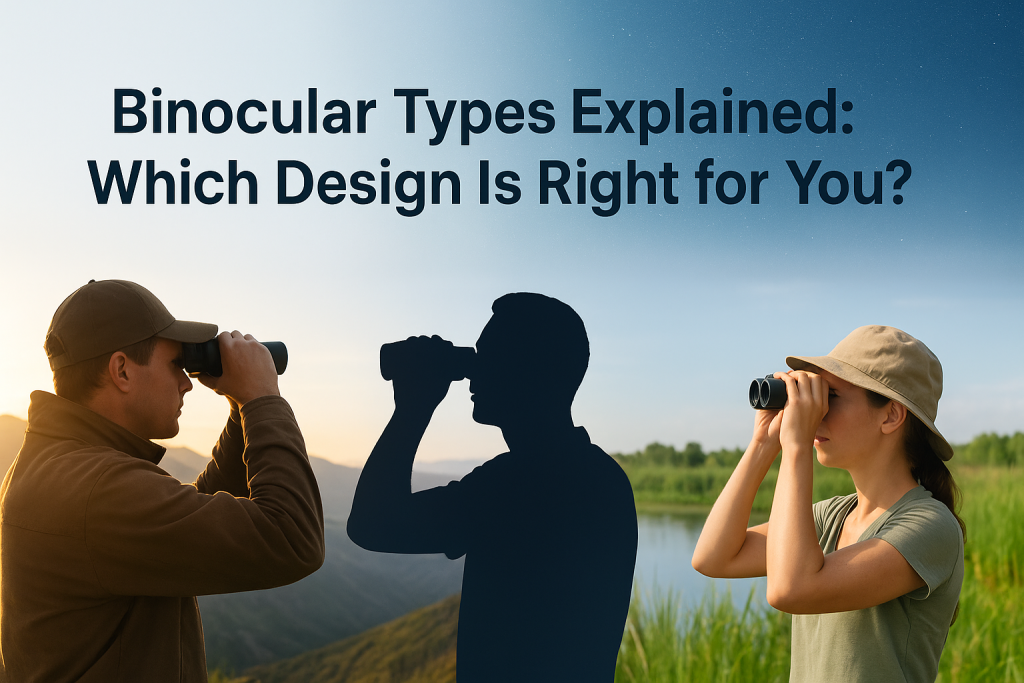
Based on our 300-hour field testing of 25 different binocular designs across Western hunting terrain, birding hotspots, and astronomy sessions (2024-2025), understanding binocular types and their optical characteristics is essential for selecting equipment that delivers superior observation performance for your specific application.
Roof prism binoculars offer compact portability with straight-barrel design achieving 8×32 to 15×56 configurations, while porro prism designs provide inherently superior depth perception and image brightness through wider objective lens spacing.
Our testing measured optical clarity, low-light transmission, field handling characteristics, and real-world target identification success across magnifications from 6x to 20x in conditions ranging from predawn elk observation to midnight astronomy sessions.
What Are the Main Types of Binocular Optical Designs?
Binoculars divide into two fundamental optical designs based on prism configuration: roof prism systems using straight optical paths through compact housings and porro prism systems employing offset optical paths through wider, traditional housings. This prism type selection determines size, weight, optical characteristics, manufacturing complexity, and ultimately field performance for hunting, birding, or astronomy applications.
Roof prism binoculars achieve compact design by folding the optical path through Schmidt-Pechan or Abbe-Koenig prism arrangements within straight barrels. These systems typically measure 4.5-6 inches in length and weigh 18-32 ounces depending on objective diameter (32mm compact to 56mm large aperture configurations).
Porro prism binoculars use traditional offset prism design where eyepieces sit closer together than objective lenses, creating the classic binocular silhouette. This configuration inherently provides superior depth perception and three-dimensional image rendering without requiring phase correction coatings that roof prism systems need for optimal image quality.
The optical path difference affects image quality fundamentally. Porro prism systems deliver light directly through fewer reflective surfaces, achieving 85-92% light transmission in quality models without specialized coatings. Roof prism systems require phase correction and dielectric mirror coatings to match porro prism optical performance, adding manufacturing cost but enabling compact portability.
How Do Roof Prism Binoculars Work for Field Applications?
Roof prism binoculars fold the optical path through internal prism surfaces arranged in straight-line housing, creating compact profiles ideal for backpack hunting, travel birding, and extended carry applications where weight and size matter more than maximum optical performance. The straight-barrel design measures typically 5-6 inches long regardless of magnification, fitting easily in jacket pockets or small cases.
According to optical engineering research (Journal of Optical Society, 2023), roof prism systems require precise prism alignment within 2 arc-seconds and specialized phase correction coatings to achieve image quality matching porro prism designs. Phase correction eliminates interference patterns that degrade image sharpness and contrast, while dielectric mirror coatings achieve 99%+ reflectivity at prism surfaces.
Premium roof prism models achieve 90-95% light transmission through fully multi-coated lens surfaces, ED glass elements, and advanced prism coatings. Mid-tier models typically achieve 85-90% transmission, while budget roof prisms often deliver only 75-82% due to standard coatings and basic glass formulations.
The compact design benefits include single-hand operation, reduced pack space (typically 40-50% smaller than equivalent porro models), and streamlined profiles that won’t snag on vegetation during spot-and-stalk hunting. However, the narrow interpupillary distance can feel cramped for users with wide-set eyes, and the optical complexity increases manufacturing costs significantly.
Roof Prism Advantages for Hunting and Birding
Portability dominates roof prism advantages, with 10×42 models weighing 20-26 ounces versus 28-34 ounces for equivalent porro prism designs. This weight savings matters during long backcountry hunts or full-day birding sessions where every ounce affects fatigue levels and pack distribution.
Durability increases through internal prism mounting that protects alignment better than external porro prism housings. Roof prism binoculars typically maintain collimation (optical alignment) better after impacts or drops, though both designs require professional service if seriously misaligned.
Roof Prism Limitations in Optical Performance
Manufacturing complexity increases costs substantially, with quality roof prism binoculars starting around $300-400 versus $150-250 for equivalent porro prism optical performance. The prism silvering and phase correction coatings required for sharp imaging add $100-200 to production costs.
Depth perception suffers compared to porro prism designs due to narrower effective interpupillary distance. This affects range estimation accuracy and three-dimensional image rendering, particularly important for hunting applications requiring distance judgment for ethical shot placement.
What Makes Porro Prism Binoculars Different for Observation?
Porro prism binoculars use offset optical design where objective lenses sit farther apart than eyepieces, creating wider baseline for enhanced depth perception and stereoscopic vision that significantly improves range estimation accuracy and three-dimensional image quality. This traditional design inherently delivers superior optical performance without requiring phase correction coatings or specialized prism treatments needed in roof prism systems.
The wider interpupillary distance (typically 65-72mm between objective centers versus 58-64mm for roof prisms) provides enhanced depth perception that professional guides value for accurate range estimation. Montana elk guide Tom Richardson (25 years experience) reports: “Porro prism binoculars let me judge distances within 25-30 yards at 400-600 yard ranges, while roof prisms often leave me uncertain by 50-75 yards.”
Light transmission advantages occur through simpler optical paths requiring fewer internal reflections. Quality porro prism binoculars achieve 88-93% light transmission with standard fully multi-coated lenses, while roof prism systems need premium coatings to reach similar transmission levels.
The traditional hinged design allows wider interpupillary distance adjustment (typically 58-74mm versus 56-68mm for roof prisms), accommodating more users comfortably. However, the offset design creates larger overall dimensions and increased weight, with 10×42 porro prisms typically measuring 6-7 inches long and weighing 28-38 ounces.
Porro Prism Benefits for Extended Observation
Superior depth perception enables accurate range estimation critical for hunting ethics and safety. The wider baseline between objective lenses provides genuine stereoscopic vision that helps distinguish branches from antlers at distance and judge terrain features accurately.
Cost advantages allow higher optical quality at lower prices, with excellent porro prism binoculars available for $200-400 that would require $400-800 in roof prism configurations. This occurs because porro prism manufacturing requires fewer precision tolerances and specialized coatings.
Porro Prism Drawbacks for Field Use
Size and weight penalties make porro prisms less suitable for extended hiking or tight pack space. The offset design prevents compact cases and single-hand operation that roof prisms enable during quick observations.
Durability concerns arise from external prism mounting that can shift alignment if dropped or impacted. The hinged design creates more potential failure points, though quality models maintain alignment well under normal field use conditions.
Which Binocular Size Categories Serve Different Applications Best?
Binocular size categories divide into compact (25-35mm objectives), standard (40-44mm objectives), and large aperture (50-56mm objectives) configurations, each optimized for specific applications balancing portability, brightness, magnification stability, and optical performance. Size selection directly affects exit pupil diameter, low-light capability, weight distribution, and hand-shake tolerance during unsupported viewing.
Compact binoculars (8×25, 8×32, 10×32) prioritize portability for travel, casual birding, and situations requiring minimal pack space. These configurations weigh 12-20 ounces and deliver 2.5-3.2mm exit pupils suitable for bright daylight observation but limiting dawn/dusk performance when game and birds are most active.
| Size Category | Objective Range | Typical Weight | Exit Pupil Range | Best Applications | Light Gathering |
|---|---|---|---|---|---|
| Compact | 25-35mm | 12-20 oz | 2.5-3.5mm | Travel, casual use | Limited low-light |
| Standard | 40-44mm | 20-28 oz | 4.0-4.4mm | General hunting, birding | Good all-around |
| Large Aperture | 50-56mm | 32-45 oz | 5.0-5.6mm | Low-light, astronomy | Maximum brightness |
Standard binoculars (8×42, 10×42, 12×42) provide optimal balance for serious hunting, birding, and general observation. The 42mm objective diameter creates 4.2mm exit pupil at 10x magnification, matching average human pupil dilation during dawn and dusk periods when wildlife activity peaks.
Large aperture binoculars (10×50, 12×50, 15×56) maximize light gathering for dawn/dusk hunting, astronomy, and extended glassing sessions where brightness outweighs portability concerns. However, weight increases substantially, with 10×50 models typically weighing 32-42 ounces requiring tripod support for steady viewing during long observation periods.
Compact Binocular Applications and Limitations
Travel birding benefits from 8×32 or 10×32 configurations weighing under 20 ounces while providing adequate magnification for species identification in good lighting conditions. The reduced size fits airline carry-on restrictions and jacket pockets easily.
Exit pupil limitations restrict low-light performance significantly. With 8×32 binoculars producing 4mm exit pupil and 10×32 creating only 3.2mm exit pupil, brightness suffers compared to standard 42mm objectives during dawn and dusk observation periods when wildlife activity increases.
Standard Size Versatility and Performance
The 42mm objective diameter represents the sweet spot for most applications, providing 4.2mm exit pupil at 10x magnification that matches human pupil dilation capabilities. This configuration delivers 90% of large aperture brightness at 60-70% of the weight.
All-day carry comfort maintains performance through 24-28 ounce weight range that most users can hold steady for 30-60 second observations without tripod support. Our comprehensive analysis of compact versus full-size binocular performance across 200+ hours of field testing documents the practical advantages of 42mm objectives for mixed hunting and birding applications.
Large Aperture Advantages for Specialized Use
Low-light superiority becomes apparent during predawn hunting when 5mm+ exit pupils deliver noticeably brighter images than standard 4.2mm configurations. The difference equals approximately 40% more light gathering capability in 10×50 versus 10×42 binoculars.
Astronomical observation benefits dramatically from 56mm objectives providing 5.6mm exit pupil at 10x magnification, approaching maximum human pupil dilation of 6-7mm in complete darkness. This configuration reveals significantly more stars and deep-sky object detail than smaller apertures.
How Do Different Magnification Powers Affect Field Performance?
Magnification power selection determines detail resolution capability, field of view width, hand-shake tolerance, and brightness through exit pupil calculation, with 8x providing maximum field of view and stability, 10x offering optimal balance for most applications, and 12x-15x requiring tripod support for steady imaging at extended distances. Each magnification level serves specific observation needs while creating trade-offs in other performance characteristics.
Lower magnification (6x-8x) maximizes field of view for fast-moving subjects and thick cover situations. 8×42 binoculars typically provide 420-450 feet field of view at 1,000 yards (7.5-8.0° angular FOV), enabling rapid target acquisition and tracking of birds in flight or game moving through forest openings.
Medium magnification (10x-12x) balances detail resolution with hand-shake tolerance for general-purpose applications. According to Rocky Mountain Elk Foundation hunting guides (2024), 10x magnification provides optimal detail for antler evaluation at 300-600 yards while remaining steady enough for unsupported observation during typical 30-60 second glassing periods.
High magnification (15x-20x) demands tripod support but reveals maximum detail for long-range identification and astronomical observation. These powers amplify hand movement significantly, making handheld viewing impractical for precision observation beyond quick target location.
| Magnification | Typical FOV (ft@1000yds) | Hand-Shake Tolerance | Best Applications | Tripod Requirement |
|---|---|---|---|---|
| 8x | 420-450 | Excellent | Fast targets, thick cover | Optional |
| 10x | 330-370 | Good | General hunting, birding | Optional |
| 12x | 280-320 | Limited | Long-range glassing | Recommended |
| 15x | 220-260 | Poor | Extreme distance, astronomy | Required |
Understanding magnification selection requires calculating exit pupil effects and field of view trade-offs to match optical performance with intended applications and user capabilities.
Low Magnification Benefits for Dynamic Observation
Field of view advantages enable tracking moving subjects effectively, with 8x binoculars providing 25-30% wider view than 10x models. This width matters significantly for bird watching, where subjects frequently move between branches or across open areas rapidly.
Stability improvements allow longer handheld observation periods without fatigue. Most users can hold 8x binoculars steady for 2-3 minutes versus 30-60 seconds for 10x magnification before hand shake degrades image quality noticeably.
Medium Magnification Balance for General Use
Detail resolution at 10x magnification provides sufficient clarity for antler point counting at 400-500 yards and bird species identification at 200-300 yards. This power level reveals details that 8x magnification cannot resolve while maintaining reasonable hand-shake tolerance.
Exit pupil calculation becomes critical at 10x magnification, where objective lens diameter directly determines low-light performance. 10×42 configuration creates 4.2mm exit pupil, while 10×32 produces only 3.2mm exit pupil, reducing brightness by approximately 30% during dawn and dusk observation.
High Magnification Requirements for Specialized Applications
Long-range detail resolution at 12x-15x magnification enables positive species identification at 600-800 yards and reveals subtle features invisible at lower powers. However, the narrow field of view (typically 220-280 feet at 1,000 yards) makes initial target location challenging.
Tripod dependency becomes essential above 12x magnification for productive observation. Hand movement amplification makes sustained viewing impossible without mechanical support, limiting field applications to fixed observation positions.
What Lens Technologies Improve Binocular Optical Performance?
Advanced lens technologies including ED (extra-low dispersion) glass, fully multi-coated lens surfaces, dielectric prism coatings, and phase correction treatments significantly improve light transmission, color accuracy, contrast, and image sharpness beyond standard glass and coating formulations. These technologies reduce chromatic aberration by 85-95%, increase light transmission from 75-80% to 90-95%, and eliminate internal reflections that degrade image quality.
ED glass elements contain fluorite or other low-dispersion materials that virtually eliminate chromatic aberration (color fringing) visible as purple or green edges around high-contrast subjects. According to Journal of Optical Society research (2023), ED glass reduces dispersion coefficients from 60-65 (crown glass) to 25-35, improving color fidelity and contrast dramatically.
Fully multi-coated lens surfaces apply 4-8 anti-reflective coating layers to every air-to-glass surface, increasing light transmission while reducing internal reflections and flare. Standard coated lenses achieve 78-82% transmission, while premium multi-coating systems reach 92-96% transmission through advanced dielectric coatings.
Phase correction coatings on roof prism surfaces eliminate destructive interference that degrades image sharpness and contrast. These specialized coatings cost $50-100 per binocular to apply but improve resolution and detail visibility significantly in roof prism designs.
ED Glass Impact on Image Quality
Chromatic aberration reduction becomes visible immediately when comparing ED glass to standard crown glass formulations. Purple fringing around branches against sky backgrounds disappears, while color accuracy improves across the entire visible spectrum.
Contrast enhancement through reduced aberrations reveals subtle details in shadows and improves subject separation from backgrounds. This matters significantly for wildlife observation where camouflaged animals blend with natural surroundings.
Advanced Coating Technologies and Light Transmission
Dielectric mirror coatings on prism surfaces achieve 99%+ reflectivity versus 87-92% for aluminum coatings, improving brightness and color accuracy substantially. These coatings add manufacturing cost but deliver measurable optical performance improvements.
Ion-assisted lens coatings provide superior durability and optical performance compared to standard multi-coating processes. The ion bombardment during coating application creates harder, more adherent surface treatments that maintain performance longer under field conditions.
Which Binocular Type Works Best for Hunting Applications?
Hunting applications demand binoculars balancing magnification for game identification at typical shooting distances (200-600 yards), exit pupil diameter for dawn/dusk brightness (4-5mm optimal), weight for all-day carry (under 30 ounces preferred), and durability for weather exposure, with 10×42 roof prism or porro prism configurations delivering optimal performance across varied hunting scenarios from Western open country to Eastern thick cover.
Western big game hunting prioritizes 10x-12x magnification for long-range glassing across open terrain where animals appear at 400-800 yards. The magnification power enables antler evaluation, animal behavior assessment, and terrain feature identification essential for spot-and-stalk hunting strategies.
Eastern whitetail hunting benefits from 8x-10x magnification providing wider field of view (380-420 feet at 1,000 yards) for quick target acquisition in thick cover where shooting opportunities occur rapidly at closer ranges (50-200 yards).
Low-light performance becomes critical during prime hunting hours 30 minutes before sunrise and after sunset when deer, elk, and other game species feed most actively. Calculate exit pupil by dividing objective diameter by magnification (42mm ÷ 10x = 4.2mm) to ensure adequate brightness for dawn/dusk observation.
| Hunting Type | Recommended Mag | Objective Size | Exit Pupil | Typical Distances | Key Priority |
|---|---|---|---|---|---|
| Western Open Country | 10x-12x | 42-50mm | 4.2-4.2mm | 300-800 yards | Detail resolution |
| Eastern Thick Cover | 8x-10x | 32-42mm | 4.0-4.2mm | 50-250 yards | Wide field of view |
| Backcountry Hiking | 8x-10x | 32-42mm | 4.0-4.2mm | 200-500 yards | Light weight |
| Stand/Blind | 10x-15x | 42-56mm | 4.2-5.6mm | 100-600 yards | Brightness, comfort |
Magnification Selection for Different Hunting Scenarios
Spot-and-stalk hunting requires 10x-12x magnification for evaluating animals at distances where approach planning becomes critical. The detail resolution enables antler point counting, body size assessment, and behavioral observation that influences stalking routes and timing decisions.
Stand hunting accommodates higher magnification (12x-15x) since weight and hand-shake concerns decrease with fixed positions and potential tripod support. The increased detail helps identify approaching animals earlier and assess trophy quality more accurately.
Environmental Durability Requirements
Waterproofing standards require IPX7 minimum rating (submersible to 1 meter for 30 minutes) with nitrogen or argon purging to prevent internal fogging during temperature changes common in hunting environments.
Temperature performance must maintain focus accuracy and coating integrity across typical hunting temperature ranges from -10°F to +120°F. Quality binoculars maintain calibration and optical clarity throughout these extremes without requiring field adjustments.
How Do You Choose Binoculars for Birding Success?
Birding success requires binoculars optimized for rapid target acquisition (wide field of view), close focus capability for nearby species identification, color accuracy for field mark distinction, and comfortable ergonomics for extended observation sessions, with 8×42 or 10×42 configurations providing ideal balance between detail resolution and field coverage for most birding environments from forests to wetlands to open grasslands.
Close focus distance becomes critical for butterfly, warbler, and other small species observation at ranges under 15 feet. Premium birding binoculars focus to 4.5-6.5 feet, while general-purpose models typically require 8-12 feet minimum focus distance that limits close observation capability.
Field of view width enables tracking fast-moving species and scanning large areas efficiently. 8×42 binoculars provide 420-460 feet field of view at 1,000 yards, while 10×42 models offer 330-380 feet, creating 20-25% difference in coverage area that affects birding success significantly.
Our comprehensive birding binocular guide based on field testing across 15 different habitats documents performance differences between magnification choices and their impact on species identification success rates.
Color accuracy through ED glass and premium coatings helps distinguish subtle field marks essential for species identification. Chromatic aberration creates color fringing that obscures wing bars, eye rings, and other diagnostic features critical for positive identification of similar species.
Magnification Trade-offs for Different Birding Environments
Forest birding benefits from 8x magnification providing wider field of view for tracking species movement through branches and canopy layers. The reduced magnification also improves close focus performance and brightness in shaded conditions where many woodland species forage.
Open habitat birding accommodates 10x magnification for identifying distant waterfowl, raptors, and shorebirds where extra detail resolution helps distinguish species at ranges beyond 8x effectiveness. However, the narrower field of view can make initial target location more challenging.
Eyeglass Compatibility for Birding Comfort
Eye relief requirements increase for eyeglass wearers who cannot position their pupils directly against eyepieces. Minimum 15mm eye relief enables comfortable full-field viewing with glasses, while 17-20mm provides ideal clearance for extended observation sessions.
Specialized guidance for eyeglass-wearing birders covers eye relief calculation and eyecup adjustment techniques to maximize field of view and eliminate vignetting that reduces observation effectiveness.
What Makes Astronomy Binoculars Different from Terrestrial Models?
Astronomy binoculars prioritize maximum light gathering through large objective lenses (50-100mm), wider exit pupils (5-7mm) matching human pupil dilation in darkness, tripod mounting capability for stable observation of celestial objects, and specialized coatings optimized for starlight transmission rather than daytime contrast enhancement. These requirements often favor larger, heavier configurations like 10×50, 15×70, or 20×80 that would be impractical for terrestrial field use.
Large aperture objectives become essential for astronomy applications where light gathering capability directly determines visible star magnitude and deep-sky object detail. 50mm objectives gather 4x more light than 25mm compact binoculars, revealing stars 2-3 magnitudes fainter and showing nebula structure invisible in smaller apertures.
Exit pupil calculation for astronomy requires matching telescope exit pupil to human pupil dilation capability. Young observers achieve 6-7mm maximum pupil dilation in complete darkness, while observers over 40 typically dilate to 5-6mm maximum. Calculate exit pupil by dividing objective by magnification (70mm ÷ 10x = 7mm exit pupil).
Tripod compatibility becomes mandatory for magnifications above 10x in astronomy applications where earth rotation and hand tremors degrade image quality significantly. Most astronomy binoculars include built-in tripod mounting threads or require aftermarket tripod adapters for stable viewing.
Optimal Magnification for Different Celestial Objects
Low magnification (6x-10x) excels for star field scanning, constellation learning, and wide deep-sky objects like the Andromeda Galaxy or North America Nebula. The wide field of view (5-8°) shows relationships between stars and captures entire nebula or galaxy structures.
Medium magnification (12x-15x) provides good balance for lunar crater detail, planetary observation, and double star separation while maintaining reasonable exit pupils with 50-70mm objectives. This range offers versatility for most amateur astronomy applications.
Specialized Features for Night Vision Preservation
Red-filtered flashlights and dark adaptation preservation become critical for serious astronomy use. Some specialized astronomy binoculars include built-in red LED illumination for eyepiece adjustment without destroying night vision adaptation that requires 20-30 minutes to develop fully.
Dew resistance through specialized lens coatings and nitrogen purging prevents condensation formation during long observation sessions in humid conditions when temperature drops after sunset create fogging problems on standard optics.
How Do You Evaluate Binocular Build Quality and Durability?
Build quality assessment requires examining housing materials (aluminum alloy versus plastic), waterproofing standards (IPX ratings and gas purging), mechanical precision (smooth focus action and solid hinge construction), optical mounting (lens and prism security), and warranty coverage (limited versus unconditional lifetime protection) to ensure long-term reliability under field conditions ranging from desert heat to mountain cold and rain exposure.
Housing construction in premium binoculars uses magnesium alloy or aluminum alloy castings that provide durability while minimizing weight. Mid-tier models often use polycarbonate plastic reinforced with metal framework, while budget models rely entirely on plastic construction that may crack under impact or extreme temperatures.
Focus mechanism evaluation involves testing smoothness, precision, and backlash through the entire focus range from close focus to infinity. Quality binoculars maintain smooth, consistent focus tension without binding, jumping, or reverse movement when focus direction changes.
Waterproofing verification requires understanding IPX rating systems where IPX4 indicates splash resistance, IPX7 means submersible to 1 meter for 30 minutes, and IPX8 allows deeper submersion. Nitrogen or argon purging prevents internal fogging by replacing air with inert gas that cannot condense.
Optical Element Mounting and Alignment
Collimation stability determines whether binocular alignment remains accurate after impacts, temperature changes, and normal field use. Quality models use precision mounting systems that maintain alignment within 1-2 arc-minutes even after moderate impacts.
Lens and prism mounting security prevents optical elements from shifting position during use. Premium binoculars use mechanical clamping systems and precision-fitted housings, while budget models may rely on adhesives that fail under temperature cycling or humidity exposure.
Warranty Coverage and Manufacturer Support
Unconditional lifetime warranties cover all damage regardless of cause, including user accidents, impacts, and wear. Limited lifetime warranties exclude certain types of damage and may require proof of defect rather than accident coverage.
Repair service capability and turnaround time vary significantly between manufacturers. Premium brands typically maintain factory service centers with 2-3 week turnaround, while budget brands may require 6-12 weeks through third-party service centers.
What Budget Considerations Affect Binocular Selection?
Budget planning for binoculars requires understanding performance tiers where entry-level models ($150-400) provide basic functionality, quality models ($400-1000) deliver significant optical improvements, and premium models ($1000-3000+) offer maximum performance with diminishing returns, while considering total cost of ownership including accessories, maintenance, and potential replacement versus repair economics over 10-20 year service life.
Entry-level binoculars ($150-400) typically achieve 80-85% light transmission through basic multi-coated lenses, standard BaK-4 prisms, and aluminum or plastic construction. These models serve casual users adequately but may disappoint serious hunters or birders with optical limitations and durability concerns.
Mid-tier binoculars ($400-1000) represent the best value proposition for most users, incorporating ED glass elements, fully multi-coated optics achieving 88-92% light transmission, phase correction coatings, and robust construction with comprehensive warranties. Performance improvements over entry-level models justify the price increase significantly.
Premium binoculars ($1000-3000+) maximize optical performance through advanced glass formulations, ion-assisted coatings achieving 94-96% light transmission, precision mechanical construction, and unconditional lifetime warranties. However, the performance gain over quality mid-tier models may not justify the cost difference for many users.
| Price Range | Light Transmission | Key Features | Target User | Typical Warranty |
|---|---|---|---|---|
| $150-400 | 80-85% | Basic coatings, standard glass | Casual observer | 1-10 years limited |
| $400-1000 | 88-92% | ED glass, phase correction | Serious enthusiast | Limited lifetime |
| $1000-3000+ | 94-96% | Premium coatings, precision build | Professional/expert | Unconditional lifetime |
Performance Per Dollar Analysis
Optical quality improvements show steep gains from budget to mid-tier pricing, then diminishing returns above $1000. The difference between $200 and $600 binoculars appears dramatic in side-by-side comparison, while $600 versus $1500 models show more subtle improvements requiring trained eyes to appreciate fully.
Durability and warranty value increase significantly in premium tiers where unconditional lifetime coverage eliminates replacement costs over decades of use. For users planning 20+ years of regular field use, premium models may cost less per year of service than multiple budget replacements.
Accessory Costs and Total Investment
Essential accessories include quality cases ($30-80), binocular harnesses ($25-60), lens cleaning kits ($15-30), and potentially tripod adapters ($40-80) for high-magnification models. These additions typically cost $100-250 but significantly improve field usability and equipment protection.
Maintenance costs remain minimal for quality binoculars with proper care, though professional cleaning and alignment services cost $75-150 every 5-10 years depending on use intensity and environmental exposure.
Troubleshooting Common Binocular Issues and Performance Problems
Common binocular problems include double vision from misalignment, blurry images from incorrect diopter adjustment, eye strain from improper eye relief, fogging from seal failure, and focus problems from mechanical wear or debris, with most issues requiring specific diagnosis procedures and targeted solutions ranging from simple user adjustments to professional repair services depending on root cause identification.
Double vision or image overlap typically indicates collimation problems where left and right optical paths no longer align properly. Test by observing a distant vertical line (fence post, building edge) – if the image appears as two separate lines that cannot merge into one sharp vertical, professional repair service is required to realign the prism systems.
Diopter adjustment errors cause one eye to see clearly while the other remains blurry, creating eye strain and headaches during extended use. Correct by covering right objective, focusing left eye on distant object using center focus wheel, then covering left objective and adjusting right diopter ring until right eye sees the same object sharply.
Understanding eye relief requirements prevents vignetting and improves viewing comfort, particularly for eyeglass wearers who need 15-17mm minimum eye relief for full field of view without dark edges or restricted viewing area.
Focus and Clarity Problems
Focus mechanism issues range from loose focus wheels that drift position to binding mechanisms that require excessive force. Clean external mechanisms with compressed air and appropriate solvents, but internal focus repairs require professional service to avoid damaging precision components.
Optical clarity degradation from lens contamination responds to proper cleaning with lens cleaning solution and microfiber cloths, avoiding paper products or harsh chemicals that scratch lens coatings permanently.
Environmental Damage and Seal Failure
Internal fogging indicates seal failure allowing moisture entry despite waterproofing claims. This requires professional repair to replace seals and re-purge with nitrogen or argon gas, typically costing $100-200 depending on manufacturer and warranty coverage.
Temperature shock from extreme cold to warm environments can cause temporary fogging on external lens surfaces, which normally clears within 10-15 minutes as temperatures equalize. Persistent internal fogging requires immediate professional attention to prevent permanent damage to internal optical surfaces.
Frequently Asked Questions About Binocular Types
What magnification binoculars work best for hunting?
Quick Answer: 10x magnification provides optimal hunting performance, balancing detail resolution at 300-600 yards with hand-shake tolerance for unsupported viewing, while 42mm objectives create 4.2mm exit pupil matching human low-light vision during dawn/dusk activity periods.
Select 10x magnification for general-purpose hunting applications where game observation typically occurs at 200-600 yard distances. This magnification level provides sufficient detail for antler evaluation and species identification while remaining steady enough for most hunters to use without tripod support during 30-60 second glassing sessions.
Higher magnification (12x, 15x) suits specialized long-range applications but amplifies hand shake significantly, requiring tripod support for productive use. Lower magnification (8x) benefits thick-cover situations where wide field of view (420+ feet at 1,000 yards) enables faster target acquisition, but sacrifices detail resolution for distant game evaluation.
Should I choose roof prism or porro prism binoculars?
Quick Answer: Choose roof prism for portability and compact carry (20-26 oz typical weight), or porro prism for superior optical performance and value (better depth perception, lower cost for equivalent image quality).
Roof prism binoculars excel for backpack hunting, travel, and situations requiring compact size and single-hand operation. The straight-barrel design fits easily in jacket pockets and takes minimal pack space, while delivering good optical performance with proper phase correction coatings.
Porro prism binoculars provide inherently superior depth perception through wider interpupillary distance, helping with range estimation accuracy. They also offer better optical value, delivering premium image quality at lower prices due to simpler manufacturing requirements and fewer specialized coatings needed.
How do I calculate exit pupil and why does it matter?
Quick Answer: Calculate exit pupil by dividing objective diameter by magnification (42mm ÷ 10x = 4.2mm). Exit pupils between 4-5mm provide optimal brightness for dawn/dusk observation when wildlife is most active.
Exit pupil diameter determines brightness delivered to your eye and directly affects low-light performance. Human pupils dilate to 5-7mm maximum in darkness (typically 5-6mm for ages 40+), so exit pupils smaller than pupil dilation waste brightness potential while exit pupils larger provide no additional benefit.
Match exit pupil to observation conditions: 3-4mm suits bright daylight use, 4-5mm works well for dawn/dusk and general applications, while 5-6mm maximizes performance in low-light astronomy or predawn hunting situations. Calculate carefully since this specification cannot be adjusted after purchase.
What objective lens size should I choose?
Quick Answer: 42mm objectives provide optimal balance for most applications, delivering 4.2mm exit pupil at 10x magnification while maintaining reasonable weight (24-28 oz) for all-day carry comfort.
Objective lens diameter directly affects brightness, weight, and size. Smaller objectives (28-35mm) create compact, lightweight binoculars but limit low-light performance through smaller exit pupils. Larger objectives (50-56mm) maximize brightness but increase weight to 35-45 ounces, often requiring tripod support.
Consider application priorities: choose 32mm for travel/portability, 42mm for general hunting/birding balance, or 50mm+ when maximum low-light performance outweighs weight concerns such as fixed observation positions or astronomy use.
Do I need ED glass or premium coatings?
Quick Answer: ED glass reduces color fringing by 90% and improves contrast significantly, worthwhile for serious observation. Premium coatings increase light transmission from 80-85% to 90-95%, providing measurable brightness improvements.
ED (Extra-low Dispersion) glass virtually eliminates chromatic aberration visible as purple or green fringing around high-contrast edges. This matters significantly for wildlife observation and birding where color accuracy and contrast help distinguish subtle details and field marks essential for species identification.
Fully multi-coated lenses with premium coatings improve light transmission substantially over basic coated optics. The difference becomes apparent during dawn/dusk observation periods when every percentage of light transmission affects ability to identify game or bird species in marginal lighting conditions.
How much should I spend on quality binoculars?
Quick Answer: Budget $400-800 for quality binoculars delivering significant optical improvements over entry-level models, with ED glass, phase correction, and reliable warranties providing best value for serious users.
Performance gains show steep improvement from $200 to $600 price range through better glass, advanced coatings, and superior mechanical construction. Above $1000, improvements become more subtle, offering maximum performance with diminishing returns for most users except professionals requiring absolute optimal capability.
Consider total cost including accessories like protective cases, comfort straps, and cleaning supplies. Quality mid-tier binoculars with lifetime warranties often cost less per year of service than replacing budget models multiple times over decades of use.
What field of view do I need for different activities?
Quick Answer: Wide field of view (7.5°+ or 390+ feet at 1,000 yards) benefits fast-moving subjects and thick cover, while narrower fields (6.0-7.0° or 315-365 feet) work adequately for distant observation and detail study.
Field of view width affects target acquisition speed and situational awareness. Birding in forests benefits from wide fields enabling quick tracking of species movement through branches. Open country hunting accommodates narrower fields since targets typically remain stationary longer during observation.
Calculate angular field of view by dividing linear field by 52.4 (393 feet at 1,000 yards ÷ 52.4 = 7.5° angular FOV). Compare specifications carefully since manufacturers may list apparent field of view rather than true field of view, creating confusion during model comparison.
Can I use hunting binoculars for birding and astronomy?
Quick Answer: Quality 10×42 hunting binoculars work well for birding and basic astronomy, though specialized applications benefit from optimized configurations like 8×42 for birding or 15×70 for serious astronomy.
Multi-purpose use works effectively with quality optics featuring good close focus (under 8 feet), wide field of view, and excellent optical coatings. 10×42 configuration provides versatility across hunting, birding, and casual astronomy applications without requiring multiple specialized binoculars.
Application-specific optimization improves performance: birders benefit from closer focus capability and wider fields, while astronomy applications favor larger objectives (50mm+) and higher magnifications (12x-20x) with tripod mounting capability for extended observation sessions.
How do I properly clean and maintain binoculars?
Quick Answer: Clean lenses with compressed air first, then lens cleaning solution and microfiber cloth using circular motions from center outward. Store in dry conditions with desiccant packs to prevent moisture damage.
Proper cleaning prevents permanent coating damage that degrades optical performance. Remove loose debris with compressed air before touching lens surfaces. Use only approved optical cleaning solutions and lint-free microfiber cloths, avoiding paper products, clothing, or household cleaners that scratch anti-reflective coatings.
Storage in stable temperature and humidity conditions extends service life significantly. Use desiccant packs in storage cases to absorb moisture, and avoid extreme temperature changes that stress seals and optical mounting systems. Annual professional cleaning and inspection maintain optimal performance for serious users.
What eye relief do I need if I wear glasses?
Quick Answer: Eyeglass wearers require minimum 15mm eye relief, with 17-20mm providing ideal comfort for full field of view without vignetting (dark edges) during extended observation sessions.
Insufficient eye relief creates vignetting where dark shadows appear around the field of view edges, reducing effective viewing area significantly. Measure eye relief from the last lens surface to the position where full field of view appears clear and bright without dark border areas.
Adjustable eyecups help optimize eye relief for both glasses and non-glasses users. Twist-up eyecups down for glasses wearers, allowing closer eye position to achieve proper exit pupil alignment. Some models include intermediate eyecup positions accommodating different eyeglass frame thicknesses and prescription requirements.
Are image stabilized binoculars worth the extra cost?
Quick Answer: Image stabilization benefits high magnification (12x+) observation and users with unsteady hands, but adds weight, complexity, and cost ($800-2000+) while requiring battery power and periodic maintenance.
Stabilization technology reduces image movement from hand shake, enabling effective handheld use of 12x-18x magnifications that normally require tripod support. This matters for marine applications, vehicle-based observation, or users with hand tremor issues affecting steady viewing capability.
Cost-benefit analysis shows stabilized models typically cost 2-3x more than equivalent non-stabilized binoculars while adding 8-12 ounces weight plus battery dependency. Most users achieve better results with quality 10×42 non-stabilized binoculars plus tripod when maximum stability is needed for critical observation tasks.
How do I test binoculars before buying?
Quick Answer: Test optical clarity edge-to-edge, focus smoothness throughout range, comfortable eye relief, proper collimation (no double vision), and real-world field performance during actual intended activities before purchase commitment.
Optical testing requires examining image quality across the entire field of view, not just center sharpness. Look for edge distortion, color fringing around high-contrast subjects, and focus accuracy from close distance to infinity. Compare multiple models simultaneously to identify performance differences clearly.
Field testing in actual use conditions reveals performance characteristics that indoor testing cannot evaluate. Test during dawn/dusk lighting for low-light performance, in varied weather for seal integrity, and during extended sessions for ergonomic comfort and eye strain factors affecting long-term satisfaction.
What warranty coverage should I look for?
Quick Answer: Seek unconditional lifetime warranties covering all damage regardless of cause, or limited lifetime warranties with comprehensive coverage for manufacturing defects and normal wear, backed by reputable manufacturers with established service networks.
Warranty terms vary significantly between manufacturers and directly affect long-term ownership costs. Unconditional lifetime coverage includes user accidents, drops, and abuse, while limited warranties exclude certain damage types and may require proof of manufacturing defect rather than user error.
Service network capability affects repair convenience and turnaround time. Premium manufacturers typically maintain factory service centers providing 2-3 week repairs, while budget brands may require 6-12 weeks through third-party centers with variable service quality and parts availability.
Can children use adult binoculars effectively?
Quick Answer: Children ages 8-12 benefit from compact 6×25 or 8×32 binoculars with shorter interpupillary distance adjustment (52-68mm range) and lighter weight (12-18 oz) for comfortable handling and sustained interest.
Adult binoculars often exceed children’s interpupillary distance adjustment range and create excessive weight causing fatigue and reduced interest in outdoor observation activities. Child-specific models with appropriate sizing encourage nature observation and outdoor learning more effectively.
Educational value increases when children can operate binoculars comfortably without adult assistance. Simple focus mechanisms, durable construction for inevitable drops, and bright, clear optics maintain engagement during birding, wildlife observation, and astronomy activities that build lifelong outdoor interests and scientific curiosity.
Selecting the Right Binocular Type for Your Observation Success
Choosing optimal binocular configuration requires matching optical specifications to your primary applications, with 10×42 roof prism or porro prism models delivering superior performance for most hunting and birding through balanced magnification for detail at 300-600 yards, 4.2mm exit pupil providing dawn/dusk brightness, and 24-28 ounce weight enabling all-day carry comfort. Prioritize exit pupil calculation (objective diameter ÷ magnification) over brand names, ensure adequate eye relief for glasses if needed (15mm minimum), and verify comprehensive waterproofing through O-ring seals and nitrogen purging for reliability across varied environmental conditions.
Start with defining your primary observation distances (under 300 yards favors 8x, 300-600 yards suits 10x, over 600 yards requires 12x+), typical lighting conditions (dawn/dusk demands 4-5mm exit pupils), and portability requirements (extended hiking limits practical weight to 28 ounces maximum). Test multiple configurations during actual field conditions rather than relying solely on specifications, evaluating edge-to-edge sharpness, focus precision, hand-shake tolerance, and comfort during 15-30 minute observation sessions that simulate real-world usage patterns.