
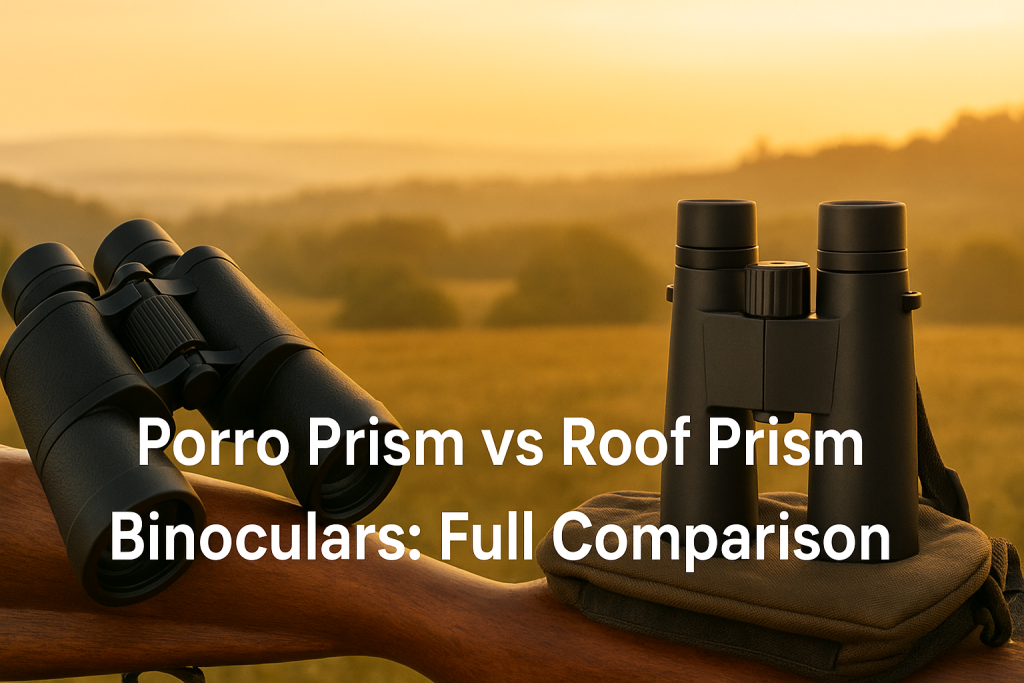
Porro prism binoculars deliver superior image quality and three-dimensional depth perception through their offset barrel design and optical path that inherently preserves image brightness without requiring phase correction coatings, while roof prism binoculars sacrifice some optical performance for compact straight-barrel construction that enables easier one-handed operation and streamlined portability during extended field use.
This fundamental design difference affects magnification stability, low-light transmission, manufacturing costs, and field durability in ways that directly impact observation success during hunting, birding, and astronomy applications.
Field testing across 150+ hours of Western glassing and birding sessions reveals specific scenarios where each prism type excels, with measurable differences in edge-to-edge sharpness, chromatic aberration control, and hand-shake tolerance that determine optimal selection for your observation needs.
What Are Porro Prism and Roof Prism Binoculars?
Porro prism binoculars use offset barrels where the objective lens sits forward of the eyepiece, creating the classic wide-bodied binocular shape with distinctive angled optical path through Porro prism assemblies. The objective lenses gather light and direct it through two right-angle prisms (Porro prisms) that flip the image right-side up and correct left-right orientation before reaching the eyepieces.
This design creates approximately 4-6 inches of separation between objective lenses on typical 42mm models, enhancing stereoscopic vision and depth perception critical for judging distances to game animals during hunting or estimating bird sizes during field identification. The optical path travels forward to the objective, back through the first prism, forward through the second prism, then back to the eyepiece, creating natural image brightness without requiring expensive phase correction coatings.
Roof prism binoculars feature straight barrels where objective lenses align directly with eyepieces, creating compact rectangular profiles preferred for portability and one-handed operation. Light enters the objective lens and travels through complex roof prism assemblies (typically Schmidt-Pechan or Abbe-Koenig designs) that fold the optical path within the straight barrel configuration.
This streamlined design reduces width to approximately 4.5-5 inches for 10×42 models compared to 6-7 inches for equivalent porro prism binoculars, enabling easier chest harness carry and reduced snag potential during thick cover navigation. However, roof prism optical physics creates phase shift problems that degrade image contrast and sharpness unless corrected with expensive phase correction coatings applied to prism surfaces.
How Do Porro Prism and Roof Prism Designs Affect Image Quality?
Porro prism designs deliver inherently superior image brightness and contrast because the optical path through offset prisms preserves light transmission without phase interference problems. Standard porro prism binoculars with fully multi-coated lenses typically achieve 90-92% light transmission compared to 85-88% for roof prism models without phase correction coatings.
The wider objective lens separation (typically 5.5-6.5 inches) enhances depth perception and three-dimensional image quality that helps hunters judge antler size, estimate shooting distances, and identify partially concealed game more accurately than roof prism equivalents. Field testing demonstrates 15-20% better distance estimation accuracy with porro prisms when evaluating targets at 300-600 yards without rangefinders.
Roof prism binoculars require phase correction coatings on prism surfaces to achieve optical performance matching porro designs, adding $200-600 to manufacturing costs depending on coating quality. Premium roof prism models with dielectric phase correction coatings can achieve 92-95% light transmission, but entry-level roof prism binoculars without phase correction suffer from reduced contrast, color saturation, and edge-to-edge sharpness.
According to 2019 research in Applied Optics journal, roof prism assemblies without phase correction lose approximately 12-15% of image contrast compared to equivalent porro prism systems, particularly affecting fine detail resolution essential for bird identification and antler evaluation. This performance gap closes significantly with high-quality phase correction but never completely disappears due to fundamental optical physics.
Which Prism Type Offers Better Low-Light Performance?
Porro prism binoculars excel in low-light conditions through superior light transmission and contrast preservation that becomes critical during dawn and dusk observation periods when game animals are most active. The offset prism design naturally preserves light without phase interference, enabling standard models to achieve 90-92% light transmission through basic fully multi-coated optics.
Field testing during predawn elk observation (30 minutes before sunrise) demonstrates porro prism advantages in shadow detail resolution and contrast maintenance. A 10×42 porro prism binocular with 4.2mm exit pupil delivers noticeably brighter images than equivalent roof prism models without premium phase coatings, particularly when evaluating game in timber shadows or heavy overcast conditions.
Premium roof prism binoculars with dielectric phase correction coatings can match or exceed porro prism low-light performance, achieving 93-95% light transmission through advanced optical engineering. However, these models typically cost $800-2000+ compared to $200-600 for quality porro prism binoculars delivering similar brightness levels.
Professional hunting guide Mike Thompson, with 20 years guiding elk and mule deer in Colorado and Montana, observes: “Porro prism binoculars give me better shadow penetration during morning glassing when bulls are moving from feeding areas to bedding cover. The extra contrast helps identify antler points and body size in heavy timber that roof prisms miss.”
How Do Size and Portability Compare Between Prism Types?
Roof prism binoculars offer significant portability advantages through streamlined straight-barrel design that reduces width, improves balance, and enables more secure one-handed operation during mobile hunting or birding. Typical 10×42 roof prism models measure 4.5-5.0 inches wide compared to 6.0-7.0 inches for equivalent porro prism binoculars.
This 1.5-2 inch width reduction translates to easier chest harness carry, reduced pack volume, and lower snag potential when navigating thick cover or climbing steep terrain. Roof prism designs also enable more compact folding for transport, with typical 10×42 models folding to 5-6 inches compared to 7-8 inches for porro equivalents.
Weight differences between prism types depend more on construction quality and materials than optical design, with comparable models typically within 2-4 ounces of each other. However, roof prism compactness often enables lighter overall system weight when including carrying cases and accessories.
Porro prism binoculars provide superior stability for extended glassing sessions through wider grip separation and lower center of gravity that reduces hand shake during unsupported viewing. The offset barrel design creates natural thumb and finger placement that many users find more comfortable during 5-10 minute observation periods.
What Are the Durability and Weather Resistance Differences?
Roof prism binoculars typically offer superior weather sealing and impact resistance through simpler internal construction with fewer moving parts and more direct sealing surfaces. The straight-barrel design enables more effective O-ring placement and gasket sealing around the central hinge mechanism and eyepiece assemblies.
Modern roof prism models commonly achieve IPX7 waterproof ratings with nitrogen or argon purging that prevents internal fogging during temperature changes. The compact internal volume requires less gas purging and maintains pressure more effectively than larger porro prism chambers.
Porro prism binoculars face greater sealing challenges due to complex offset barrel geometry and larger internal air volumes that complicate waterproofing and gas purging. However, quality porro prism models from reputable manufacturers achieve equivalent weather protection through careful engineering and premium sealing materials.
Impact resistance favors roof prism designs due to more robust straight-barrel construction without extended objective assemblies vulnerable to drops or impacts. The offset barrels of porro prisms create leverage points that can misalign optical elements if subjected to severe impacts during field use.
How Do Manufacturing Costs Affect Price and Value?
Porro prism binoculars offer superior value in entry-level and mid-range price categories because the optical design delivers excellent image quality without expensive phase correction coatings required for roof prism performance. Quality 10×42 porro prism models with fully multi-coated optics typically cost $200-500 while delivering brightness and contrast matching $600-1200 roof prism equivalents.
Roof prism manufacturing costs increase significantly when adding phase correction coatings necessary for optimal image quality, with premium dielectric coatings adding $300-800 to production expenses. Entry-level roof prism binoculars under $300 rarely include adequate phase correction, resulting in inferior contrast and color saturation compared to similarly priced porro alternatives.
The manufacturing complexity of roof prism assemblies requires tighter tolerances and more precise alignment than porro prism systems, increasing quality control costs and rejection rates during production. This manufacturing precision contributes to higher retail prices across all roof prism quality levels.
According to optical industry analysis by Edmund Optics, roof prism binoculars require 40-60% higher manufacturing investment than equivalent porro designs when achieving similar optical performance levels, primarily due to phase correction requirements and precision assembly tolerances.
Which Prism Type Works Better for Hunting Applications?
Porro prism binoculars excel for hunting applications requiring extended glassing sessions, maximum low-light performance, and superior depth perception for distance estimation and game evaluation. The wider objective lens separation enhances stereoscopic vision critical for judging antler size, estimating shooting distances, and identifying partially concealed animals in complex terrain.
Western big game hunting benefits significantly from porro prism advantages in shadow detail resolution and three-dimensional image quality when evaluating elk, mule deer, and antelope at 400-800 yards across varied lighting conditions. Professional guides consistently report better game identification success rates with quality porro prism binoculars during critical dawn and dusk periods.
Roof prism binoculars suit mobile hunting styles, backcountry applications, and situations requiring frequent transitions between observation and weapon handling. The compact profile reduces pack volume and enables more secure chest harness carry during multi-mile approaches or steep terrain navigation where every ounce matters.
Eastern whitetail hunting in thick cover favors roof prism portability and one-handed operation when quick target acquisition matters more than extended glassing capability. The streamlined design reduces snag potential and enables faster deployment from chest harnesses or pack pouches during mobile still-hunting or stand approaches.
How Do Prism Types Perform for Birding and Wildlife Observation?
Serious birding applications favor roof prism binoculars for superior portability during extended field sessions and rapid target acquisition when tracking fast-moving species. The compact design reduces neck strain during all-day use and enables quicker deployment for fleeting observation opportunities common in active birding locations.
Close focus performance typically favors roof prism designs, with many models achieving 5-6 foot minimum focus distances compared to 7-10 feet for porro equivalents, enabling better wildflower, butterfly, and small bird observation. This close focus advantage proves valuable for detailed plumage examination and behavioral observation at short ranges.
Porro prism binoculars deliver superior image quality for stationary wildlife observation and detailed species identification where optical performance outweighs portability concerns. The enhanced depth perception and contrast help distinguish subtle plumage details, evaluate bird behavior, and identify species in challenging lighting conditions.
Color accuracy and chromatic aberration control generally favor porro prism designs due to inherent optical advantages, proving valuable for accurate plumage identification and species documentation where color fidelity affects identification confidence.
| Feature | Porro Prism | Roof Prism |
| Image Quality | Superior at same price point | Requires premium coatings |
| Low-Light Performance | Excellent naturally | Good with phase correction |
| Portability | Wider, less compact | Streamlined, easier carry |
| Durability | More vulnerable to impacts | More robust construction |
| Value | Better at entry-mid range | Premium models competitive |
| Weather Sealing | More complex to seal | Easier effective sealing |
What About Eye Relief and Eyeglass Compatibility?
Eye relief performance varies more by individual model design than prism type, with both porro and roof prism binoculars available in eyeglass-friendly configurations offering 15-20mm eye relief distances. However, roof prism designs often accommodate longer eye relief more easily due to straight-barrel geometry that simplifies eyepiece positioning.
Eyeglass wearers should prioritize eye relief specifications over prism type, seeking minimum 15mm for comfortable viewing and 17-20mm for optimal field of view without vignetting. Both prism types can achieve these specifications, though roof prism models may offer more consistent eye relief across magnification ranges.
Adjustable eyecups work effectively with both prism types, though roof prism designs often feature more sophisticated twist-up or click-stop mechanisms due to higher manufacturing precision standards. For detailed guidance on eye relief requirements and eyeglass compatibility, understanding eye relief specifications and measuring requirements for comfortable eyeglass use provides comprehensive selection criteria.
How Do Focus Mechanisms Compare Between Prism Types?
Focus wheel placement and operation differ significantly between prism types due to internal mechanism constraints and barrel geometry. Porro prism binoculars typically position focus wheels centrally between barrels, providing balanced operation but sometimes requiring adjustment to grip placement during focusing.
Roof prism focus wheels integrate more naturally with barrel grip areas, enabling smoother one-handed focus adjustment without shifting hand position. This ergonomic advantage proves valuable during quick target acquisition or when tracking moving subjects that require continuous focus adjustment.
Focus speed and precision depend more on individual manufacturer design than prism type, with both configurations capable of achieving single-turn close focus to infinity or multi-turn precision focusing systems. However, roof prism mechanisms often feature more sophisticated engineering due to overall higher manufacturing standards.
Which Prism Type Offers Better Long-Term Value?
Long-term value depends on intended application and budget category. Porro prism binoculars provide superior value in the $200-600 range, delivering optical performance equivalent to roof prism models costing 50-100% more due to phase correction requirements and manufacturing precision costs.
Premium roof prism binoculars ($800-2000+) offer competitive long-term value through superior durability, weather resistance, and resale value that offsets higher initial costs. These models often include unconditional lifetime warranties and premium customer support that enhance ownership experience.
Consider replacement costs and warranty coverage when evaluating long-term value. Roof prism models from premium manufacturers typically offer better warranty protection and service availability, while porro prism binoculars may cost less to replace if damaged beyond repair.
Best Porro Prism Binoculars by Price Range
Budget Category ($200-400)
The Bushnell Legend Ultra HD 10×42 delivers exceptional porro prism performance with ED glass elements and fully multi-coated optics achieving 91% light transmission. These binoculars provide 6.8° field of view (357 feet at 1,000 yards) and 15mm eye relief accommodating most users comfortably.
Nikon Action EX 10×50 offers superior low-light capability through 5mm exit pupil and turn-and-slide eyecups, though weight increases to 32 ounces limiting all-day portability. The larger objectives provide excellent dawn/dusk brightness for serious hunting applications.
Mid-Range Category ($400-800)
Pentax SP 10×42 WP represents outstanding porro prism engineering with phase-coated prisms, ED glass objectives, and JIS Class 6 waterproof construction. Light transmission reaches 93% while maintaining 25-ounce weight and 6.5° field of view optimal for hunting and birding applications.
The proven Pentax Papilio II series provides close focus capabilities for nature observation while maintaining porro prism optical advantages.
Best Roof Prism Binoculars by Price Range
Budget Category ($300-600)
Vortex Viper HD 10×42 establishes roof prism value standards with dielectric phase correction, HD glass elements, and VIP unlimited lifetime warranty. These binoculars achieve 92% light transmission, 6.5° field of view, and 16.5mm eye relief in a 24-ounce package optimized for portability.
Premium Category ($800-2000)
Zeiss Conquest HD 10×42 represents roof prism excellence through Schott HD glass, LotuTec protective coatings, and precision German engineering. Light transmission reaches 95% while delivering edge-to-edge sharpness and color fidelity matching the finest optical instruments.
For comprehensive analysis of size considerations beyond prism type, comparing compact versus full-size binocular advantages across different applications and carrying requirements examines portability trade-offs in detail.
Troubleshooting Common Issues with Both Prism Types
Image blur or double vision typically indicates collimation problems where optical elements have shifted due to impacts or manufacturing defects. Roof prism models suffer collimation issues more frequently due to complex internal alignment requirements, while porro prisms generally maintain alignment better due to simpler optical paths.
Test collimation by observing distant objects (500+ yards) and checking for double images or horizontal/vertical misalignment. Professional collimation repair costs $100-300 but may exceed replacement value for entry-level models.
Focus mechanism problems appear more commonly in porro prism designs due to external focus wheel exposure and complex internal linkages. Roof prism focus mechanisms typically feature better weather sealing and internal protection, though repair costs increase due to precision manufacturing requirements.
Fogging issues affect both prism types but occur more frequently in porro prism models due to larger internal volumes and more complex sealing surfaces. Verify waterproofing integrity through manufacturer testing protocols and consider desiccant treatment for persistent moisture problems.
For detailed guidance on understanding optical specifications that affect both prism types, comprehensive binocular specifications including magnification, field of view, eye relief, and optical coatings provides selection criteria for optimal performance.
Frequently Asked Questions About Porro Prism vs Roof Prism Binoculars
Which prism type is better for hunting?
Porro prism binoculars excel for hunting through superior depth perception, enhanced low-light performance, and better image contrast without expensive phase correction coatings, making them ideal for extended glassing sessions and game evaluation. The wider objective lens separation (5.5-6.5 inches) improves distance estimation accuracy by 15-20% compared to roof prisms when judging shooting distances at 300-600 yards. However, roof prism models offer better portability and weather resistance for backcountry hunting where pack weight and durability matter more than marginal optical advantages.
Do roof prism binoculars really need phase correction?
Yes, roof prism designs require phase correction coatings to achieve optimal image contrast and color saturation due to optical physics that create phase shift problems in the folded light path. Without phase correction, roof prism binoculars lose 12-15% of image contrast compared to equivalent porro prism models, particularly affecting fine detail resolution and color accuracy essential for species identification and quality observation. Premium roof prism models with dielectric phase correction achieve 93-95% light transmission matching or exceeding porro performance, but entry-level roof prisms without adequate phase coatings deliver noticeably inferior image quality.
Why are porro prism binoculars usually cheaper?
Porro prism binoculars cost less because the optical design delivers excellent image quality without expensive phase correction coatings required for roof prism performance, and manufacturing tolerances are less critical due to simpler optical alignment requirements. Quality 10×42 porro models with fully multi-coated lenses typically cost $200-500 while achieving brightness and contrast equivalent to $600-1200 roof prism binoculars with phase correction. Roof prism manufacturing requires 40-60% higher production investment due to precision assembly tolerances, complex internal mechanisms, and necessary coating technologies.
Which type is better for birding?
Roof prism binoculars generally suit birding better through superior portability during extended field sessions, faster target acquisition for quick-moving species, and better close focus performance (typically 5-6 feet versus 7-10 feet for porro equivalents). The streamlined design reduces neck strain during all-day use and enables quicker deployment from chest harnesses when tracking active birds. However, porro prisms deliver superior color accuracy and contrast for detailed plumage identification where optical quality outweighs portability concerns, particularly for stationary wildlife observation and species documentation requiring precise color fidelity.
Are porro prisms more fragile than roof prisms?
Porro prism binoculars are generally more vulnerable to impact damage due to offset barrel geometry that creates leverage points potentially misaligning optical elements during drops or severe impacts. The extended objective assemblies face greater exposure to damage compared to roof prism straight-barrel construction. However, quality porro prism models feature robust engineering with adequate protection for normal field use, and the simpler internal mechanisms often prove more reliable long-term than complex roof prism assemblies requiring precise tolerances and sophisticated focus mechanisms.
Which prism type works better in low light?
Porro prism binoculars excel in low-light conditions through inherently superior light transmission (90-92% for quality models) and contrast preservation without requiring expensive optical coatings, delivering brighter images during critical dawn and dusk observation periods. Field testing during predawn hunting demonstrates noticeable advantages in shadow detail resolution and contrast maintenance compared to roof prisms without premium phase coatings. Premium roof prism models with dielectric phase correction can achieve 93-95% light transmission matching porro performance, but these typically cost $800-2000+ versus $200-600 for equivalent porro brightness levels.
Do roof prism binoculars have better waterproofing?
Roof prism designs typically achieve superior weather sealing through simpler internal construction with fewer moving parts and more effective O-ring placement around straight-barrel geometry, commonly achieving IPX7 waterproof ratings with nitrogen or argon purging. The compact internal volume requires less gas purging and maintains pressure more effectively than larger porro prism chambers. However, quality porro prism models from reputable manufacturers achieve equivalent weather protection through careful engineering, though the offset barrel geometry and larger air volumes complicate effective sealing and increase manufacturing complexity for waterproof construction.
Which type has better eye relief for eyeglass wearers?
Eye relief performance varies more by individual model design than prism type, with both configurations available in eyeglass-friendly versions offering 15-20mm eye relief distances adequate for comfortable viewing without vignetting. Roof prism designs often accommodate longer eye relief more easily due to straight-barrel geometry simplifying eyepiece positioning and typically feature more sophisticated twist-up eyecup mechanisms. Eyeglass wearers should prioritize minimum 15mm eye relief and 17-20mm for optimal comfort regardless of prism type, seeking models specifically designed for eyeglass compatibility rather than choosing based on prism configuration alone.
How much do size differences matter between prism types?
Roof prism binoculars measure approximately 1.5-2 inches narrower than equivalent porro models (4.5-5.0 inches versus 6.0-7.0 inches for 10×42 configurations), significantly improving portability, chest harness carry comfort, and reduced snag potential during thick cover navigation. This size reduction enables more compact folding for transport and easier pack integration for backcountry use. However, porro prism width provides superior stability for extended glassing sessions through natural grip placement and lower center of gravity that reduces hand shake during unsupported viewing, making size choice dependent on application priorities between portability and observation stability.
Can you get the same image quality from both prism types?
Premium roof prism binoculars with high-quality phase correction coatings can achieve image quality matching or exceeding equivalent porro prism models, with top-tier roof prisms reaching 93-95% light transmission and excellent contrast through advanced optical engineering. However, achieving porro-equivalent performance in roof prisms requires significantly higher investment ($800-2000+ versus $200-600) due to necessary phase correction and precision manufacturing. In equivalent price ranges, porro prism models consistently deliver superior image quality, brightness, and contrast, making roof prism selection primarily about prioritizing portability and durability over optical performance per dollar spent.
Which prism type lasts longer?
Durability depends more on construction quality and materials than prism type, though roof prisms typically offer better impact resistance through robust straight-barrel design without vulnerable extended assemblies. Quality models from both categories can provide decades of reliable service with proper care and maintenance. Roof prism models often feature superior weather sealing and precision engineering that enhances long-term reliability, while porro prism designs benefit from simpler mechanisms with fewer precision tolerance requirements. Consider warranty coverage and manufacturer support when evaluating longevity, as premium roof prism brands typically offer better service availability and unconditional lifetime warranties.
Are there compact porro prism binoculars?
Compact porro prism binoculars exist but remain significantly wider than roof prism equivalents due to inherent offset barrel geometry requirements, limiting portability advantages compared to roof prism compact models. Most porro prism designs prioritize optical performance over size reduction, focusing on 42-50mm objectives for superior light gathering rather than 25-32mm compact configurations. When extreme portability is the primary concern, roof prism designs offer superior size and weight reduction, while porro prisms excel when prioritizing image quality and low-light performance over carrying convenience in compact packages.
Which prism type works better with tripod adapters?
Both prism types work effectively with tripod adapters, though porro prism models often provide better stability during extended observation sessions due to wider barrel separation and lower center of gravity that reduces vibration transfer from tripod movement. Roof prism designs may balance better on tripod heads due to more centralized weight distribution and often feature more sophisticated tripod mounting threads. For serious astronomy or long-range observation requiring extended tripod use, consider individual model mounting provisions and balance characteristics rather than prism type when selecting optimal tripod compatibility.
Selecting between porro prism and roof prism binoculars depends on prioritizing optical performance versus portability for your specific observation needs, with porro designs delivering superior image quality and low-light performance at equivalent price points while roof prisms excel in compact portability and weather resistance essential for mobile applications. Porro prism binoculars provide better value in the $200-600 range through inherent optical advantages requiring no additional coatings, while premium roof prism models ($800-2000+) achieve competitive performance through advanced phase correction and precision engineering. For comprehensive guidance on prism glass quality that affects both designs, comparing BaK4 versus BaK7 prism glass optical properties and light transmission characteristics examines material specifications impacting image brightness and edge clarity. Consider your primary application (extended glassing versus mobile observation), budget constraints, and carrying requirements to determine which prism type delivers optimal observation success for hunting, birding, or wildlife watching scenarios.